
Monday, November 12, 2012

Sex! Gore! Scary Monsters! Attack of the Mexican B-Movie Posters

Collectors and their obsessions are as varietal as the flora and fauna of a jungle. Under deep canopies of ephemera and artifacts, an archivist can still find more elements that are just waiting to be discovered. It might be movie posters in this case, or it could be vintage parts or even sports cards, but folks who have an affinity for the rounding up of rare items tend to see the world in a much different light. History is never lost on them and preservation is of the utmost importance.

The article below is from Collectors Weekly and goes into depth about Mexican film poster ads. If you find these interesting, also dive into one of our personal favorite archives, that of Russian Constructivist Posters and the famous Stenberg Brothers.

Link to article on Collector's Weekly

A 1958 Mexican lobby card for “La Calavera Chillona,” or “The Screaming Skull.”
John Cozzoli’s collection is frightening. Not because of its sheer size (though he does have over 500 film artifacts), but because Cozzoli’s ephemera all relates to lesser-known horror movies of the 20th century.

Primarily devoted to Mexican lobby cards, or small placards displayed in theater entrances to advertise upcoming films, and American pressbooks, which provided promotional guides for theater owners, Cozzoli has curated an extensive array of cult classics on his blog, Zombos’ Closet. Spanish-language lobby cards specifically piqued his interest because of their exaggerated details and wild graphics, unrestricted by more prudish American guidelines.
“Lon Chaney, Boris Karloff, and Bela Lugosi made it cool to be scared.”
Cozzoli’s dream is to preserve these campy bits of horror film history, particularly items made during the golden era, which lasted from the 1940s through the ’60s. In the process, he’s created a virtual haunted house of zany, lurid, and sometimes downright disgusting marketing materials. Recently, we spoke to Cozzoli, who explained his passion for the weird world of horror-film memorabilia.

Collectors Weekly: How did you first get into horror films?

John M. Cozzoli: Growing up in Brooklyn I was blessed with two movie theaters within walking distance: the Loews Oriental and the Benson, both on 86th Street. They played a lot of horror movies, and I have fond and frightening memories of the movies my mom took me to. She was a big horror fan, and I suppose that rubbed off on me, but I think deep down I was born a horror fan.
Add on the Shock! movies showing on local television, which were usually hosted by some wacky and creepy horror host, like Zacherley in New York, and I had a good upbringing on classic, and not-so-classic, cinematic horror every week.

The ephemera side must have come from my love of Famous Monsters of Filmland magazine and all the wonderful merchandise sold through Captain Company’s mail order catalog. Two blocks from my house was Joe’s Luncheonette, whose magazine rack was always full of comics and magazines distributed by Warren Publishing, like After Hours, Creepy, or Famous Monsters of Filmland, so I began collecting them. Unfortunately, I sold off my extensive collection just as the “investment” people (the ones dressed in suits) started showing up at Phil Seuling’s New York Comic Cons. But that’s another story. With the influences of the classic Universal monsters, Joe’s magazine rack, and my weekly allowance, it was a pretty sure bet I’d be a collector sooner than later.

Despite its alluring graphics, Cozzoli couldn't find any records of the film "El Ataque de los Sombies."
Despite its alluring graphics, Cozzoli couldn’t find any records for the film “El Ataque de los Sombies.”

Collectors Weekly: Do you consider yourself a B-movie expert?

Cozzoli: No, I’m just another fan with an opinion, only I try to back it up with experience and knowledge. When I tried to actually discuss movies with other fans on certain forum boards, I quickly realized there were many “experts” who had no sense of cinema history or composition, who were praising or cursing movies without being able to express why, using flaming to drown out anyone’s opinion that differed with theirs. Older “experts” knew nothing about modern horror cinema yet decried it as they cherished their decade or two’s worth of movie memories.
“The more fears, the better the box-office receipts.”
I gave up on the forums and started my blog, Zombos’ Closet, in 2005 to prove a horror fan can be articulate while embracing the broader styles of horror found in each decade. Zombos’ Closet is graphics heavy: I enjoy posting pressbooks, Mexican lobby cards, and pictures of classic horror actors. My goal is to become an online archive for them by uploading high-resolution scans to help others fully appreciate what cool objects of movie memorabilia they truly are.

1958's "La Momia Azteca Contra El Robot Humano," or "The Aztec Mummy Against the Humanoid Robot," features a highly plausible battle scenario.
“La Momia Azteca Contra El Robot Humano,” or “The Aztec Mummy Against the Humanoid Robot,” from 1958 featured a highly plausible battle scenario.
I tend to be classic-centric, but I also love, and hate, modern horror movies. These days, the horror sub-genres are all over the place, so it’s hard to be an expert in everything. For me, the art of horror cinema officially starts with Universal’s “Dracula” and “Frankenstein,” and begins its descent to solid B, but still classy, movies in the 1940s with films like “Son of Frankenstein,” “The Wolf Man,” and “Creature from the Black Lagoon,” eventually hitting close to rock bottom with C- or D-grade fare from the 1950s drive-in circuit. Which is still fun to watch, by the way, especially with a rum and Coke.

Collectors Weekly: Where did the name “Zombos’ Closet” come from?

Cozzoli: I’m a big fan of “The Munsters” television show, and I kept all my comics, magazines, and collectibles in my bedroom closet as a kid. It was also the place I could run to, for personal reasons, where I could be alone and felt safe. I’d often pull out the Famous Monsters magazines and a flashlight while sealed up in my closet.

There’s a great “Munsters” episode where little Eddy discovers his favorite TV horror host, Zombo, is not really very horrible. I felt bad ripping off the name as is, so I added an ‘s’ to the end of Zombo to create “Zombos.” I try not to say Zombos’s Closet because it sounds terrible—rhymes with thrombosis!—but maybe I should.

"El Monstruo Del Millon De Ojos "
1955′s “El Monstruo Del Millon De Ojos,” also known as “The Monster with a Million Eyes,” uses illustrated graphics to improve on special effects available at the time.

Collectors Weekly: How do you select films to review?

I find out about movies by reading reviews, reading books about movies, reading other blogs—especially those from members of The League of Tana Tea Drinkers—and seeing trailers while I’m at the theater. Many times I’ll watch a movie, like “Frankenstein’s Castle of Freaks,” because, although I know I’ll hate it, I also know I’ll have a bang-up time writing the review. There are times I like to do a story framework around the review, using my characters that live in Zombos’ mansion [Cozzoli's blog features a cast of fictional characters based on horror film archetypes]. “Tokyo Gore Police“ is a perfect example: Insane movie equals wild fun to review. So if I feel I can have some gonzo fun while reviewing a movie, that’s a perk for me.

Collectors Weekly: Is your collection limited to a specific era?

Cozzoli: Horror and exploitation themes have always been money-makers, no matter which era we’re talking about. Their cinema is malleable—its subgenres, themes, moods, and political or social insinuations, like any timeless drama, fit the period the movie is situated in. Most of the time. Then, of course, you have your schlock productions, which are always cheeky fun and surprisingly buoyant in the marketplace.

The field of horror has long recognized the one truth of commercial and artistic cinema: There’s an audience out there for everything and anything, you just need to reach them. Now, of course, with YouTube, Facebook, etc., it’s a lot easier to reach that audience. Back then, you needed pressbooks and lobby cards to sell the merits of the movie.
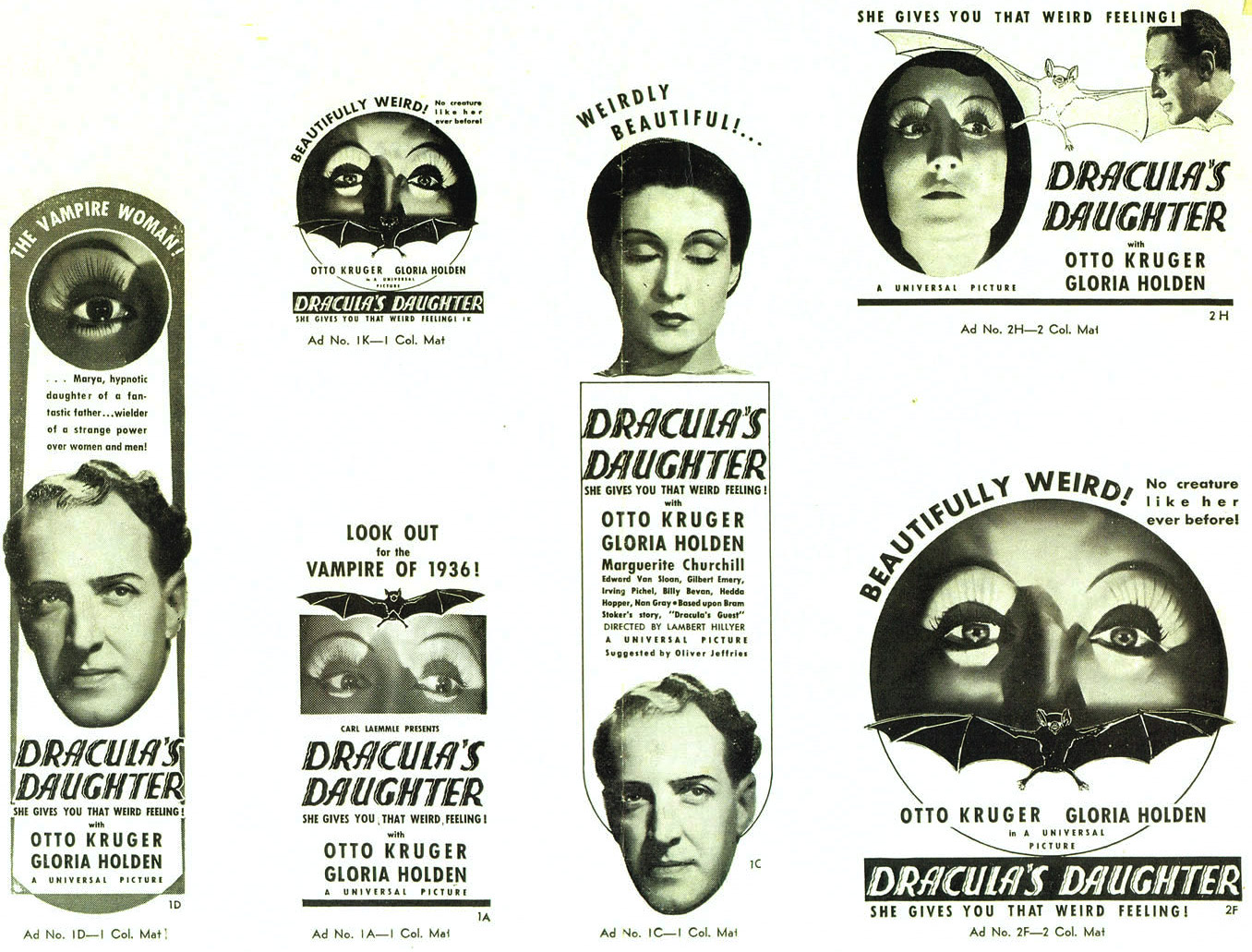
A pressbook for "Dracula's Daughter" from 1936 shows the various styles of advertising displays offered.
A pressbook page for “Dracula’s Daughter” from 1936 shows the various styles of theater displays.
You could successfully argue that Universal’s brand of horror provided the golden ticket to what followed, and Lon Chaney provided the template for horror actors to come. While you can’t dismiss or neglect the foreign horror silents and talkies, I’d put the mainstreaming of horror cinema squarely on the shoulders of Lon Chaney, Boris Karloff, and Bela Lugosi. They made horror accessible and approachable; they made it thrilling and cool to be scared.

Once the studios discovered that production runs could be trimmed, they budgeted more films. Eventually, formulaic movies took over, and by the 1950s, the youth audience became a viable target for generating revenue. More teenagers were going to the movies, a fact not lost on producers like Roger Corman. Drive-in theaters created a new milieu for horror films, and producers like William Castle noticed that younger kids were perfect audiences for “horror-light” movies like “House on Haunted Hill.”

"La Mano Del Diablo," or "The Devil's Hand" from 1962.
This 1962 ad for “La Mano Del Diablo,” or “The Devil’s Hand,” uses a spiderweb to create a dynamic layout.
Horror movies are closely tied to exploitation movies. By the 1960s and into the 1970s, more daring storylines evolved on theater screens, designed for audiences that had lived through two World Wars, Vietnam, social unrest, and enough political scandals to create a growing sense that authority figures weren’t as upstanding as previously believed. It was understood that people could be damn nasty when given the opportunity.

All of this fed easily into the subject matter for horror: Our fears were shown to us. And the more fears, the better the box-office receipts.

1968's "El Doctor Loco De La Isla Sangrienta," also known as "The Mad Doctor of Blood Island," shows a particularly disturbing juxtaposition of graphic violence and sexuality.
1968′s “El Doctor Loco De La Isla Sangrienta,” also known as “The Mad Doctor of Blood Island,” shows a particularly disturbing juxtaposition of graphic violence and sexuality.

Collectors Weekly: What do you love about these low-budget films?

Cozzoli: There’s a mistaken belief that having a big budget guarantees a good movie: It doesn’t. Many movies with modest budgets have outdone movies with bigger pockets to draw from. I love seeing how creative a director and set designer can be when faced with limited resources to work from. Horror movies were originally A-listers, drawing notable actors and production teams. Over time they switched to B and C status as the studios realized they could still make a profit on a cheap movie. Even the bad movies sometimes show a sparkle of wit or style or dramatic directness that makes them enjoyable to watch.

Now the really, really, really bad movies that look cheap and play cheap can also be fun because they don’t pretend to be anything but what they are. Look at how much zany and awkward cinema Ed Wood foisted on us, and how well regarded he is today by genre fans. “Plan 9 From Outer Space” is so inane and intentionally clumsy it’s sublime.

Cozzoli finds the silly Venusian from 1956's "It Conquered the World" to be one of the least frightening movie monsters.
Cozzoli finds the homely Venusian from 1956′s “It Conquered the World” to be one of the least frightening B-movie monsters.
Collectors Weekly: What are some of the lamest monsters you’ve come across in vintage horror films?
Cozzoli: The least frightening monsters would include the Venusian in “It Conquered the World,” Tobonga in “From Hell It Came,” and Ro-Man in “Robot Monster.” Classic monsters that lacked bite would include the Mummy, played by Tom Tyler and Lon Chaney, Jr. The stiff moved so slowly, and his victims just stood in place, screaming, waiting for him to attack. Go figure. Other non-frightening monsters include the giant bunnies in “Night of the Lepus” and the giant turkey or vulture-looking bird in “The Claw.” And you can find all of these wonderfully innocuous monsters on Mexican lobby cards.

One of the silliest monsters in Cozzoli's collection is the huge, one-eyed leech from 1959's "Attack of the Giant Leeches, or ""El Pantana Diabolico," which translates directly as "The Swamp Demon."
Other silly monsters in Cozzoli’s collection include the huge, one-eyed leeches from 1959′s “Attack of the Giant Leeches,” or “El Pantano Diabolico.”
Collectors Weekly: Were these Mexican lobby cards made to advertise films from other countries?
Cozzoli: While many Mexican lobby cards promote American movies, they also made cards for Spanish-language movies, often illustrated with vampires, witches, and mummies; Japanese movies, like those made by Toho Studios; and other non-Spanish-language movies. Really, just about any movie that could be shown in a local theater, foreign or domestic, had cards done for it. If the lobby cards were done for American or other non-Spanish-language movies, the compositions usually derive to some degree from the movie’s poster campaign, so these cards tend to be more, let’s say, sedate, and tone down the sex and mayhem. Spanish-language lobby cards are usually more vibrant and suggestive.

Monster kid and movie historian Professor Kinema (Jim Knusch) was the person who turned me on to these wonderful examples of movie promotion for theaters. It was while perusing his collection of lobby cards and pressbooks that I fell in love with both. One reason I focus on Mexican lobby cards is because at $5 to $10 a pop, they’re a lot cheaper than American cards, making them easier to collect. Additionally, Mexican cards for native Spanish movies are usually more colorful and dynamic, and the Mexican cards come in larger sizes, which make them more interesting and displayable.

Cozzoli appreciates the complexity of lobby cards like 1979's "Las Momias Asesinas," or "The Mummy's Killer," which featured a recurring character called "El Latigo," or "The Whip."
Cozzoli appreciates the complexity of lobby cards like 1979′s “Las Momias Asesinas,” or “The Mummy’s Killer,” which featured a recurring character called “El Latigo,” or “The Whip.”
La Sangre de Nostradamus“ uses a sophisticated display of horror elements that shows dramatic intensity through the tight arrangement of torch, hand with blood, and the vampire’s reflection in a frightened eye—presumably the eye of the person holding the torch. A little less sophisticated, but still classy, is the one for “El Latigo en Las Momias Asesinas.” Notice how the menacing mummies hint at the rider’s gallantry and heroism with their ominous presence, while a more sensational illustration of a female victim in distress hints at the action to come, and maybe some romance, too.

Moving from sophisticated to blatant exploitation, “La Bestia de La Noche Amarilla” is a great example of how bold a Mexican lobby card can be. The common element here, of domination over a scantily dressed female victim, is highlighted by each illustration: the monster’s blood-dripping, bone-chewing mouth looming over her; the monster’s beastly hand reaching for yet another screaming female victim; the monster standing over a victim. The illustrations don’t connect visually except for that theme.

1971's "La Bestia de la Noche Amarilla," or "The Beast of the Yellow Night," presents the more brash side of Mexican lobby cards.
1971′s “La Bestia de la Noche Amarilla,” or “The Beast of the Yellow Night,” presents the more sensational side of Mexican lobby cards.
Collectors Weekly: Why did they usually feature scantily clad females?
Cozzoli: It sold tickets, meaning more butts in those theater seats. There’s the mistake that many male-centric cultures make in thinking women are the weaker sex, so they make great victims for monsters and evil men. Lots of terrified screaming, fainting, and all those behaviors fictional female victims are expected to do. You also come across the alluring witch, young and with an ample bosom, enticing to you buy a ticket in order to see more.

Sex sells whatever product you hawk with it—just look at all those Chippendale Calendars, or next time you’re in an auto shop, see who’s holding that oil can on a poster or dressed in a bikini and smiling by an engine on a calendar. But darker insinuations can also be found in the cards: Female victims are repeatedly stalked or tortured by these male monsters, and all done with their clothes in tatters, or dressed in some flimsy nightgown.

Sexy witches abound in "Las Brujas Del Infierno" from
Sexy witches abound in this ad for 1969′s “Las Brujas Del Infierno,” or “The Witches from Hell,” a tactic that helped fill theater seats.
Collectors Weekly: Do you have a favorite lobby card?
Cozzoli: I have a lot of favorites, but, right now, my absolute favorite would have to be “El Charro de Las Calaveras.” The composition is beautiful. You have this masked gunman staring you down, and a mysterious man in a top hat and cape in the background, and to the left of both is this large skull-like mummy head with cobwebs in its right eye and its mouth opened in a menacing way. After you take all that in, there’s a small graphic of a werewolf biting the neck of a beautiful woman in the top corner. In the middle of the card you have this dramatic font for the title. It’s a neat package that hints at mystery, danger, and the supernatural, without being lurid.

Cozzoli's current favorite Mexican Lobby card for "El Charro de las Calaveras" from 1965.
Cozzoli’s current favorite is a lobby card for “El Charro de las Calaveras,” translated as “The Cowboy of the Skulls,” a Western-horror flick from 1965.
Collectors Weekly: What’s the deal with the masked wrestler lobby cards?
The Lucha Libre or masked wrestling tradition of Mexico is very similar to our own except for one important difference: the luchador is a hero, a strong man to look up to, who fights for justice and defends against evil. I thought it was a great idea in the current “Spider-Man” movie to have Peter Parker pick up the idea for his mask from seeing a wrestler’s poster.

It’s a natural to have the luchadores come up against monsters like mummies, vampires, and zombies. Why not? The luchador is the Spanish version of our superhero. If you can accept guys flying around in capes and wearing masks, well, it’s the same thing. Just look at “Neutron: El Enmascarado Negro.” The Italian equivalent would be peplum movies.
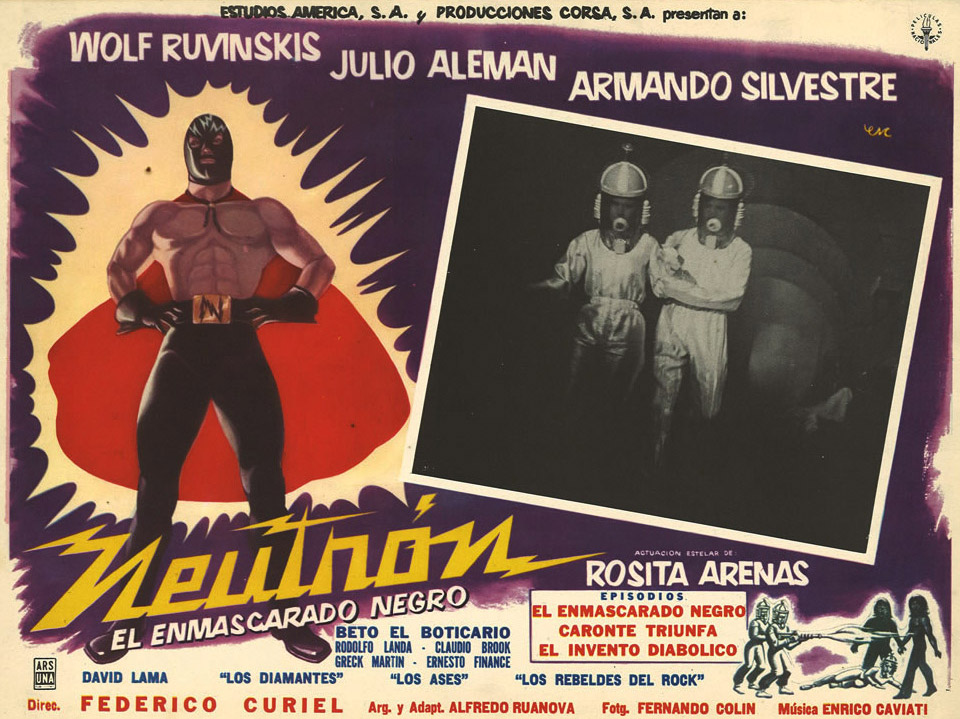
The luchador or masked wrestler is Mexico's version of the American superhero.
The luchador or masked wrestler is Mexico’s version of the American superhero.
Collectors Weekly: What sorts of other common themes do these lobby cards use?
Cozzoli: 

The main themes are violence, sexuality, and deprivation (of liberty, life, sanity, humanity, etc.), although it depends on the movie as to their intensity, or even if all three are used on one card. The Spanish-speaking movie lobbies lean toward exploiting these themes more often, so I’ll use them as examples.

“La Mente y el Crimen” is a good example of all three themes being present. We see what’s on the man’s mind, and it hints at sexuality and deviance, while violence and deprivation are shown through the hand wielding a bloody knife. In this particular case, the photo inset, of the voodoo doll with pins stuck into it, adds to the overall tone of the card. And note the doll is feminine.

1964's "La Mente y el Crimen," or "The Mind and the Crime" features common lobby card imagery of violence, sexuality, and deprivation.
1964′s “La Mente y el Crimen,” or “The Mind and the Crime,” features common lobby card imagery of violence, sexuality, and deprivation.

La Sombra del Murcielago“ also shows all three, but here the illustration is more elementary in execution, which heightens its lurid appeal. Violence, and the threat of it, is shown through the monster woman being choked in the left corner, the screaming monstrous face in the right corner, and the flaming cauldron where the masked wrestler, Blue Demon, is holding his head in physical or spiritual pain. The look of tranquility on the woman’s face near the cauldron, in the midst of all this terror, hints at a lost love or someone the wrestler cares about or simply an actress who will bring in an audience just to see her.

Finally, look at “El Satanico.” The artwork may be primitive, but it screams at you to see this movie. The subtle cues are how the knife-wielding guy in the upper corner is staring down, over the cityscape, at the other guy holding a gun. The jagged white backdrop for the title font is very aggressive and counterpoints the tip of the knife while bringing attention to it. Assuming you can stop looking at the bikini-clad babe on the left, that is."

Sunday, November 11, 2012

Urban Outlaw, Rebuilt Porsches and One Interesting Individual

Walking to the beat of your own drum is not just a great catch phrase, but for some it is the only rhythm to which there is any sort of deeper meaning. Look into any subculture and within a short amount of time, niche characters will start to emerge. The short film "Urban Outlaw" does a great job talking on one quite interesting individual by the name of Magnus Walker. His method and way of looking at the world around him are a testament to the can do spirit and one in which limitations are only small hurdles the size of speed bumps.

Link to movie on Vimeo


URBAN OUTLAW - THE MOVIE from Tamir Moscovici on Vimeo.

Thursday, November 8, 2012

Favorite Bike Photos For The Week of 11.9.12

Pinterest is awesome for a great many things and most importantly, for the menagerie of great photos of motorcycles. Dive into some of the bike groups by following the pin boards or click on the link below to one of our collections, enjoy.

Check out our Pin Board of a great selection of bikes

Open belt drive attached to a stout motor and it's easy to see why the seat is tucked in so well, hold on!
Kicker pedal and ratchet are taken off and the bike is undergoing some surgery on the land speed flats
Outpost station in a remote section of desert
Really digging the brass and copper additions to the color and style of this bike
Super clean custom Yamaha Virago bobber
Random gorgeous lady on a triumph in Paris or could that be Julia Roberts

Craftsman Recreates Vintage Trucks for Millionaires, Repost From Wired.com

Stop me if you have heard this scenario before, as it is on par for anyone that has an affinity for custom rides. That scenario would be in which, a customizer redesigns and or reconfigures a vintage ride, charges a premium, does an incredible job of making the vehicle look awesome and then folks love to complain about how much it costs.

If you know of anyone that owns or works at a custom shop, this becomes almost laughable. So many folks want an amazing ride but don't want to pay for the time it takes to make such a vehicle happen. They are more than happy to try to haggle prices and then look at parts catalog to compare rates of individual pieces of the equation, when they are forgetting the most valuable aspect of this whole operation, is the craftman's knowledge.

We applaud anyone that can figure out a way to do their craft and earn a living at it. As our nation trudges forward, we are continually losing more and more trade craftsmen who are told at a younger age, that college is the only path to a great career. We beg to differ. College is just one option of many, but what ultimately makes the difference is the aptitude to work hard and break new ground in whatever career path you choose. Choices will always have to be made, but we hope more folks get back to working with their hands and gain an intimate knowledge of machinery. 

The article below from Wired Magazine's blog called Autopia caught our eye as we dug seeing a different style of vehicle being rebuilt. Yeah, maybe these rides are a bit overpriced, but what we laugh about are the comments at the bottom. Folks are so damn mad about the rides being sold to millionaires. Quit crying about price if you want a cool ride and go build it to prove what you can do with your own two hands.

"When a work lifts your spirits and inspires bold and noble thoughts in you, do not look for any other standard to judge by: the work is good, the product of a master craftsman."
Jean de la Bruyere

Link to original post on Wired Autopia

Check out more rides from Icon


Icon’s re-imagining of a 1965 D200 pickup truck, built atop a new Dodge 3500 chassis. Photo: Courtesy Icon
Jonathan Ward, the slight, short-haired mastermind behind boutique automaker Icon, speaks much like he works: quickly and efficiently. This is especially true when he’s dissecting the underpinnings of his stunning retro-modern trucks.

Even stripped bare, his meticulous six-figure homages to classic off-road vehicles feature a cascade of tantalizing details. Mandrel-bent steel frames feature tolerances befitting a fine watch. Aerospace-grade stainless steel fasteners are liberally utilized, as are top-shelf items like hose clamps from Switzerland and gleaming CNC-milled aluminum components.

Ward moves to another wing of his shop, where a nearly completed Icon FJ45 – a stunning reinterpretation of a classic Toyota Land Cruiser – is undergoing final assembly. Ward points out polarized visors made by the same company that supplies Learjet, instruments inspired by Bell & Ross timepieces, and a convertible top worthy of a Mercedes-Benz. The snaps securing that top, by the way, are the very same you’ll find on a Bentley or Aston Martin.


“It’s asinine,” the 42-year-old Ward admits. “They’re like $9 apiece, versus 30 cents apiece. But their aesthetic and longevity is so much better.”

Icon occupies a rarefied corner of the auto industry, a place where buyers like Apple design guru Jonathan Ive happily wait a year or more for a hand-built truck more expensive than a Porsche 911 Turbo. This is the intersection of aesthetics and functionality, a place long inhabited by high-end hot rod builders and vintage car restorers. Icon isn’t building showpieces, either, but machines quite capable of carrying their well-heeled occupants to the farthest corners of the earth.

Jonathan Ward cuts hot rolled steel to make structural components for his Icon cars. Each car is handcrafted in his studio in Chatsworth, CA. Photo: Mae Ryan/Wired
On Tuesday, Ward will unveil his latest creation at the SEMA specialty auto show in Las Vegas: The Reformer, a vivid remake of the Dodge 1965 D200 pickup truck, one of the first crew-cabs ever created. Like his other cars, it’s a rolling testament to the original builder’s ingenuity and originality, updated with modern mechanics and comfort.

Ward’s unwavering emphasis on quality and his dedication to design recalls the golden era of bespoke coachbuilding, a time when craftsmen like Figoni & Falaschi spared no expense crafting exquisite automobiles. Yet even as he looks back, Ward has one foot in the future. For all the grief it has suffered of late, Ward believes the auto industry is on the cusp of a new era, one that could see upstarts wrest control from the old guard. Companies that stress innovation and creativity have the potential to create small but seismic shifts in how the industry addresses design, engineering, and even marketing.


“He’s a freak,” Icon client Mark Dowley says of Ward. “He is just so damn gifted. Why some major automotive manufacturer hasn’t bought his company, I will never understand, because the guys who are creative craftsmen and can take the through-line from design all the way to manufacturing are a rarity. Jonathan is one of those guys.”


Jonathan Ward, founder of Icon, fine-tunes the body of one of his creations. Each car is handcrafted in Chatsworth, CA.
Icon grew out of TLC, the shop Ward founded in 1996 to upgrade and restore Toyota Land Cruisers. He’d cut his teeth restoring blue-chip collector cars like Mustangs and Mercedes-Benzes, but his paradigm shifted when his world travels revealed a curious sociological automotive consistency.

“The more remote and harsh the terrain, the more people were adamant followers and believers in their Land Cruisers,” he says.

Land Cruiser owners are fanatics about their rides and go to great lengths to keep them running. But most restoration shops won’t give classic utility vehicles a second glance. Ward saw an opportunity to provide the off-road crowd with the same craftsmanship and reverence typically afforded big-ticket restorations.

Few thought he’d make it. Land Cruisers are essentially Japanese Jeeps, the automotive equivalent of a pack mule. Who’d spend the money to restore one? Ward, sitting behind a 1950s-era Steelcase desk cluttered with sketches, models and a clock pulled from a MiG, chuckles as he recalls the early days of TLC. He didn’t consult an accountant, he didn’t consider how it might play with focus groups. He just did it. He pursued “the purity of the original version, for better or worse.” And when he tabulated the cost of his first job, he came to a sad but inevitable conclusion.


“Ah, shit,” he recalls thinking. “This is not a viable business.”

Thwarted by the paradox of creating a successful venture around building 50-year-old trucks with six-figure prices, Ward approached client and friend Millard Drexler, chairman and CEO of the J. Crew Group. “What do I do?” he asked.

“I told him to stick to what he did well and not to compromise,” Drexler recalls. “There’s always a good potential market for beautifully designed cars that are made with a great amount of care, affection, and integrity.”

In other words, if you build it, they will come. Sure enough, they came. TLC’s momentum picked up. Toyota caught wind of Ward’s cult following about a dozen years ago — inevitable, given that Ward’s customers included some high-ranking Toyota execs — and company CEO Akio Toyoda stopped by.
“That, to us, was like god visiting the church,” Ward says.

Toyota, lacking the heritage of a brand like Land Rover, wanted to tap the nostalgia craze sparked by the rebirth of cars like the Mini Cooper and the Volkswagen Beetle. Toyoda asked if Ward might reimagine the iconic FJ-series Land Cruiser.


Ward quality-controls the engine of an Icon truck before it goes through assembly. The 1965 D200 crew cab in the background was once used on the Union Pacific railways and is now reborn with a new chassis and a massively powerful diesel engine.
 Ward leaped at the chance. After visiting Toyota’s factory in Fremont, California (now owned by Tesla and producing the Model S) to select a Tacoma truck chassis, he flew to Brazil to procure the body of a Toyota Bandeirante, a Land Cruiser variant that had been built there for roughly four decades. Ward had everything FedEx’d home, sequestered five of his 15 employees in shop created specifically for the project, and set to work.

Well into the build, Toyoda called with a favor. He wanted Ward to build two more vehicles. Ward scrambled, and eight months later loaded three trucks onto an 18-wheeler headed for the 2011 SEMA show. And then something curious happened: Toyota pulled the trucks from the show. Even now, it isn’t exactly clear why. Maybe they were too whimsical, too wild for public consumption. More likely, they simply did not appear modern enough for Toyota’s sensibilities.


“What he delivered was a very retro body,” says Bruce Hunt, a product planning manager for Toyota’s truck division. “It was difficult to engage our senior managers or our parent company to look backward and build the vehicle.”

Ward agrees.

“In Japanese corporate ethic, especially Toyota’s, looking back on design of the past is considered a big business no-no. It’s always about moving forward,” he says.

Move forward it did. Roughly five years after pulling the plug on Ward’s project, Toyota rolled out its own reinterpretation, the FJ Cruiser. It bears as much resemblance to the original as BMW’s modern Mini does with the classic Austin Mini of yore.

“In my humble opinion,” Ward shrugs, “they lost the utilitarian roots of the truck entirely.”
Ward is not alone in this perspective. And he considers the zeitgeist of retro design, littered with reduxes like the Fiat 500, VW Beetle and Chrysler’s frequent trips down memory lane, as an “anime pit where they turn it into a cartoon version of vintage, like a Gen Y meets PlayStation kind of thing.”

Still, Ward knew he was on to something. He realized people relish the look of the original Land Cruiser, but not necessarily the experience. A vintage FJ rides like, well, a truck. It’s rough. It’s noisy. It’s slow. So he launched Icon in 2007 to execute the concepts he explored with Toyota, without corporate constraints on his vision. He’d build the truck he wanted, not the one Toyota did.

They look old, but they’re thoroughly modern, thanks to a legal loophole that allows Icons to be registered as new vehicles just as long as Ward starts with an old one. That loophole, plus the fact Ward owns the trademarks to names like FJ and CJ, lets him sidestep IP and copyright issues.

Icon currently builds six vehicles: four FJ homages, a Jeep CJ tribute and a re-imagined Ford Bronco that is headed to customers’ driveways soon. At this week’s SEMA show, Ward will show off two new creations: a topless version of the Bronco, and the Reformer, his D200 pickup truck remake — an official collaboration between Icon and Dodge.

A bare-bones Icon CJ3B starts at $77,000, while a loaded Bronco comes in at $215,000. Few customers have a problem with that and are only too happy to request expensive options like, say, race-ready brakes. “By the time [customers] wrap their heads around my stupendous pricing,” Ward says, “they start clicking all the boxes.”

Icon has delivered over 100 trucks so far, the majority of them Icon FJs. The list of people who’ve put one in their driveway includes designer Marc Newson.

“Icon fits well in the context of design, bridging (and blurring) gaps between old and new,” Newson says. “It also acknowledges that classics should be revered. It’s kind of like luxury recycling.”

Ward takes time to inspect every aspect of his creations, including body-panel fitment.
Perhaps more telling than the praise Icon owners heap upon their vehicles and the man who built them is the rationalization they offer for spending outrageous sums on an irrational toy with an inscrutable effect on passersby.

“They sound like a PT boat coming off idle,” says Texas rancher Dave Blevins, who owns an Icon FJ and has a second on the way. “Watching the Land Rover crowd snap their necks as I blow by them on the freeway is damn near worth the price of admission.”

Blevins also insists his Icon rides “many times better” than the original. Indeed, a test drive reveals a curious combination of an on-road hot rod sensibility combined with a voracious ability to surmount virtually any off-road trail. Inside, the Bronco’s optional Chilewich woven vinyl textile completes a brutally functional yet surprisingly comfortable interior.

“I like them because they’re works of art that work and you can use,” Drexler says.
Having thoroughly reworked the classic off-roader, Ward is turning his attention to the rat rod aesthetic currently popular with the hot rod set. His Derelict line is more playful, but just as meticulous in design and execution. Icon takes any decrepit classic from 1930 through 1960, then retrofits it with a contemporary drivetrain, interior and… That’s it. The exterior, with rusted panels, peeling paint and often mismatched parts, is left as-is.

“It takes a fairly evolved automotive taste to grasp what we’re up to,” Ward acknowledges, “Particularly with the Derelict.”

Ward’s daily driver is a 1952 Chrysler Town & Country wagon with a DeSoto front end. On the outside, it looks so ramshackle you expect to find a homeless guy sleeping inside. But the mechanicals beneath its oxidized exterior are 21st century, and its interior has been refreshed with a carefully modulated patina. It drives as smoothly and comfortably as anything on the streets today, with taut handling and satisfying acceleration despite barge-like proportions. Derelicts are just as expensive as his trucks, running $120,000 to $220,000. It’s a staggering price for a car meant to look like it’s been baking in the sun for decades, but Ward’s built five so far and has three more in the works.

If the ratty look isn’t your thing, Icon’s Reformer line offers museum-quality, built-to-order restorations of vintage cars updated with discreetly disguised modern powertrains. Their cost of entry starts at around $190,000, and can reach up to $1 million for the most ambitious project. Reformer models so far include an Aston Martin Vanquish inspired by a 1960s-era DB4 Zagato GT.

Icon’s expansion has been slow and steady, but Ward has taken steps to increase production, including moving to a sprawling new 40,000 square-foot warehouse in Chatsworth, California, and expanding the scope of the vehicles he tackles. Now that his reputation is cemented, if only among a small but sufficiently affluent segment of classic car cognoscenti, Ward muses about his next project.

“I want to build a modern Volkswagen Thing so bad,” he pines, referring to the remarkably banal four-door utility vehicle the German automaker introduced in the late 1960s. This being the 21st century, however, Icon’s version could feature a diesel-electric drivetrain wrapped in environmentally friendly vinyl polymer bodywork.

“I could be dreaming,” Ward says with a chuckle. “But it hasn’t stopped me so far.”
All photos: Mae Ryan/Wired"

Tuesday, November 6, 2012

Custom USB Drives With A Steampunk Vibe

Metal is in our blood and in our soul. It could be in the form of music from Pantera to Testament to Behemoth or in the form of chromoly, brass, copper, aluminum and structural steel. As a hobby it is fun to work on new ideas that could be used as gifts. We have a great client that has helped pave our way to getting more bands heard on a large scale. Knowing their type of business, making something unique was the only route to go. Should be a great gift and one that has already opened up a few new doors.

Harley 6R12 Spark Plug and One San Disk USB Drive
USB drive removed from outer casing
Working on molds and a new casing for the USB Drive
Old Harley spark plug with some brass and copper fittings for custom USB
Custom USB drive as a gift for a client
Custom USB drive as a gift for a client using brass, copper and a Harley spark plug

Monday, November 5, 2012

Carolina Still Plays Raleigh Friday November 9th

Carolina Still headlines the Harvest Hoedown in Raleigh, NC on Nov. 9th
Need another reason to get out and get loose on a Friday night? Well here ya go. Carolina Still will roll into town in a few days to work on some new video footage and also for a killer show down at Tir Na Nog, roll up!

Keep up with Carolina Still on Facebook

Thursday, November 1, 2012

Soundgarden's New Song - Non State Actor


"We’re less than two weeks away from the release of Soundgarden’s new album King Animal. And today, the reunited grunge pioneers are offering fans another taste of new music with “Non-State Actor.” The song will please those who felt “Been Away Too Long” was a little too AC/DC-influenced, though like “Live To Rise” has a slight resemblance to Audioslave. Either way, the song still rocks.

Listen to “Non-State Actor” for yourself in the video above, and watch guitarist Kim Thayil and bassist Ben Shepherd’s commentary on the song in the video after the jump."

Go to original post on MetalInsider.net

YouTube Preview Image

Shaking Up The Music Industry And The Future Of Streaming Content

There are five big companies to always be on the lookout for in the high tech crowd. Apple, Amazon, Facebook, Google and Microsoft have done more to shape the last number of years than we care to write about. Whether its epic failures such as Microsoft's Zune or the epic heights, when it comes to Apple's stock price, these companies continue to shape our future online.

Hearing the news of Google being ready to grow it's own music service is no surprise. I am honestly surprised it hasn't happened sooner, but it plays in accordance with the skyrocketing growth of the Android market and the new phones and notepads about to be released for the holiday shopping rush. Add into this mix, Apple's announcement of it's own Pandora style music player that is customizable to your tastes and now there are some game changing plays in motion.
Competition breeds innovation and we are stoked to hear about Apple's new streaming service, as Pandora is a great application, but it has done little in terms of progression within the last few years. With Apple and Google exploring new streaming options, indie labels such as us, without deep coffers, can continue to charge into battle.

Could Apple's new streaming service put the nail in Pandora's coffin?