


Tuesday, November 20, 2012
Will Strange Musical Instruments Make A Resurgence?
Are you curious if strange musical instruments will ever make a resurgence? Hell, maybe you think that those who tinker with unique sound quality are pure artists. You could very well be right, but damn if we haven't found some tinkerers that were looking for more than just a new sound. These folks were down right engineers seeking a whole new level of opportunity.
Check out the original article on Popular Science
The Harpitar, September 1918
Finding the guitar to be a "sweet-toned instrument, but [lacking] in projection power," R.E. Bates created a Franken-instrument: a combination of a guitar and a harp, aptly called the Harpitar. It has six strings, and it's strung like a guitar with a key difference: The strings are stretched across the body of a harp. All six strings are at the center, where "the greatest volume of tone is obtained." The result, Bates said, is that "it combines the simple chromatic scale of the guitar with the peculiarly beautiful tones of the harp."
One-Man Orchestra, July 1922
If you know how to play one instrument, you are suddenly able to play three, using this device invented by William J. Maxwell. When the player strikes a chord on the "master instrument," two other instruments chime in with harmonious chords. This is made possible by "electrical contact on the fingerboard of the master instrument." In the photo here, the banjo is the master instrument.
Sound and Light Show, March 1926
The luminaphone turns beams of light into music, with 37 possible notes on its keyboard. When you strike a note, it releases a light beam from a projector. The beam then passes through a perforation in a revolving disk, hitting a selenium cell, which changes the light into an electrical vibration. A tube amplifier magnifies the vibrations and emits the sound through a loudspeaker, turning the flickering lights into a beautiful song.
Singing Coconut, March 1926
We've all heard of the ukelele. But what about that other Hawaiian export, the singing coconut? A stringed instrument whose body was made from the polished shell of a coconut, we predicted these singing coconuts would be produced at a rate of 50,000 per year, at factories such as this one in Honolulu, pictured at left.
World's Largest Fiddle, April 1935
An elderly gardener-cum-violin maker in Ironia, New Jersey, built this 14-foot fiddle as his magnum opus. The sound box alone is seven feet high. Just think of the jigs he could play! You could have a square dance that stretched for miles. It boggles the mind. But this master craftsman did not stop there, oh no. His other creations include a hybrid harp/cello, a dwarf cello and a violin with three necks.
Make Your Own Vegetable-Shaped Instruments, November 1935
A clay whistle called an ocarina is also known as a "sweet potato" because, well, it's shaped like one. PopSci determined that using plaster of Paris, you can make an ocarina at home, modeled after almost any fruit or vegetable that tickles your fancy ("carrots, turnips, Irish potatoes, beets, parsnips and bananas were all tried with equal success"). As long as you make sure the air chamber is irregular and the air is blown in from the side, not the end. Of course, you won't be playing any sonatas on these vegetables: "Though not extremely melodious, it is easily played and affords a great deal of entertainment."
The Cello-Horn, October 1936
This device that looks like a squirrel-sized playground slide debuted at a Chicago trade show under the name "cello-horn." It's played like a cello and "produces a unique tonal effect," making the player just one woodwind short of an orchestra.
Extracting Music From Anything, August 1937
Ohio State University professor Charles C. Weideman had more than 100 home-built instruments made from strange materials such as garden hoses, cardboard tubes, canceled bank checks and turkey bones. This peculiar predilection began early, when, "as a boy of ten, he tuned the pickets of a fence in front of his home by cutting them to various lengths, and played melodies on them with mallets."
Pictured here clockwise from the top, Weideman plays the world's largest xylophone made with cardboard mailing tubes, trumpets on a length of garden hose and plays a wire strung on a mop handle.
Typing Music, December 1939
If this instrument were available now, we could turn every blogger in the nation into a virtuoso worthy of Carnegie Hall. The "score" for a song is just words on a page, and by copying them on this typewriter invented by court reporter Alexander Rose, the words become music as the keys strike strings inside, much like a piano. Suddenly typing 120 words per minute becomes more than just a recipe for carpal tunnel syndrome.
Check out the original article on Popular Science
 |
| Known to woo sirens of any sort and as a precursor to prog metal, the Harpitar in the right hands was a lethal instrument |
Finding the guitar to be a "sweet-toned instrument, but [lacking] in projection power," R.E. Bates created a Franken-instrument: a combination of a guitar and a harp, aptly called the Harpitar. It has six strings, and it's strung like a guitar with a key difference: The strings are stretched across the body of a harp. All six strings are at the center, where "the greatest volume of tone is obtained." The result, Bates said, is that "it combines the simple chromatic scale of the guitar with the peculiarly beautiful tones of the harp."
 |
| Who cares about a one man band, when you could have a one man orchestra. Solo folks, take note... |
If you know how to play one instrument, you are suddenly able to play three, using this device invented by William J. Maxwell. When the player strikes a chord on the "master instrument," two other instruments chime in with harmonious chords. This is made possible by "electrical contact on the fingerboard of the master instrument." In the photo here, the banjo is the master instrument.
 |
| Anton LeVey and his Theremin would be no match for this Sound and Light show, who's composer also looks like Houdini |
The luminaphone turns beams of light into music, with 37 possible notes on its keyboard. When you strike a note, it releases a light beam from a projector. The beam then passes through a perforation in a revolving disk, hitting a selenium cell, which changes the light into an electrical vibration. A tube amplifier magnifies the vibrations and emits the sound through a loudspeaker, turning the flickering lights into a beautiful song.
 |
| Coconut milk giveth and taketh away, in this case musically |
We've all heard of the ukelele. But what about that other Hawaiian export, the singing coconut? A stringed instrument whose body was made from the polished shell of a coconut, we predicted these singing coconuts would be produced at a rate of 50,000 per year, at factories such as this one in Honolulu, pictured at left.
 |
| Rockabilly should take note, no matter how much you slap that neck, yours is still tiny in comparison |
World's Largest Fiddle, April 1935
An elderly gardener-cum-violin maker in Ironia, New Jersey, built this 14-foot fiddle as his magnum opus. The sound box alone is seven feet high. Just think of the jigs he could play! You could have a square dance that stretched for miles. It boggles the mind. But this master craftsman did not stop there, oh no. His other creations include a hybrid harp/cello, a dwarf cello and a violin with three necks.
 |
| Want to get really folky with your vegetables? Make an instrument from them. |
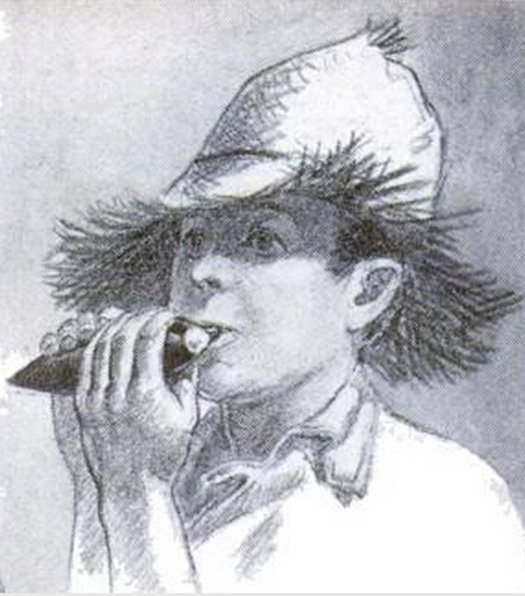
A clay whistle called an ocarina is also known as a "sweet potato" because, well, it's shaped like one. PopSci determined that using plaster of Paris, you can make an ocarina at home, modeled after almost any fruit or vegetable that tickles your fancy ("carrots, turnips, Irish potatoes, beets, parsnips and bananas were all tried with equal success"). As long as you make sure the air chamber is irregular and the air is blown in from the side, not the end. Of course, you won't be playing any sonatas on these vegetables: "Though not extremely melodious, it is easily played and affords a great deal of entertainment."
 |
| This is totally the wrong person in this illustration, it should be a dude with really tight pants, curly Q mustache and be singing about the rapid decline of squirrels in city parks or something else completely random and hipsterish |
This device that looks like a squirrel-sized playground slide debuted at a Chicago trade show under the name "cello-horn." It's played like a cello and "produces a unique tonal effect," making the player just one woodwind short of an orchestra.
 |
| Really? A bow on a mop handle? C'mon! |
Ohio State University professor Charles C. Weideman had more than 100 home-built instruments made from strange materials such as garden hoses, cardboard tubes, canceled bank checks and turkey bones. This peculiar predilection began early, when, "as a boy of ten, he tuned the pickets of a fence in front of his home by cutting them to various lengths, and played melodies on them with mallets."
Pictured here clockwise from the top, Weideman plays the world's largest xylophone made with cardboard mailing tubes, trumpets on a length of garden hose and plays a wire strung on a mop handle.
 |
| Typing music? Wasn't this meant for assistants or maybe scribes known as umm... secretaries? |
If this instrument were available now, we could turn every blogger in the nation into a virtuoso worthy of Carnegie Hall. The "score" for a song is just words on a page, and by copying them on this typewriter invented by court reporter Alexander Rose, the words become music as the keys strike strings inside, much like a piano. Suddenly typing 120 words per minute becomes more than just a recipe for carpal tunnel syndrome.


The Projects Are Piling Up...
The projects are piling up and being busy is a damn good thing...
 |
| Working on a variety of leather options for new tool bags |
 |
| More leather motorcycle bags in the works |
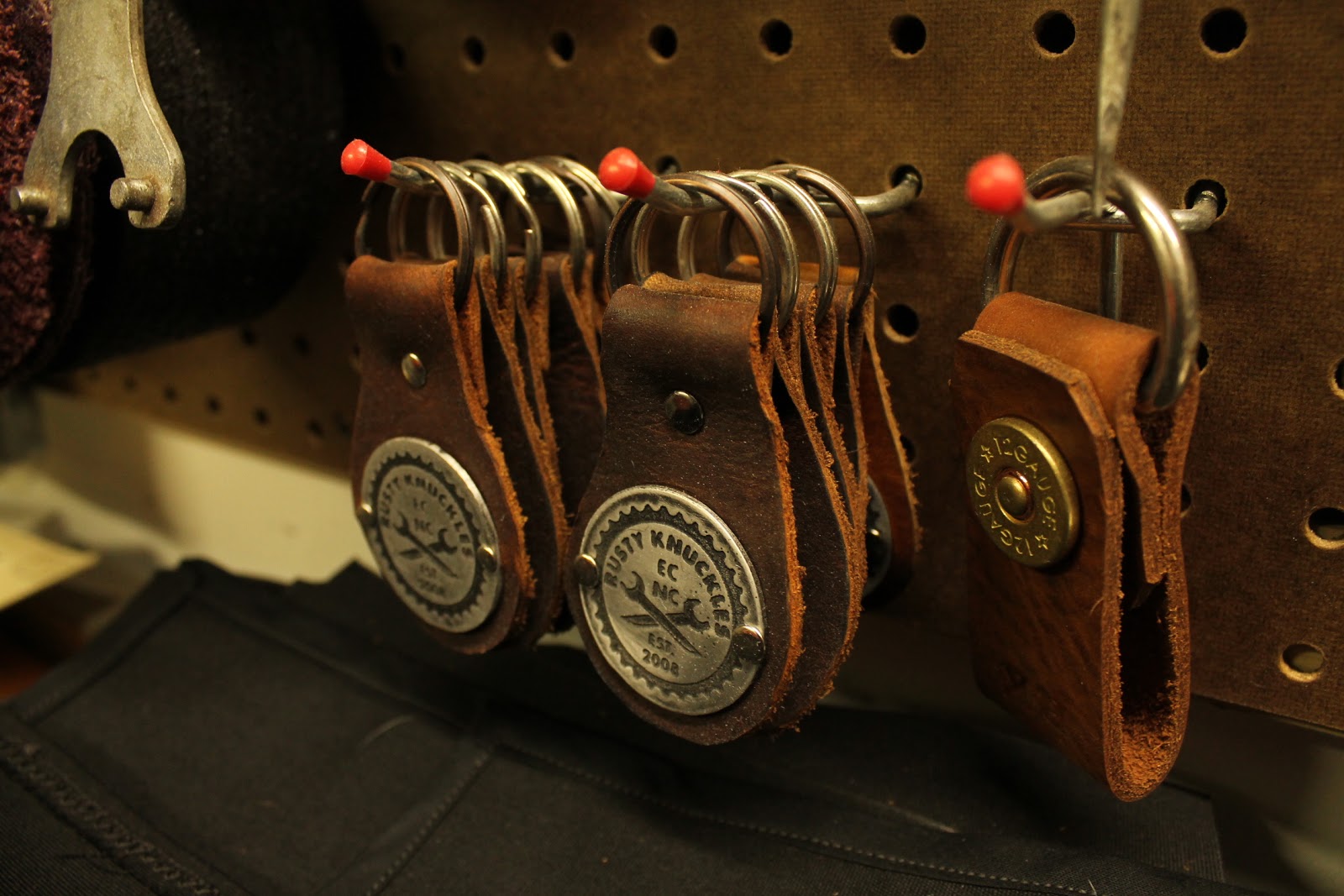 |
| Keychains made from scrap leather remnants |
 |
| Workbench ends up with all sorts of other items just laying around |
Friday, November 16, 2012
Drug War Weapons Reclaimed As Musical Instruments
Reclaiming weapons into a whole different amalgamation of functionality, speaks volumes on a political level. Guns and weapons of all sorts will forever be a hotbed of debate, as some think they help to drive crime. In a country such as Mexico with vast corruption and large organized crime families fueling a thirst for their notorious product, guns are just one of the tools in their arsenal. Seeing the work of Pedro Reyes is a quick reminder, that even a gun which was used to kill another individual, can be re-purposed into something more useful. The tragedies cannot be remedied, but the collective mindset can be changed, which may help to save lives in the long run.
Check out original post on This Is Colossal
Find out more on Pedro Reyes
pedro reyes: imagine - musical performance from designboom on Vimeo.

"As part of his latest project Imagine, Mexico City based artist Pedro Reyes acquired some 6,700 weapons that were scheduled to be buried (as is customary in mass weapon disposals) and instead collaborated with six musicians to create 50 working instruments as part of a statement regarding increased gun violence in Mexico. The numerous firearms were cut down, welded and formed into a variety of string, wind, and percussion instruments over a period of two weeks last month. Via his blog Reyes says:
Surprisingly this is not the artists first project involving the reuse of guns. Back in 2008 he was provided with 1,527 destroyed weapons which he melted down to build shovels to plant 1,527 trees as part of his Palas por Pistolas project. If you liked this also check out the work of Al Farrow. (via my amp goes to 11)"


Check out original post on This Is Colossal
Find out more on Pedro Reyes
pedro reyes: imagine - musical performance from designboom on Vimeo.
"As part of his latest project Imagine, Mexico City based artist Pedro Reyes acquired some 6,700 weapons that were scheduled to be buried (as is customary in mass weapon disposals) and instead collaborated with six musicians to create 50 working instruments as part of a statement regarding increased gun violence in Mexico. The numerous firearms were cut down, welded and formed into a variety of string, wind, and percussion instruments over a period of two weeks last month. Via his blog Reyes says:
"It’s difficult to explain but the transformation was more than physical. It’s important to consider that many lives were taken with these weapons; as if a sort of exorcism was taking place the music expelled the demons they held, as well as being a requiem for lives lost. [...] This is also a call to action, since we cannot stop the violence only at the place where the weapons are being used, but also where they are made. There is a disparity between visible and invisible violence. The nearly 80,000 deaths by gun-shot that have occurred in Mexico in the last 6 years, or the school shootings in the US are the visible side of violence. The invisible side is that one of gun trade-shows, neglecting assault rifle bans, and shareholder profit from public companies. This is a large industry of death and suffering for which no cultural rejection is expressed. Guns continue to be depicted as something sexy both in Hollywood and in videogames; there may be actors who won’t smoke on the screen, but there has not been one who would reject the role of a trigger-happy hero."
Surprisingly this is not the artists first project involving the reuse of guns. Back in 2008 he was provided with 1,527 destroyed weapons which he melted down to build shovels to plant 1,527 trees as part of his Palas por Pistolas project. If you liked this also check out the work of Al Farrow. (via my amp goes to 11)"
Reno Divorce's - Lover's Leap, Now Featured On Blank TV
 |
| Reno Divorce's new title track Lover's Leap is featured on Blank TV |
Dive into all that is BlankTV
Pre-Order your copy of Lover's Leap from Reno Divorce
She Rides Featured On Split 7" Record With Negative Fun Records
 |
| She Rides and Dripping Slits, Split 7" Vinyl Record out December 11, 2012 |
Limited Edition 7" vinyl release
Limited to 500 copies. 100 copies on random splatter-swirl colored vinyl.
Pre-order includes immediate download of 3 tracks in your choice of MP3 320, FLAC, or other formats. A link to the complete album will be emailed to you the moment it’s released. Pre-order Now $5 USD or more shipping on or around 11 December 2012, edition of 500
Pre-order includes immediate download of 3 tracks in your choice of MP3 320, FLAC, or other formats. A link to the complete album will be emailed to you the moment it’s released. Pre-order Now $5 USD or more shipping on or around 11 December 2012, edition of 500
Digital Album
Pre-order of Crucial Fix Split 7" including immediate
download of 3 tracks in your choice of MP3 320, FLAC, or other formats. A
link to the complete album will be emailed to you the moment it’s
released. Pre-order Now
$3
USD
or more releases 11 December 2012
Wednesday, November 14, 2012
The Destruction of America’s Distinct Musical Dialects, From Saving Country Music
Saving Country Music as a site for reviews and opinionated forums, has become a great repository for all things dealing with Americana and Country Music. Whether it be articles on the sale of the Grand Ole Opry, putting Big Machine in check or calling out great new albums, Triggerman, never fails to be informative and on point. If you agree with him great, if you don't, who really cares, as the site is based on one individual's view point, on how Country Music needs saving.
This is where things get rather interesting and somewhat dicey though. The comments and mud slinging at the bottom of each post can become all out war and it is a fray in which I think some enjoy pushing as many buttons as possible. Regardless of all the conjecture, the topics raise awareness and bring to light the main issue of supporting independent and what we refer to as "Real Country Music."
The article below from Saving Country Music, raises quite a few good points concerning diversity within America. Folks love to talk on how much culture urban areas have and we couldn't agree more. Hopefully though at some point, main stream media will realize that those of us from the "sticks" have always had culture, it just happens to be our own. This "Shorebilly" is damn proud of his roots.
Check out original post and all the comments on Saving Country Music
"In early October, a 92-year-old retired engineer named Bobby Hogg passed away in the little town of Comarty, Scotland. The death was significant because Mr. Hogg was the last speaker of a local dialect called “Comarty fisherfolk” that now only exists in a few brief audio clips. Many of the villages of northern Scotland have distinct dialects, and as time goes on, they become lost forever as elders pass away and the younger generations slowly drop their native accents in place for the more common pronunciations.
When President Obama won re-election last Tuesday, he said in his speech that what makes America strong is not that it has the greatest wealth in the world, or because it has the strongest military, or because its culture is the “envy of the world.” Obama cited America’s diversity, and the bonds that hold that diversity together as the reason the United States remains the most powerful nation on the planet.
But where the greatest diversity of culture exists in America, especially when it comes to dialect and musical styles, is in the rural states and counties; that red area that Obama didn’t take in the election. Cities and suburbs are much more likely to be gentrified to the more common American culture spread by popular media and entertainment than rural areas are, obviously with some exceptions.
In fact when you look at the culture of America’s rural areas, it’s is usually lampooned by the rest of the country’s culture, especially the dialect. “Rednecks” and people from the country have been a mainstay of comedic fodder for over 50 years. And now, entities like CMT, who are supposed to be for people of the country, by people of the country, are themselves formulating television series around making fun of “rednecks” in shows like Redneck Vacation and Redneck Island.
Meanwhile the negative connotations in media about redneck culture are making many people in rural areas flee from their native habits to adopt customs more indigenous to urban locales, giving rise to country rap with artists like Colt Ford. Jason Aldean’s country rap “Dirt Road Anthem” was the best-selling song in country music last year for example. At the same time, the power of pop country is causing similar gentrification in suburban and urban zones as it encroaches into areas it is not indigenous to either.This is where things get rather interesting and somewhat dicey though. The comments and mud slinging at the bottom of each post can become all out war and it is a fray in which I think some enjoy pushing as many buttons as possible. Regardless of all the conjecture, the topics raise awareness and bring to light the main issue of supporting independent and what we refer to as "Real Country Music."
The article below from Saving Country Music, raises quite a few good points concerning diversity within America. Folks love to talk on how much culture urban areas have and we couldn't agree more. Hopefully though at some point, main stream media will realize that those of us from the "sticks" have always had culture, it just happens to be our own. This "Shorebilly" is damn proud of his roots.
Check out original post and all the comments on Saving Country Music
 |
| An old red barn from rural Georgia, check it out here |
When President Obama won re-election last Tuesday, he said in his speech that what makes America strong is not that it has the greatest wealth in the world, or because it has the strongest military, or because its culture is the “envy of the world.” Obama cited America’s diversity, and the bonds that hold that diversity together as the reason the United States remains the most powerful nation on the planet.
But where the greatest diversity of culture exists in America, especially when it comes to dialect and musical styles, is in the rural states and counties; that red area that Obama didn’t take in the election. Cities and suburbs are much more likely to be gentrified to the more common American culture spread by popular media and entertainment than rural areas are, obviously with some exceptions.
In fact when you look at the culture of America’s rural areas, it’s is usually lampooned by the rest of the country’s culture, especially the dialect. “Rednecks” and people from the country have been a mainstay of comedic fodder for over 50 years. And now, entities like CMT, who are supposed to be for people of the country, by people of the country, are themselves formulating television series around making fun of “rednecks” in shows like Redneck Vacation and Redneck Island.
 |
| Miss Redneck of the Year (2007), Rawni White. |
I’ve always found it perplexing how Americans generally look at the varying cultures of the rest of the world with interest and appreciation for their diversity, but seem to be unwilling to do so in their own country and community. Our differences are something that need to be resolved, whether by promulgating our political or religious beliefs on other people, or trying to promote our products or culture to people who it might either be foreign to or downright unhealthy for, usually for the purpose of financial gain.
Similarly there is a demonstrative focus on preserving rare or endangered animals and plant species, or historic buildings or artifacts. We will stop the whole of human progress for concerns over an endangered strain of the titmouse. But those rednecks living out in the rural part of the county need to understand that the old-school agrarian life is gone and they better contemporize or risk being branded closed-minded. Yes, many racist, judgmental customs should be a thing of the past, but not at the sacrifice of what makes these people and their customs unique.

When the American South was populated, many times by native Scots and Irish that brought their folk instruments and musical learnings with them, a vibrant tapestry bloomed all across the Southern region with distinct musical dialects representing the geographical and genealogical makeup of the areas where they were founded. As people moved West during the gold rush and the Depression, they carried their musical cultures with them that then intermixed with the landscapes and labor they found there, giving birth to even more individual musical dialects.
Many of these varying styles and dialects would come together at institutions like the Grand Ole Opry, and this in part was how the big umbrella of country music was formed. But the differences in styles was something that was always celebrated instead of something that was attempted to be resolved to increase the economic potential of the music. They understood that the loss of the diversity may result in long-term decay of the musical format, even though it may garner short-term financial gain.
Ironically, it is not the mainstream, nationally-focused musicians that say they want to destroy the diversity in American music. Many go out of their way to tell you how country they are, citing very specific artifacts of rural life to prove it, many times to take the sting away of the actual music itself being more rooted in rock or hip-hop modes. It is the roots-based musicians who do not have the benefit of the country genre’s industrial machine that tend to speak out and say that genres don’t matter any more; artists in the loosely-defined “Americana” world.
Meanwhile radio may be the the most-obvious place where our differences are disappearing. When Clear Channel cut hundreds of local positions at stations in rural media markets last year in favor of nationally-syndicated programming, this also disproportionately effected the rural/red zones that are so rich with cultural diversity. Just like rainforests and wild areas around the world that are held back from development in conservancies cited as being vital to ecological and economic sustainability, America’s rural areas as robust cultural generators are just as important in sustaining the overall health of the greater cultural landscape.
Things are always evolving, changing, and coagulating together, and wringing your hands over it in some respects is foolish. At the same time, if the “melting pot” theory of how America became the greatest nation on the planet is true, then there’s nothing more important than protecting that diversity for the long-term preservation of the world’s greatest economic engine and mouthpiece for freedom. And this would also be true in protecting the diversity of any country or region for them to live up to their greatest potential.
In other words, the destruction of America’s distinct musical dialects is not just a musical problem."
Tuesday, November 13, 2012
Was The First Monster Truck Actually A Car?
Found this awesome photo on Pinterest. A 1931 Ford Model 68B cabriolet convertible coupe is an extremely
scarce Montana mail carrier car. One of two custom-built in
Glendive, Montana in 1941 in order to maneuver in deep snow drifts.
 |
| Was the first monster truck actually a car and employed by the United States Postal Service? |
Custom USB Drive Box Set For Reno Divorce's New Album, Lover's Leap
Doing something different and unique is always the challenge and it's a mantra which we do our best to live by on a daily basis. To say it is an honor to be able to work with all the great bands that are part of Rusty Knuckles Music, is indeed an understatement. Each band has a distinct vibe and voice within their music.
For Reno Divorce's new album, Lover's Leap, we wanted to create a nice gift for a great client of ours who has helped us out immensely. These are the box sets we shipped out to them. The early part of 2013 will witness some damn great music coming out from our end of the spectrum. Stay tuned for more updates on Reno Divorce, Flat Tires, She Rides, The Green Lady Killers, Carolina Still and The Speed Kings.
Pre-Order your copy of Lover's Leap by Reno Divorce
For Reno Divorce's new album, Lover's Leap, we wanted to create a nice gift for a great client of ours who has helped us out immensely. These are the box sets we shipped out to them. The early part of 2013 will witness some damn great music coming out from our end of the spectrum. Stay tuned for more updates on Reno Divorce, Flat Tires, She Rides, The Green Lady Killers, Carolina Still and The Speed Kings.
Pre-Order your copy of Lover's Leap by Reno Divorce
 |
| Custom USB drives created for the launch of Reno Divorce's new album, Lover's Leap |
 |
| Custom USB drives created for the launch of Reno Divorce's new album, Lover's Leap |
Sneak Peak Of The Wrench N' Roll, Designed By Rusty Knuckles
All right folks, we have been deep in the design mode trenches for many months now and wanted to give a quick update on the progress of the "Wrench N' Roll". After researching for over two years now and never finding a product that works as functionally efficient to carry quality tools, we have filed for a patent on our design. Forget a tool roll that just has pockets, if you are really into being prepared for hitting the road, know exactly what tools to carry for your metric or standard ride and keep the right tools only. Extra weight and bulk were taken into consideration for other items, so we leaned it all out to accommodate exactly what you would need for a potential roadside fix.
In the coming weeks we will have a full write up and detail specs on the tool rolls, but for now, enjoy the sneak peak of the Wrench N' Roll!
In the coming weeks we will have a full write up and detail specs on the tool rolls, but for now, enjoy the sneak peak of the Wrench N' Roll!
 |
| Rusty Knuckles - Wrench N' Roll - The best damn tool roll money can buy |