
Showing posts with label Circle Jerks. Show all posts

Wednesday, January 1, 2014

Can't Live Without My Radio, I Need A New Boom Box

do-the-right-thing-radio-raheem-puerto-rican-music-duel
Radio Raheem and his Promax J-1 Super Jumbo boombox as seen in a still from Spike Lee’s 1989 film, “Do The Right Thing.”
Nostalgic bliss shows up in many forms and certain items will always be a litmus test within pop culture. If someone were to pull out a killer boombox there will always be a distinct vibe to immediately pop up. I know that my eyes will light up at the sight as I will instantly think of my childhood in the early 80's and recall seeing Beat Street in the theater and thinking how fast can I find a piece of linoleum to break dance on.

Later on, well as in a roughly maybe three years later that same boombox would switch to albums by the Circle Jerks and old Metallica and would be blasting while we skated our local slick curb. 

Do yourself a favor, find a boombox and go make a skate session happen somewhere. If you are more on the hip hop side of things, find a killer wall to paint and blast some early 80's hip hop such as LL Cool J or Grand Master Flash and let the good times roll. 

Huge shout out to my older brother for getting our first boom box, thanks for the memories Toby!


Find more great articles like this on Collectors Weekly

"Boomboxes are, by definition, excessive. With their deafening bass thud and dazzling chrome dials, these electric beasts are heavy enough to tone your biceps. Also known as “ghetto blasters” or “jamboxes,” they rose to fame in the 1980s along with hip-hop, flourishing as a tool for sharing and mixing the latest beats. Yet despite their widespread popularity, the innovators who conceived of these devices are still largely unknown, consigned to anonymity by the corporations that manufactured their creations.

Miles Lightwood hopes to change that. He’s the founder of Boomboxラジカセ Creators, an online archive and forthcoming documentary film devoted to identifying the individuals behind the most successful boomboxes of all time. So far, Lightwood has only located a handful original designers and engineers, a few of whom are already deceased, but he hopes that with the help of the Internet’s global community, more will be found before they pass away.

Compared to today’s sleek micro-gadgets, boomboxes are like electronic dinosaurs, dated as much by their ludicrous size as their outmoded technology. Beginning in the late 1970s, companies recognized that buyers wanted their radios louder and more dynamic, so they made sure each model could project a solid mix of treble, midrange, and bass, while offering options for recording and editing, too. This was what made the analog boxes so big, requiring huge speakers, cassette decks, a radio receiver, and up to 10 D-sized batteries, all wrapped in heavy-duty casing.
“A boombox is a campfire, drawing in those nearby to enjoy a warm analog musical experience.”
The oversized radio-and-cassette-player combos quickly became a sign of status among urban youth, who knew their models by name: The JVC RC-550; the Panasonic RX-7200; the Sharp VZ-2000. Eventually they included features like detachable speakers and keyboard synthesizers, allowing for even greater mixing capability. These monster boxes grew so large and expensive that one model, the Conion C-100F, actually included a motion detector that sounded an alarm if the box was moved.

Today, boombox connoisseurs typically swap information and compare their finds on forums like Boomboxery and Stereo2go, waxing nostalgic for the era of street parties and tape sampling that couldn’t have existed without these master blasters. With his 2010 book, “The Boombox Project,” boombox collector and photographer Lyle Owerko lamented the shift from this culture of public music-sharing to one that exists in private. “The world of sharing music in parks and on city streets now resides in cyberspace as we share in anonymity online. The boombox that marked this change from public music ‘broadcasting’ to private consumption was the JVC PC-100, a mini unit with a detachable headset. Now you could share your music in the public sphere, or keep it private by ejecting the cassette deck and plugging headphones into it.”

Lightwood is hopeful that shedding light on the origins of classic boomboxes might renew interest in the technology that facilitated this communal audio culture. We spoke to Lightwood about the world of vintage boomboxes, and why their creators are often shrouded in mystery.

The Philips "Radio Recorder" from 1969 is thought of as the world's first boombox.
The Philips “Radio Recorder” from 1969 is thought of as the world’s first boombox.

Collectors Weekly: Where did the boombox originate?

Miles Lightwood: The boombox by its typical definition—a handled, portable, radio cassette deck with one or more speakers—was actually invented in the Netherlands by Philips in 1969. The one considered the first boombox was made so that you could record from the radio onto the cassette without having any external cables for a microphone. All of a sudden, you’ve got a very easy music-sharing culture, and the Japanese companies basically took that idea and ran with it.

In my mind, the first device that’s like the urban boombox of popular culture is the JVC RC-550, which was a monster box. It’s got a 10-inch woofer, it looks mean, and it’s got lights and the whole package. That was made in ’75.

Collectors Weekly: How did your boombox obsession begin?

Lightwood: When I was younger, I had a couple of boomboxes, and they both got stolen out of my apartment. I was living in a bad part of downtown Los Angeles. One day, I came home, and someone had taken every electronic device I had.

When I was skateboarding in empty pools back in the ’80s, just having a box gave you status. Regardless of whether it was the biggest or flashiest one, it was cool to be the one with the music. Some of those huge Japanese boxes cost around a thousand bucks. There was no Walkman; there was no iPod. Back then, the only way you could share music was with a boombox.

Lightwood considers the JVC RC-550, also known as "El Diablo," as the first radio to resemble a true boombox.
Lightwood considers the JVC RC-550, also known as “El Diablo,” as the first radio to resemble a true boombox. Via radiohier.com.
Then about two and a half years ago, the radio in my car went out, and when I looked into getting it replaced, I realized it was going to cost me about the same as a boombox. So I decided I was just going to get a boombox and keep it in the car. I got what’s called an “AKA,” or a re-badged and re-styled version of an earlier box, and it’s actually still in my car. I listen to it all the time. But like any other type of collecting, one is never enough.

I’ve been collecting boomboxes for a few years now, and earlier this year, I began wondering who created these magnificent machines. We know the musicians, artists, and celebrities that appreciate boomboxes, but more than 30 years later we still don’t know who created these boomboxes: Who is the Jonathan Ive of Sharp? Who are the Charles and Ray Eames of Conion? Who is the Dieter Rams of Magnavox?
“A bigger, louder, flashier box got you more attention on the street—boosting your reputation.”
While functionally developed in the Netherlands, the most iconic boomboxes were created in Japan during the 1970s and ’80s. This was a time when Japanese design and manufacturing was evolving from a copying culture to an innovating culture, and the boombox is a great example of this. I want to find the inventors of these important “grail” boxes and tell the stories of how they designed the machines we love, before it’s too late. Aside from satisfying my own curiosity, boombox creators need to be recognized and celebrated for the contributions they have made, not only to the fields of design and engineering, but also to music-sharing and popular culture worldwide.

I really hope to make this a collaborative, crowd-sourced project, and our website will be the central point for that, possibly enlisting some design schools in Asia to help track down these people. It’s going to be a bit of a challenge, because even once we’ve identified certain people, they’re generally older, so they don’t really have any presence on the Internet.

The cover of LL Cool J's 1985 album "Radio" featured a JVC RC-M90.
The cover of LL Cool J’s 1985 album “Radio” featured a JVC RC-M90.
Collectors Weekly: What makes a boombox a grail?
Lightwood: That’s shorthand for “holy grail,” meaning the most collectible or the most recognizable, the ones that have all the features that you associate with a boombox. They’re big; they’re loud; they’ve got all the bells and whistles.

There are certain agreed-upon grails within the community, and then everyone has their own personal grail. Take for example, the JVC RC-M90, which is on the cover of LL Cool J’s first album “Radio.” It has an amazing sound but it’s also got an amazing look, and it’s one of the most sought-after boomboxes. If you can get one, it’s going to cost you at least $800 and a fierce bidding war on eBay or another auction website. I’ve got one of those, but personally, I focus on the Japanese boxes, which are fairly rare. I recently found one of those boomboxes that was stolen from me on eBay, not the exact same one, obviously, but a replacement in really good condition.

I know some collectors who have found grails like a Conion C-100F, another legendary box, on Craigslist. They went over to check it out, and they met this little old lady whose husband passed away, so she was downsizing. The couple originally bought this Conion so they could have some portable music at their cha-cha dance class or something. The box is like a time capsule: It never was a street warrior, never got beat up. I don’t have that type of story yet, but one day I will.

A Conion C-100F, which included an ear-splitting motion detecting alarm (visible in the upper right corner) from the collection of Lyle Owerko. Photo courtesy Lyle Owerko.
A Conion C-100F, which included an ear-splitting motion detecting alarm (visible in the upper-right corner), from the collection of Lyle Owerko. Photo courtesy Lyle Owerko.

Collectors Weekly: Why were they so big?

A young B-boy struts his stuff in New York, circa 1980. Photo by Martha Cooper.
Lightwood: The classic grail boomboxes of the ’70s and ’80s were designed to provide a home stereo experience on the go. That meant several large speakers (typically 2 to 3 speakers ranging from 2″ to 10″ in diameter), one or more cassette decks (side-by-side or stacked), a multi-band radio receiver (typically 2 to 5 bands, but some had more), the power supply to blast it in the street (8-10 batteries), and the transformer that allowed you to plug-in at home. In the analog era, to get the loudest sound out of big speakers required a large amplifier and other crossover electronics that occupied quite a bit of physical space within a box.

Transporting all these components safely and with style required a sturdy enclosure that satisfied both aesthetic, sonic, and functional requirements; consequently, these boomboxes were large and heavy. Practical issues aside, a bigger, louder, flashier box got you more attention on the street—boosting your reputation—and manufacturers could charge more; so win-win. Bigger is better.

Collectors Weekly: What have we lost with the switch to MP3 players?

Lightwood: Sonic warmth and physical community. When shared in a public space, a boombox is a campfire, drawing in those nearby to enjoy a warm analog musical experience and connecting them in a spontaneous community. Anytime I share music from a boombox in public, I meet new people, learn new stories, and everyone has a great time. Listening to an MP3 player in public just isn’t the same.

Often boomboxes were customized with emblems of a favorite band or musical style, like this punked-up Crown CSC-950. Photo courtesy Lyle Owerko.

Collectors Weekly: Why is it so hard to locate the original inventors of these devices?

Lightwood: A designer, engineer, or marketer working in a consumer electronics manufacturing company in the ’70s and ’80s was just a cog in the corporate wheel. Then as now, very few people were individually acknowledged for their contributions to a given product. Without assistance from a manufacturer, the only way to identify a creator is via a thorough examination of publicly available documents, and even then, not all these people can be identified.

For several months at the start of the project, I reached out to the original manufacturers to help identify the creators of their boomboxes, but with no success. I continued researching, and once I realized how to search the public patent databases, many creators were revealed. I’ve identified 17 creators thus far, and I’m discovering more each month. Now identified, the real work begins: locating these people around the world and telling their stories before it’s too late, as many of them are elderly.

Lightwood purchased this 1981 conceptual drawing by Richard Culbertson from an estate liquidation on Etsy.
Lightwood purchased several conceptual drawings from 1981 by Richard Culbertson through an estate liquidation on Etsy.
So, the first breakthrough was realizing that people’s names are in the patent databases if you know how to look for them. The second was actually getting 50-some odd drawings from the estate of an actual boombox creator. There’s a guy who has a Mid-Century Modern furniture store on Etsy, but he also has drawings and paintings and whatnot. And he came across these Richard Culbertson drawings from an estate liquidator. When I found them, I was like “Holy moly!” They’re all meticulously hand-drawn, just gorgeous.

Collectors Weekly: Are most of the companies who made these boomboxes still operating?

Lightwood: Yes, most of them are still operating. JVC, Panasonic, General Electronic, Pioneer, Sanyo, Hitachi, Toshiba, they’re all around. There’s a few oddball ones that aren’t, like Skitronic, which made the Discolite that has the light-up speakers and was featured in music videos by Madonna, Lady Gaga, and a bunch of others. That company is out of business, and those are grails as well. The sound quality isn’t that great on those, but they’re popular for their looks and their “wow” factor.


Collectors Weekly: How do you find replacement parts for vintage boomboxes?

Lightwood: Replacement parts don’t really exist, but there are a few options, like asking other collectors for used parts, seeking out and buying a parts box, or utilizing new technologies to make your own. I’m involved in the 3-D printing community, and when I was trying to repair my most recent purchase, a Lasonic TRC-931, I needed new knobs. So I started printing up knobs. But I’ve realized that the resolution of most 3-D printers means that you don’t get an exact reproduction part. You get a functional part, but it doesn’t look quite right. There are plenty of internal parts that can fail, gears and whatnot, and those you can easily print because there’s no real cosmetic requirement—it’s all functional.

Collectors Weekly: What’s been your favorite discovery related to boomboxes?

Lightwood: There are so many. Acquiring original drawings from the estate of a boombox creator, or meeting a creator who worked for one of the longest-standing boombox manufacturers.

Lightwood has used his 3-D printer to create replacements for knobs and other internal parts.


Matsushita was this Japanese company that owned a bunch of different brands, like Technics, JVC, Quasar, Panasonic, and Sanyo. Over a 16-year period, Matsushita sold 4.2 million of one model boombox, the National Panasonic RQ-543. That’s a little over 700 boomboxes a day for 16 years. And that blew my mind; I had no idea they were made in such numbers.

Collectors Weekly: Why was that model so popular?

Lightwood: I don’t really know. Through my research, I realized that several of these Japanese manufacturers have museums devoted to the company founders and their popular products, which include all types of electronics and home appliances. Some guy went to the Matsushita museum and filmed a walkthrough that I found on YouTube, just panning over all the different products in there. And I thought, “Wow, there’s a boombox over there!” It was a gold boombox developed for the Middle Eastern market.
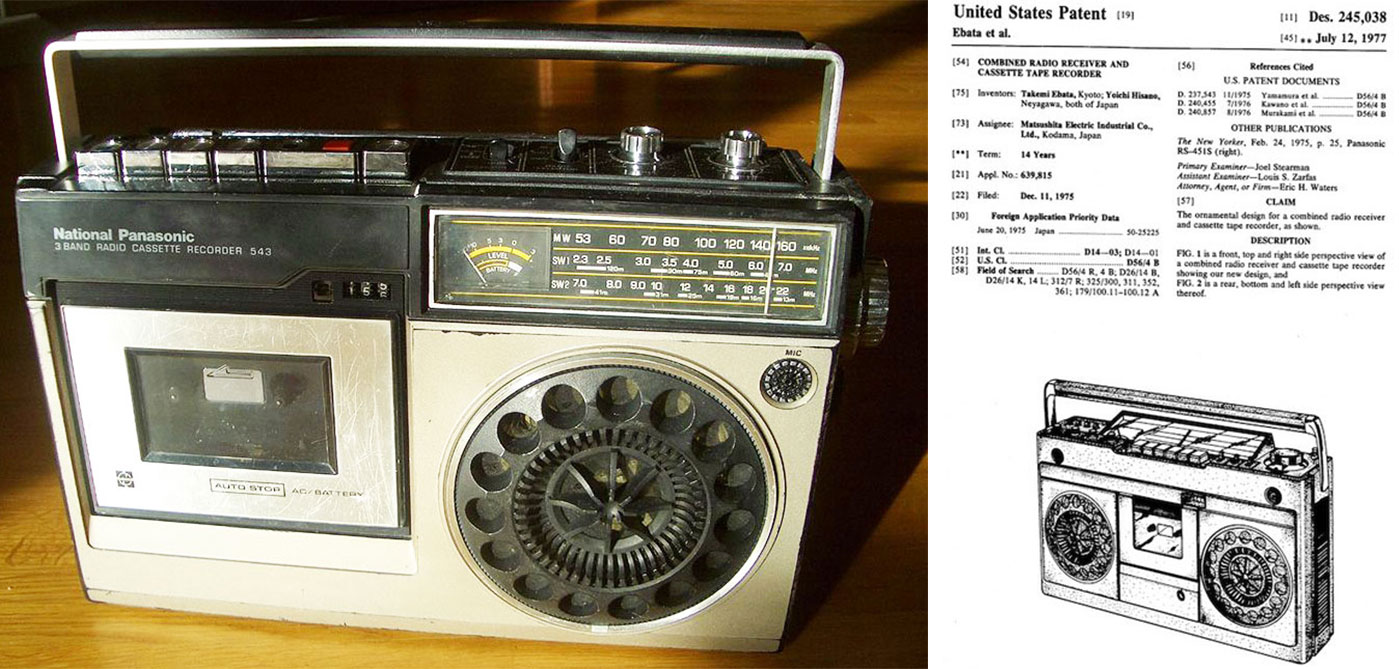
The National Panasonic RQ-543 made by Matsushita sold over 4.2 million models, primarily in the Middle East. Photo via shizaudio.ru.

If I spoke Japanese, I could write to the museum and get a little more background on it. I contacted one individual in the boombox collecting community who lives in the Middle East, in the U.A.E., and asked him if he’s ever seen this gold box. I don’t know if they were all gold, or if this is a commemorative one for the 4.2 million they sold.

This member in the U.A.E. said that most of those boomboxes aren’t even in the country anymore, because the people that would’ve bought them were mostly foreign laborers that were brought in to build or maintain the country’s infrastructure. Once their time was up, they would leave and take their equipment with them, so the boomboxes would end up wherever the laborers came from.

Collectors Weekly: Do you have a favorite boombox?

Lightwood: In no particular order: Victor RC-550, Tisonic PR-7000, Victor RC-M90, Amsen FK-887, Sanyo MR-X920, Sharp GF-999, Lasonic TRC-931, Victor RC-M70. I have them all, and that’s like a parent choosing a favorite child. Each has its own look and sonic personality.

The JVC PC-100 included a detachable cassette player, which began the shift to private audio devices like Walkmans.


Friday, August 24, 2012

Off! Is Invading Your Town On Their Southern Tour

Mario Rubalcaba, Keith Morris, Dimitri Coats and Steve McDonald are Off!
The fellas in Off! need little to no introduction. Check out the lineup and you know for sure that some good shit is about to go down. After missing them a few times, we finally get to check out their set later next month, hells yes! Below is a cool write up from Spin.com

"How are you doing?


I'm doing pretty good, I'm experiencing the heaviness and fucked-upped-ness of allergy season. I've experienced like two or three days where I would have this thing in my throat, like acid reflux. I experience it every now and then if I eat the wrong thing but this has just been brutal. Like fuck, man, what is it? Throat cancer or bronchitis? This is pretty uncool. So I'm feeling that and because of that I get this like post nasal. You know it starts in your nose and your eyes and it goes to your ears and it goes to the back of your throat? I have a tendency to eat thick and heavy food, and I dig dairy and dairy just creates phlegm and so you're just laying in bed at night and it's just balling up in your sinuses and then it rolls down into your throat and it rolls down into your stomach so you wake up in the morning with a stomach ache and your throat's sore and your nose is all itchy and your eyes are all scratchy and everything. It's just really such a wonderful thing to experience. I wish it upon everybody. It's like you've not lived life unless you've experienced the discomfort of allergies, whether it be food or whether it just be pollen or weeds or grass. Whatever is in the air. Our weather here is really fucked up, too. I mean we've got really nice weather right now but two days ago it was raining and the day before that we were supposed to have the worst thunderstorm, the worst rain that we've had at this time of the year. We have all of these people who don't believe in the global warming thing, which is fine, but how do you explain all of the flooding in the Midwest and you know how all of the weird fuckin' tornadoes? We just had a bunch. What was it, like, Oklahoma or Nebraska or somewhere? Indiana? But you know there's supposed to be certain times of year where things are just supposed to be nice and you're supposed to be able to just drive along and not experience any fucked up weird wacky changes in the weather. And now all of a sudden we're getting all of that stuff. So these people need to get more real about what's happening at the North Pole, you know?

It sounds like fodder for song writing.

Yes. The heavens are going to open and you're all going to hell. So you better believe.


Well, what is "I Got News for You” about?

Well, a lot of our songs are very angry. A lot of finger-pointing. There was a reunion, a couple of reunion shows with one of the bands I was in, in the very beginning of my musical career. I was one of the founding members. And it got really ridiculous. It just spiraled into, — there could've been some more things written for
Spinal Tap. And in the process I realized why I left in the first place. It was pretty much one guy's band and everybody else were just players in it, everybody else were just parts. Everybody was kind of like the New England Patriots: Bill Belichick, the way he looks at all of the players with the exception of say, Tom Brady. You can't replace Tom Brady, but all of the other people, well, you could get a new running back or a new wide receiver or replace a defensive lineman. And that was that. It wasn't even a revolving door. But if you look at the family tree there were, oh I don't know, four singers in the band, four different bass players, and how many drummers? My friend Billy Stevenson was the drummer in the Descendants. Probably besides Greg Ginn, Billy was in the band longer than anyone else. But it was, everybody came and went. But the situation that I was in, I went to a couple of rehearsals and I got there and I was just blown away by the building that the rehearsals were taking place in. I was excited, because I love the band, I love the music, and I was a part of it. And the situation, it just turned into this comedy of errors. And when they finally did do the reunion shows I was asked to not be a part of it. You know, when I left the band we were only playing 16 songs and we were working on 4 other songs. So it was one of these situations where, if you blinked your eyes, four or five songs would've passed you by. I'm completely lost. Are you there?

I am.

Shit. I'm just spaced out.

We were talking about "I Got News for You."

The situation was that there are a lot of people that don't have good things to say about the character. You're full of yourself and you know, go on and do whatever you're gonna do, but there's just, it's pretty much just a spiteful, hateful kind of song. And having been in the situation and it's a finger pointing type of song. You know, "you're bulletproof and nobody can get at you, so you just go on about doing what you're doing." It's a character in real life. And it's not pretentious. It's very much drenched in anger. The situation was: I left a band and when I left the band everybody really disliked me. And there were a few events that went down and this is something that's gone on throughout time with people in bands, and people playing music, people stealing music, people borrowing music. It's all pretty much been played before, it's just a matter of putting your own spin on it, putting your own personality into it. A lot of finger pointing, back and forth: you're this, you're that. Very childish kind of thing. And the song has almost got a kind of hateful, spiteful, teenage kind of vibe, I guess.

Some would say that's typical of hardcore in a way, right? The last time we spoke, we talked a lot about the moment hardcore's having right now, and the audiences it's reaching for what seems like the very first time.

I don't like using the word hardcore. Unless say, I'm describing, like, adult entertainment. No, just kidding. The situation is that being in this band and playing the kind of music that we play, that's what we're labelled. But we're just like the guys in the band. They're dads and they've got kids and they've got good hearts and you know when I think of hardcore I think of like, a biker gang and Hell's Angels and Mongols and fuckin' beards and leather, and fuckin' steel-toed boots and here comes the bad gang and they're hardcore and you better get out of their way. Just because we play angry, hateful, spiteful, very energetic, very loud, very brief, very to the point kind of music, I don't know if we're really a hardcore band. 

If you were to ask us our influences you would probably say, "Yeah those influences aren't very hardcore." Cheap Trick is certainly not a very hardcore band. Although, KISS in a way, looks like what I just described with the Hell's Angels and the Mongols. We are living in a time where you know if we were doing this say, 30 years ago, maybe the moniker would apply. But we're doing a thing now: we only have so much time, there's only so much of your attention that we can hold onto because there's so much stuff going on. So it's way more hectic, it's way more urgent, it's way more in your face. This is what we are, you're gonna know what we are half way through our first song, and if you're down with it, cool. If you're not, hey, maybe we might grow on you. And you know, this isn't about creating the 30 minute opus. We don't have time. We don't have time to like hang out and jam and like stretch out. 

Would you say then that the way you play is more a reflection of right now rather than the way things were?

It's very much about what's happening now. You know, what's happening in our lives. You've got those few minutes and you've gotta make the best of them. We don't have the opportunity to turn this into anything more than it is.

Which is what?

This is a very profound statement: It is what it is. Who said that? Oh, I forget his name. He was this soul brother character on television. It was almost like something that would've been said on this comedy show called
Laugh In and it was on Monday nights. We as a band, the guys in the band, we enjoy each other's company because we don't spend a lot of time together. It's not like we're a real band and everyone's breathing down each other's necks. And there's a space for creativity. It's not a big space. You've gotta get in and you gotta do what you gotta do but don't be playing all over everybody else's parts. There's a certain mentality, there's a certain instinct amongst the players. Everybody knows where to go, and everybody knows where to go and we know that there's only a certain amount of time to be able to go there. You know, we know that it's not three-and-a-half minutes and it's not four-and-a-half minutes or five minutes. It's like let's just pounce on this and do it. And we don't get to sit around and dwell upon what's gonna happen with us or what we're gonna do for the next record. When it comes, it just kind of fuckin' happens, I guess."


Off! Is invading US clubs this fall, get out to this show!
09-14 Scottsdale, AZ @ Martini Ranch tickets #
09-15 Tucson, AZ @ The Rock tickets #
09-16 Albuquerque, NM @ Launchpad tickets #
09-18 San Antonio, TX @ White Rabbit tickets #
09-19 Dallas, TX @ Trees tickets #
09-20 Houston, TX @ Warehouse Live tickets #
09-21 New Orleans, LA @ Tipitina's tickets #
09-22 Pensacola Beach, FL @ De Luna Fest tickets
09-23 Jacksonville Beach, FL @ Freebird Live tickets -
09-25 St Petersburg, FL @ State Theatre tickets -
09-26 Miami, FL @ Grand Central tickets -
09-27 Orlando, FL @ The Social tickets -
09-28 Atlanta, GA @ The Loft tickets -
09-29 Athens, GA @ 40 Watt Club tickets -
09-30 Raleigh, NC @ Kings Barcade tickets -
10-16 New York, NY @ Irving Plaza tickets +
10-17 Teaneck, NJ @ Mexicali Live tickets +
10-18 Washington, DC @ Black Cat tickets +
10-19 Philadelphia, PA @ First Unitarian Church tickets +
10-21 Cambridge, MA @ The Middle East tickets +
10-22 Montreal, Quebec @ Les Foufounes Electriques tickets +
10-23 Toronto, Ontario @ Wrongbar tickets +
10-25 Cleveland Heights, OH @ Grog Shop tickets +
10-26 Detroit, MI @ St. Andrews Hall tickets +
10-27 Chicago, IL @ The Bottom Lounge tickets +
10-28 St. Paul, MN @ Station 4 tickets +
10-30 Omaha, NE @ The Waiting Room tickets +
10-31 Kansas City, MO @ The Record Bar tickets +
11-01 St. Louis, MO @ Fubar tickets +
11-03 Austin, TX @ FFF Fest tickets