Showing posts with label Hip Hop. Show all posts

Sunday, February 9, 2014

7 Things A Major Label Record Deal Teaches You About The Music Industry, From Cracked

Clay Aiken is a manufactured pop star, where is his career now?
The illusion of fame and fortune is indeed just that, an absolutely wicked illusion. There is a reason the casino's in Vegas are glamorous and beautiful as they rely on a majority of folks to lose their money in a staged bilking draped in a veil called entertainment. 

Notoriety can be born overnight but not when the cards are clearly stacked against success in terms of financial gain and or freedom for an individual or band. Signing a hefty contract with a corporate entity that intends to manufacture pop hits, not careers may be for more pop oriented acts or ones that enjoy swimming in shallow pools. Bands and acts that want to insure a long career path with their music should really vet all the folks that come along their path. If anything is askew or seems odd, walk away as much of entertainment business that we all seem to know and love, is purely an illusion.


Below is a great read we found over on Cracked.com and is co-written by hip hop artist Spose and Robert Evans, about Spose's dealings with a major label.

Read more great articles on Cracked

"Getting a record deal is the musician equivalent of a high school ball player making it pro, only with fewer head injuries and lower odds of an overdose. Two albums into my career as a rapper, I had a hit song, and the recording industry whisked me off to Hollywood. My fairy tale lasted 11 months before they abruptly dropped me from my recording contract without ever releasing my album, despite my first single going gold (selling over 600,000 copies in just a few months).

In that short time, I got a crash course in the recording industry: how it works, how they exploit and manipulate young talent, and how to go from having nothing to everything to nothing again in a very short period of time. My name is Spose, and this is an inside look at how the sausage is made.


7. Labels Hunt For Unique Voices

My first hit song blew up on the radio first. "I'm Awesome" got picked up by the local alt-rock station in my town, the radio station I'd grown up on. It quickly became the most requested song there and then jumped to the local pop station. Keep in mind I'd only self-released two albums at this point. I was very new to the game, and suddenly the two biggest local radio stations were playing the shit out of my stuff, which was unprecedented. No local artist had ever broken through at pop radio in my area (Portland, Maine, is not exactly known for its burgeoning rap game).


We lost a lot of guys during our East Coast/West Coast beef with Portland, Oregon.

The way the world works now, if you're blowing up on the radio, you're killing on iTunes, too. I think there's an intern at Universal who goes through the regional iTunes charts every week, from Des Moines to Albuquerque, and looks for outliers.

"We know all the other guys on here. Taylor Swift, Bruno Mars, Ke$ha ... who the hell is Spose?"

So this intern looked at the Portland sales and saw that I had the #1 song. I doubt I cracked the top 200 nationwide, but that was enough to get their attention. At this point, I was 24 years old and totally broke, delivering pizzas and raising a newborn. The day Universal sent me a $35,000 check for signing on with their label, my bank account was at -$800. I couldn't even buy gas for my car without overdrafting my account again -- one generally doesn't hear Jay-Z rapping about bank fees and bus passes.


99 overdraft fees, just doesn't have a ring to it

6.  They Have Minions For You

The labels do a great job of making you feel like the center of the universe when you're recording. Every studio I've worked at in LA and New York had runners. Usually we'd arrive at 3 p.m. and go till 3 a.m. Sometimes we'd make one song, sometimes four. The runners were there to keep us from needing to ever leave. We'd say, "We need Heineken, Seagram's Seven, ice cubes, a venti iced coffee with whole milk only, a quarter ounce of weed, Backwoods cigars, and we're also going to need sushi." A half hour later, the runner would come back with a bag full of all that stuff, courtesy of Universal. That means Universal has a designated weed guy.

I mean, at least try to look surprised.

Can a bag of weed be a business expense?

I met a lot of people who were caught in the record label game. This dude Matt Toka was one of the writers they brought in to help us. He could play guitar and sing and had some cool ideas. We wrote a song called "Party Foul" together. I think a lot of guys like Toka get signed for their writing abilities, even if the label doesn't see any star potential in them. But they don't say that, of course: These guys all want to be stars, but writing lyrics FOR stars and up-and-coming artists pays the bills. There's probably a thousand musicians who could've been like the biggest star in Duluth, or wherever, but chose to play the label game in LA instead.

They're not foolishly throwing away their lives or anything -- it's just that they get barely enough hope to carry on in the background instead of doing what they really want to do. And they do carry on, because not all of these dudes wallow in label limbo forever. For example, my lawyer also represents Bruno Mars, and for almost 10 years Bruno Mars was one of these writers, contributing his ideas and scratch vocals to other people's hits, before ever getting his shot at personal stardom. They'd take Bruno's vocals and search for a "real star" to replace them. The irony is that now those same A&R dudes would kill to have Bruno Mars singing their hooks, because he won the "background guy" lottery.

5. The Major Labels Convince Naive Kids They Are Rock Stars
Labels definitely seek out young people, and they are extremely good at making you simultaneously feel like their top priority and like you're fighting against a ticking clock. When they called me the first time, they offered to fly me to NYC. I was at Suffolk University at this point; I stepped out of class and saw that I had like 15 missed calls and voice mails. I Googled the name of the dude from the voice mails, because that is the gift the Internet gave to the antisocial, and eventually called him back. He picked up and immediately gave me both barrels of enthusiasm: "We'll fly you and anyone else you want out, first class, to NYC, right now." If my Myspace had said "I like the Celtics," they would have had me courtside that very night.
Straight up ballin'!

They flew Monte Lipman in to meet me in NYC. He's one member of a tiny group that runs the record industry, and he came over to chill with me and have dinner. Because that's not going to inflate a broke 24-year-old's ego. He asked, "You wrote this song all by yourself?"

I said yes and he started flipping out, telling me to get my passport ready because I was about to be huge, flying all over the world in a private jet fueled by raw hip-hop.

Then he sent me an email on the weekend, mainly to let me know that he never sends emails on the weekend. "I want to get this signed by Monday morning. Your song played huge when we tested it in Miami, we want to sign you and fly you down." But at the same time, he was like, "These references are VERY current and your record will expire really soon. YOU HAVE TO SIGN IMMEDIATELY."

Hurry up and sign the deal!
I'm sure that's a common trick. (Although the record industry does shut down completely by 5 p.m. on Friday. That's a fact. Hip-hop apparently keeps DMV hours.) It was all just smoke being blown up my ass. Monte sent excited email after excited email about how big I was about to be and how we were "just getting started." I think the last "just getting started" email hit about a week before the label dropped me. I guess he was trying to type "We're just getting started on the process of firing you" and hit enter too soon.

4. They Are Casting A Role

When I was making music by myself, I'd make a song and show it to my friends, and if they liked it, that was enough. I'd do it in my live show, put it on an album, and then roll about in piles of literally dozens of dollar bills.


Cash Money Records showcasing the jewels

But in the recording industry, you might make 25 songs and none of them ever see the light of day. You develop real thick skin. I'd pour my heart into a song, spend all day making it, everyone in the recording room would be feeling it ... my friends, my family, management, engineers. We'd all be stoked, and then I'd send it to Universal in an email, and a few minutes later: "Ehhhh ... not really what we're looking for." To get that response to my work for the first time was A) shocking; B) disheartening; C) a wake-up call; and D) oddly erotic if you get off on unhelpful apathy. I realized then that we were at the "you either win a Grammy and sell lots of records or get the fuck out of Hollywood" point. I sent them songs that are now somewhat classic fan favorites, and my A&R dude responded with "Yeah, that's not it" more often than not. Super helpful criticism! I didn't realize I had sent you the "not it" song, when I clearly meant to attach the "it" file.
I grew up idolizing Biggie and Jay-Z, artists with real, intricate lyrics. And that's part of what I love about music -- great descriptions and verses. But that's the opposite of what my label wanted. I got in the studio for the first time and spent like five hours writing what I thought was one of my best songs yet, only to hear:


"The lyrics don't even matter, write that shit tomorrow. We just need the hook. All Universal really cares about is a catchy chorus."

And that's what the industry runs on. The label comes up with a chorus, a pre-chorus, and a melody, and then they fill in the blanks with people like me. In pop music, artists are like those Styrofoam packing peanuts, just there to make sure nothing shifts around too much in transit. When it comes down to the music, the labels have a very narrow idea of what they want, and no new artist is going to change their minds. The producer they paired me with did a lot of dance music. You know -- "bottles in the club, bitches on my junk, Cadillacs literally infesting my house" type stuff. I don't do that, and the song that got me noticed was nothing like that. But once I was signed, that's the only thing they wanted from me.

Universal picked me out of the crowd because I had a unique style. Like a fool, I thought that meant they wanted me to keep making my style of music. But they just wanted to take my name, my sorta-notoriety from one hit, and plug "Spose" into a bunch of pop songs. Probably because it's really easy to rhyme with "hos." They're playing the long game, those keen, strategy-minded record producers.

3. You Write Songs By Committee

Music is a big business, too big for something as expensive as a pop song to hang on the shoulders of just one dude. We all like to imagine the songs we like being penned with a shaking hand by some weeping artist staring out at the sunset and letting the muse guide his soul. But when it comes to pop, it's much more likely that those lyrics were banged out by a conference room full of writers trying to rhyme "make it rain" with "hand grenade" because it's late and they're working against a deadline. I'd always written my own verses before, but when I hit LA, they invited me to a session with Mike Caren (the head of A&R at Atlantic), a producer, and four writers.


Dilbert explaining the complexities of design by committee

It seemed like a weird way to do things, but I gave it a shot. Sticking a bunch of creative people in a room together and letting them write can work pretty well. Just ask Breaking Bad. But it's the kind of thing that only works out when everyone more or less has the same vision for what they want to write. Stick Vince Gilligan in a room with all the writers from Glee and you'd wind up with a real different series. Perhaps ... a better one? Who doesn't want to see Mike rock some Journey?

Anyway, when I came in for my first session, the other guys were already clustered around the table, listening to the melody they'd picked out and trying to figure out what sort of song should go with it. Finally Mike said, "You gotta make it about a party ... a party you, like, filmed. You filmed all these chicks! And the hook can be "... and I got it on caaamera." They started getting deeper and deeper into brainstorming this song.


Say my name!

Then I pointed out that this wasn't at all the kind of music I did. In fact, it was the exact type of song I'd gotten famous for mocking. It was like I'd sucker punched the whole room. You get caught in this downward spiral where everyone's a yes-man to the producer and the producer's a yes-man to the label. A producer decides he wants to do a "caught it on camera" song and no one wants to contradict him, so they just build on this idea that has nothing to do with anything the artist has said, thought, or even mumbled to himself in a stoned haze and immediately rejected when the cold light of sobriety dawned the next day.

So the next time you're barreling down the highway listening to some overproduced piece of pop crap, don't blame the artist. If pop music is the aural equivalent of a sausage, most singers are nothing more than a clear casing ready to be stuffed.


That sounds way dirtier than I intended.

2. It's A Ridiculous Numbers Game

For people in the recording industry, the whole world revolves around the "second single." I recall one specific email exchange between Mike Caren and Imran Majid, who is now the head of A&R at Columbia. We'd just made four songs in a night, and they were convinced that one of them was my "second single." And in the course of a single week, they made me do 60 revisions of this song. I have them all in my iTunes still: "Don't Let This Be Over (Version 44)," "Don't Let This Be Over (Version 5538438)," etc.

There was this guy named Owl City who got signed around the same time as me. We reached out to see what he thought about the label, because his song "Fireflies" had been a big hit and he was in the midst of trying to find his second single. Universal stuck with him, but he didn't end up finding it for a couple of years. Then Carly Rae Jepsen came out with "Call Me Maybe," and on her second big hit, he sang backups. I'm not saying that reflects on him as an artist at all, just that it's weird. That was the big break the studio wanted to wait years for: "Guy in the back of the Carly Rae Jepsen song. No not that one, the other one -- you remember the other one? No? Nobody?"


It's all a numbers game

For every Macklemore who has a hit song and follows it up with another, there's at least 20 more who never have a second hit. And I'm one of the latter. After 11 months, they didn't find a second single -- even though a bunch of the songs I made then still sell well today -- and a new VP came in and dropped me.

You can make great, heartfelt music with a sound all your own that thousands of fans love, but none of that is going to convince Universal that you know better than they do. If you want to break into pop music, you'd better be ready for hundreds of hours of failure. The labels aren't looking for brilliant artists to drop fully formed beats onto the radio. They want someone who'll help them Frankenstein some hybrid pop monster from the stitched-together corpses of originality. And that's how we wound up with the Black Eyed Peas.

1. There Is A Blessing For One Hit Wonders In 2014

Today, failing to follow up on a big success with a second single doesn't mean you're back to spinning signs for mattress sales on the street corner. My first big video, "I'm Awesome," got something like 10 million views. When the single released on iTunes, 850,000 people actually paid to download it. When I released a mix tape recently, about 8,000 people bought it. So I was able to keep, like, 1 percent of the fans that "I'm Awesome" attracted. It might sound grim, but do the math: If you put out something for $10 and 8,000 fans buy it, that's a pretty solid year's salary. My album The Audacity came out in 2012 and sold the same number, $10 apiece. iTunes took a small chunk, and then the cost of making that album (production, printing, studio time) was probably $6,000. So I made a profit of $70,000. And that's before royalties from Pandora, Spotify, and YouTube come in quarterly for years to come -- hell yeah, that's where the real "make a modest living" cash comes in. We're gonna make it rain! With actual water -- because this motherfucker can afford his water bill this month, baby.

I reinvested about $40,000 in new projects, but that left enough to cover rent and food and Scotch and a nice Christmas. It's not small-yacht-in-the-pool-of-a-bigger-yacht money, but I don't have to play that game of trying to keep up appearances with fancy clothes and cars. That's part of traditional rap nonsense, and my fans don't expect that. My "brand" is just being me. A regular dude. So, thankfully, for my finances' sake, the more I relate to my brokest fan, the more albums I sell. Which is good, because there's like a million things that rhyme with "Hot Pockets."

I released the songs Universal hadn't wanted in a free album called Yard Sale and used that to advertise my Kickstarter. It brought in $28,000. And now that I have that small, loyal fan base, I'm able to make the music I want to make without spending 300 hours per song pleasing a bunch of record executives. I make all the money from my iTunes sales now, too. I pay $35 to list it and get close to $1 per sale. When I was with the label, I made 16 cents per sale. If you're Lady Gaga or Ke$ha, the recording industry is one big blank check for a life of unfathomable luxury and custom-tailored meat clothing. For the rest of us, connecting and selling to the people who like our music is a little less soul-crushing and at least sort of profitable, and at no point do you ever have to talk to a guy who describes you as "the next Fred Durst" and means it as a compliment.

Wednesday, January 1, 2014

Can't Live Without My Radio, I Need A New Boom Box

do-the-right-thing-radio-raheem-puerto-rican-music-duel
Radio Raheem and his Promax J-1 Super Jumbo boombox as seen in a still from Spike Lee’s 1989 film, “Do The Right Thing.”
Nostalgic bliss shows up in many forms and certain items will always be a litmus test within pop culture. If someone were to pull out a killer boombox there will always be a distinct vibe to immediately pop up. I know that my eyes will light up at the sight as I will instantly think of my childhood in the early 80's and recall seeing Beat Street in the theater and thinking how fast can I find a piece of linoleum to break dance on.

Later on, well as in a roughly maybe three years later that same boombox would switch to albums by the Circle Jerks and old Metallica and would be blasting while we skated our local slick curb. 

Do yourself a favor, find a boombox and go make a skate session happen somewhere. If you are more on the hip hop side of things, find a killer wall to paint and blast some early 80's hip hop such as LL Cool J or Grand Master Flash and let the good times roll. 

Huge shout out to my older brother for getting our first boom box, thanks for the memories Toby!


Find more great articles like this on Collectors Weekly

"Boomboxes are, by definition, excessive. With their deafening bass thud and dazzling chrome dials, these electric beasts are heavy enough to tone your biceps. Also known as “ghetto blasters” or “jamboxes,” they rose to fame in the 1980s along with hip-hop, flourishing as a tool for sharing and mixing the latest beats. Yet despite their widespread popularity, the innovators who conceived of these devices are still largely unknown, consigned to anonymity by the corporations that manufactured their creations.

Miles Lightwood hopes to change that. He’s the founder of Boomboxラジカセ Creators, an online archive and forthcoming documentary film devoted to identifying the individuals behind the most successful boomboxes of all time. So far, Lightwood has only located a handful original designers and engineers, a few of whom are already deceased, but he hopes that with the help of the Internet’s global community, more will be found before they pass away.

Compared to today’s sleek micro-gadgets, boomboxes are like electronic dinosaurs, dated as much by their ludicrous size as their outmoded technology. Beginning in the late 1970s, companies recognized that buyers wanted their radios louder and more dynamic, so they made sure each model could project a solid mix of treble, midrange, and bass, while offering options for recording and editing, too. This was what made the analog boxes so big, requiring huge speakers, cassette decks, a radio receiver, and up to 10 D-sized batteries, all wrapped in heavy-duty casing.
“A boombox is a campfire, drawing in those nearby to enjoy a warm analog musical experience.”
The oversized radio-and-cassette-player combos quickly became a sign of status among urban youth, who knew their models by name: The JVC RC-550; the Panasonic RX-7200; the Sharp VZ-2000. Eventually they included features like detachable speakers and keyboard synthesizers, allowing for even greater mixing capability. These monster boxes grew so large and expensive that one model, the Conion C-100F, actually included a motion detector that sounded an alarm if the box was moved.

Today, boombox connoisseurs typically swap information and compare their finds on forums like Boomboxery and Stereo2go, waxing nostalgic for the era of street parties and tape sampling that couldn’t have existed without these master blasters. With his 2010 book, “The Boombox Project,” boombox collector and photographer Lyle Owerko lamented the shift from this culture of public music-sharing to one that exists in private. “The world of sharing music in parks and on city streets now resides in cyberspace as we share in anonymity online. The boombox that marked this change from public music ‘broadcasting’ to private consumption was the JVC PC-100, a mini unit with a detachable headset. Now you could share your music in the public sphere, or keep it private by ejecting the cassette deck and plugging headphones into it.”

Lightwood is hopeful that shedding light on the origins of classic boomboxes might renew interest in the technology that facilitated this communal audio culture. We spoke to Lightwood about the world of vintage boomboxes, and why their creators are often shrouded in mystery.

The Philips "Radio Recorder" from 1969 is thought of as the world's first boombox.
The Philips “Radio Recorder” from 1969 is thought of as the world’s first boombox.

Collectors Weekly: Where did the boombox originate?

Miles Lightwood: The boombox by its typical definition—a handled, portable, radio cassette deck with one or more speakers—was actually invented in the Netherlands by Philips in 1969. The one considered the first boombox was made so that you could record from the radio onto the cassette without having any external cables for a microphone. All of a sudden, you’ve got a very easy music-sharing culture, and the Japanese companies basically took that idea and ran with it.

In my mind, the first device that’s like the urban boombox of popular culture is the JVC RC-550, which was a monster box. It’s got a 10-inch woofer, it looks mean, and it’s got lights and the whole package. That was made in ’75.

Collectors Weekly: How did your boombox obsession begin?

Lightwood: When I was younger, I had a couple of boomboxes, and they both got stolen out of my apartment. I was living in a bad part of downtown Los Angeles. One day, I came home, and someone had taken every electronic device I had.

When I was skateboarding in empty pools back in the ’80s, just having a box gave you status. Regardless of whether it was the biggest or flashiest one, it was cool to be the one with the music. Some of those huge Japanese boxes cost around a thousand bucks. There was no Walkman; there was no iPod. Back then, the only way you could share music was with a boombox.

Lightwood considers the JVC RC-550, also known as "El Diablo," as the first radio to resemble a true boombox.
Lightwood considers the JVC RC-550, also known as “El Diablo,” as the first radio to resemble a true boombox. Via radiohier.com.
Then about two and a half years ago, the radio in my car went out, and when I looked into getting it replaced, I realized it was going to cost me about the same as a boombox. So I decided I was just going to get a boombox and keep it in the car. I got what’s called an “AKA,” or a re-badged and re-styled version of an earlier box, and it’s actually still in my car. I listen to it all the time. But like any other type of collecting, one is never enough.

I’ve been collecting boomboxes for a few years now, and earlier this year, I began wondering who created these magnificent machines. We know the musicians, artists, and celebrities that appreciate boomboxes, but more than 30 years later we still don’t know who created these boomboxes: Who is the Jonathan Ive of Sharp? Who are the Charles and Ray Eames of Conion? Who is the Dieter Rams of Magnavox?
“A bigger, louder, flashier box got you more attention on the street—boosting your reputation.”
While functionally developed in the Netherlands, the most iconic boomboxes were created in Japan during the 1970s and ’80s. This was a time when Japanese design and manufacturing was evolving from a copying culture to an innovating culture, and the boombox is a great example of this. I want to find the inventors of these important “grail” boxes and tell the stories of how they designed the machines we love, before it’s too late. Aside from satisfying my own curiosity, boombox creators need to be recognized and celebrated for the contributions they have made, not only to the fields of design and engineering, but also to music-sharing and popular culture worldwide.

I really hope to make this a collaborative, crowd-sourced project, and our website will be the central point for that, possibly enlisting some design schools in Asia to help track down these people. It’s going to be a bit of a challenge, because even once we’ve identified certain people, they’re generally older, so they don’t really have any presence on the Internet.

The cover of LL Cool J's 1985 album "Radio" featured a JVC RC-M90.
The cover of LL Cool J’s 1985 album “Radio” featured a JVC RC-M90.
Collectors Weekly: What makes a boombox a grail?
Lightwood: That’s shorthand for “holy grail,” meaning the most collectible or the most recognizable, the ones that have all the features that you associate with a boombox. They’re big; they’re loud; they’ve got all the bells and whistles.

There are certain agreed-upon grails within the community, and then everyone has their own personal grail. Take for example, the JVC RC-M90, which is on the cover of LL Cool J’s first album “Radio.” It has an amazing sound but it’s also got an amazing look, and it’s one of the most sought-after boomboxes. If you can get one, it’s going to cost you at least $800 and a fierce bidding war on eBay or another auction website. I’ve got one of those, but personally, I focus on the Japanese boxes, which are fairly rare. I recently found one of those boomboxes that was stolen from me on eBay, not the exact same one, obviously, but a replacement in really good condition.

I know some collectors who have found grails like a Conion C-100F, another legendary box, on Craigslist. They went over to check it out, and they met this little old lady whose husband passed away, so she was downsizing. The couple originally bought this Conion so they could have some portable music at their cha-cha dance class or something. The box is like a time capsule: It never was a street warrior, never got beat up. I don’t have that type of story yet, but one day I will.

A Conion C-100F, which included an ear-splitting motion detecting alarm (visible in the upper right corner) from the collection of Lyle Owerko. Photo courtesy Lyle Owerko.
A Conion C-100F, which included an ear-splitting motion detecting alarm (visible in the upper-right corner), from the collection of Lyle Owerko. Photo courtesy Lyle Owerko.

Collectors Weekly: Why were they so big?

A young B-boy struts his stuff in New York, circa 1980. Photo by Martha Cooper.
Lightwood: The classic grail boomboxes of the ’70s and ’80s were designed to provide a home stereo experience on the go. That meant several large speakers (typically 2 to 3 speakers ranging from 2″ to 10″ in diameter), one or more cassette decks (side-by-side or stacked), a multi-band radio receiver (typically 2 to 5 bands, but some had more), the power supply to blast it in the street (8-10 batteries), and the transformer that allowed you to plug-in at home. In the analog era, to get the loudest sound out of big speakers required a large amplifier and other crossover electronics that occupied quite a bit of physical space within a box.

Transporting all these components safely and with style required a sturdy enclosure that satisfied both aesthetic, sonic, and functional requirements; consequently, these boomboxes were large and heavy. Practical issues aside, a bigger, louder, flashier box got you more attention on the street—boosting your reputation—and manufacturers could charge more; so win-win. Bigger is better.

Collectors Weekly: What have we lost with the switch to MP3 players?

Lightwood: Sonic warmth and physical community. When shared in a public space, a boombox is a campfire, drawing in those nearby to enjoy a warm analog musical experience and connecting them in a spontaneous community. Anytime I share music from a boombox in public, I meet new people, learn new stories, and everyone has a great time. Listening to an MP3 player in public just isn’t the same.

Often boomboxes were customized with emblems of a favorite band or musical style, like this punked-up Crown CSC-950. Photo courtesy Lyle Owerko.

Collectors Weekly: Why is it so hard to locate the original inventors of these devices?

Lightwood: A designer, engineer, or marketer working in a consumer electronics manufacturing company in the ’70s and ’80s was just a cog in the corporate wheel. Then as now, very few people were individually acknowledged for their contributions to a given product. Without assistance from a manufacturer, the only way to identify a creator is via a thorough examination of publicly available documents, and even then, not all these people can be identified.

For several months at the start of the project, I reached out to the original manufacturers to help identify the creators of their boomboxes, but with no success. I continued researching, and once I realized how to search the public patent databases, many creators were revealed. I’ve identified 17 creators thus far, and I’m discovering more each month. Now identified, the real work begins: locating these people around the world and telling their stories before it’s too late, as many of them are elderly.

Lightwood purchased this 1981 conceptual drawing by Richard Culbertson from an estate liquidation on Etsy.
Lightwood purchased several conceptual drawings from 1981 by Richard Culbertson through an estate liquidation on Etsy.
So, the first breakthrough was realizing that people’s names are in the patent databases if you know how to look for them. The second was actually getting 50-some odd drawings from the estate of an actual boombox creator. There’s a guy who has a Mid-Century Modern furniture store on Etsy, but he also has drawings and paintings and whatnot. And he came across these Richard Culbertson drawings from an estate liquidator. When I found them, I was like “Holy moly!” They’re all meticulously hand-drawn, just gorgeous.

Collectors Weekly: Are most of the companies who made these boomboxes still operating?

Lightwood: Yes, most of them are still operating. JVC, Panasonic, General Electronic, Pioneer, Sanyo, Hitachi, Toshiba, they’re all around. There’s a few oddball ones that aren’t, like Skitronic, which made the Discolite that has the light-up speakers and was featured in music videos by Madonna, Lady Gaga, and a bunch of others. That company is out of business, and those are grails as well. The sound quality isn’t that great on those, but they’re popular for their looks and their “wow” factor.


Collectors Weekly: How do you find replacement parts for vintage boomboxes?

Lightwood: Replacement parts don’t really exist, but there are a few options, like asking other collectors for used parts, seeking out and buying a parts box, or utilizing new technologies to make your own. I’m involved in the 3-D printing community, and when I was trying to repair my most recent purchase, a Lasonic TRC-931, I needed new knobs. So I started printing up knobs. But I’ve realized that the resolution of most 3-D printers means that you don’t get an exact reproduction part. You get a functional part, but it doesn’t look quite right. There are plenty of internal parts that can fail, gears and whatnot, and those you can easily print because there’s no real cosmetic requirement—it’s all functional.

Collectors Weekly: What’s been your favorite discovery related to boomboxes?

Lightwood: There are so many. Acquiring original drawings from the estate of a boombox creator, or meeting a creator who worked for one of the longest-standing boombox manufacturers.

Lightwood has used his 3-D printer to create replacements for knobs and other internal parts.


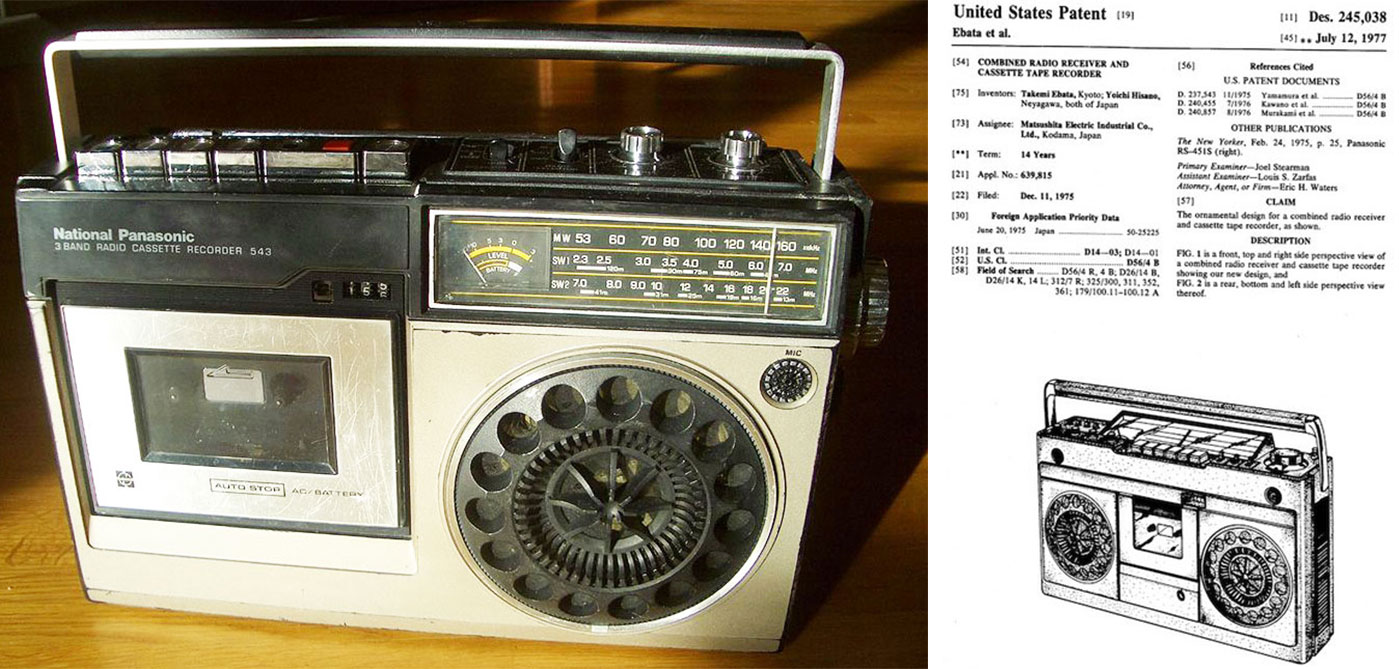
Matsushita was this Japanese company that owned a bunch of different brands, like Technics, JVC, Quasar, Panasonic, and Sanyo. Over a 16-year period, Matsushita sold 4.2 million of one model boombox, the National Panasonic RQ-543. That’s a little over 700 boomboxes a day for 16 years. And that blew my mind; I had no idea they were made in such numbers.

Collectors Weekly: Why was that model so popular?

Lightwood: I don’t really know. Through my research, I realized that several of these Japanese manufacturers have museums devoted to the company founders and their popular products, which include all types of electronics and home appliances. Some guy went to the Matsushita museum and filmed a walkthrough that I found on YouTube, just panning over all the different products in there. And I thought, “Wow, there’s a boombox over there!” It was a gold boombox developed for the Middle Eastern market.

The National Panasonic RQ-543 made by Matsushita sold over 4.2 million models, primarily in the Middle East. Photo via shizaudio.ru.

If I spoke Japanese, I could write to the museum and get a little more background on it. I contacted one individual in the boombox collecting community who lives in the Middle East, in the U.A.E., and asked him if he’s ever seen this gold box. I don’t know if they were all gold, or if this is a commemorative one for the 4.2 million they sold.

This member in the U.A.E. said that most of those boomboxes aren’t even in the country anymore, because the people that would’ve bought them were mostly foreign laborers that were brought in to build or maintain the country’s infrastructure. Once their time was up, they would leave and take their equipment with them, so the boomboxes would end up wherever the laborers came from.

Collectors Weekly: Do you have a favorite boombox?

Lightwood: In no particular order: Victor RC-550, Tisonic PR-7000, Victor RC-M90, Amsen FK-887, Sanyo MR-X920, Sharp GF-999, Lasonic TRC-931, Victor RC-M70. I have them all, and that’s like a parent choosing a favorite child. Each has its own look and sonic personality.

The JVC PC-100 included a detachable cassette player, which began the shift to private audio devices like Walkmans.


Wednesday, December 21, 2011

Mac Miller: Indie Music's Savior? From Forbes.com

How does an indie artist turn into the number one selling album? The only other time this has happened was with the debut of Snoop Dogg on Death Row Records back in the early nineties. This is the power of social media and the death of the major labels and their bad bank loans to bands. Forget the 360 deals and corporate big wigs who have never toured in a cargo van, think on hard work and success that is earned and not given away. Forget shows such as X Factor, American Idol or the Voice. That system works for "pop stars", as I can equate them to a can of soda. On that initial burst from the can opening or bottle cap dropping away it tastes good, but goes flat more a few sips in. All that processed sugar and more chemicals with huge names meant to instill flavor do nothing but leave a sour taste in your mouth, same as most contestants on those shows.

We understand why that system exists and can applaud its purpose in a business discussion, but here is what it lacks, soul. Yep, something as simple as real soul. Having character, depth and a true value in relating to other folks while weaving stories to get them enthused and buying your music. Mac Miller has done this in spades as he went out and won over the masses the old fashioned way. Mac brought the message to them and believed in himself. We are not huge fans of rap by any means, but we can appreciate hard work and dedication to your craft. Hopefully Mac won't get corrupted by hip-hop's reliance on self indulgence and can keep his eye on the real prize, a long career in the music business.

Mac Miller from RagerLife.com


At first glance, Mac Miller would appear unlikely to have a secret interest in art conservation. The 19-year-old rapper slouches into the Forbes Galleries sporting a pair of camouflage pants, a backwards baseball cap and what seems to be a week’s worth of facial hair. Upon noticing the Salvador Dali painting on the wall by the door, though, he suddenly snaps into curator mode.


“This is an original Salvador Dali painting? Who uses this room? Wait, so they just have a Salvador Dali painting here, and no one is ever in here?” He pulls out his iPhone to snap a picture. “If I had a Salvador Dali painting, I would cuddle it to sleep.”


Almost as unexpected as Miller’s interest in fine art is his rapid rise—and accompanying role as a possible savior of independent music. In November, the Pittsburgh-born rhymester released his debut album Blue Slide Park through indie label Rostrum Records; it sold 144,000 copies in its opening week and became the first indie album to top the charts since 1995. The success earned him a spot in the music section of FORBES’ first-ever 30 Under 30 list.

Miller went from mixtape maven to national sensation without the help of a major record label or a big radio hit. Instead, he’s relied largely on social media to build his following, releasing a new song for every 100,000 Twitter followers (he now has 1.4 million). His quirky, low-budget YouTube videos have clocked over 200 million views. One, titled “Donald Trump,” even elicited a video response from the billionaire real estate developer himself. His secret: opening the spigot.


“I flood the internet with what I feel is quality content,” says Miller, settled into a cushy red chair opposite the Dali. “I’m just looking for creative ways to get all that content out there. And just being reachable. Not necessarily sitting there and responding every tweet or every fan, but being a symbol of someone who doesn’t think that [he’s] anymore more special than anyone else.”


Adds Rostrum Records founder Benjy Grinberg: “He’s relentless … If he’s not doing a show, he’s in the studio writing music. If he’s not in the studio, it’s because he’s doing an interview or coming up with merch ideas.”


The buzz is there, and the money is starting to roll in. Miller played over 200 shows in 2011, grossing an average of $40,000 per night. He expects to play almost as many shows in 2012, and his nightly rate is now approaching $150,000. Miller also rakes in tens of thousands per night in merchandise sales, thanks largely to the wealthy suburban high school and college students who are the primary consumers of his music.

And unlike Pittsburgh pal Wiz Khalifa, who signed a multiple rights deal with Atlantic Records that calls for him to hand over a slice of all revenues to the company, Miller is still fully independent. He doesn’t enjoy some of the perks that often come with a major label deal—like the ability to tap into a broader publicity network and get favored status from radio stations—but he’s already connected, directly through Twitter, to his massive fan base.

“With Mac, we’ve proven that we—and other independent artists—can sell records by ourselves,” says Grinberg. “It just depends on how far we want to take it alone. We haven’t seen the ceiling yet.

Miller’s rise is all the more amazing when one puts his age into context. Born in 1992, he hadn’t yet started first grade when Tupac Shakur and The Notorious B.I.G. were gunned down. At age six, he taught himself piano, drums and guitar (Miller hasn’t given up the latter, regularly reeling off rock hits like Weezer’s “Say It Ain’t So” between rap songs; at a recent New York show, he flipped the guitar onto his back and played an impressive solo).


He started putting out mixtapes as a teenager, first as part of a group called Ill Spoken, then by himself. He released The Jukebox and The High Life in 2009, earning him a modicum of buzz on the Pittsburgh rap scene and throughout the internet. Miller soon caught Grinberg’s ear and signed with Rostrum the following year; his big break followed with the debut of the mixtape K.I.D.S. (Kickin Incredibly Dope Shit).
“I had been putting out mixtapes before that, and I had generated a little fan base, but K.I.D.S. was when I felt I did something that people really decided to take notice of who I was,” says Miller. “I feel like that gave me a platform to build and reach a bigger fan base for people to care.”


Miller built off that success with Blue Slide Park, an album that chronicles and almost glorifies suburban ennui. This is not the youthful rebellion music of the Baby Boomers; rather, Miller describes a world of endless adolescent possibility–albeit mostly concerning controlled substances and consenting females–a sort of figurative playground echoing the real one mentioned in the title.


And that’s precisely what makes Miller’s music so appealing to many middle class high school and college aged students. They grew up on hip-hop, but the music’s content didn’t always mirror their experience. In Miller, however, there’s a bit more with which to identify.


“The reason Miller’s mass of fans follow him is not because of his music, at least not completely,” wrote Pitchfork’s Jordan Sargent. “It’s because he looks just like them, because they can see themselves up on the stage behind him, if not next to him.”


Detractors dismiss Miller’s work as “frat rap,” pointing out that Miller’s subject matter rarely ventures beyond telling tales of teenage debauchery. The young rapper, they contend, spends too much time chronicling his herbal indulgences. Miller’s defense, as explained to audiences at his shows, is that he’s simply being honest: “I just so happen to smoke a lot of weed!”


That same what-you-see-is-what-you-get attitude pervades Miller’s videos, which he makes with the help of pal and director Ian Wolfson. Far from glitz and glamor of a traditional hip-hop video, his tend to find glory in the mundane–take the video for “Frick Park Market,” which starts out in the aforementioned deli with Miller placing an order for a turkey sandwich.


“I always thought I’d look corny in the type of rap video in the club with girls and all that type of stuff,” says Miller. “I just didn’t think I could really pull that off. We always think it’s more fun and better just to go outside the box and to use our videos to show cool concepts.”


It seems unlikely that he’d be given the same creative freedom if he signed with a major (think of the feathers that might have been ruffled on a record company’s legal team by the idea of releasing a song called “Donald Trump”). There’s no reason Miller can’t keep making videos on his own—many of his earlier cuts cost less than $1,000 to put together.


Even  the newer ones are cheap. “Party on 5th Ave,” a generalized celebration that involves motorized scooters and wigs, clocked in below $10,000, about one-tenth the cost of a typical big-budget video. It’s unclear whether a major would be able to give him a platform bigger than the one he’s already created for himself using little more than a computer, a video camera and his brain.


For his part, Miller says he’s not philosophically opposed to the idea of being involved with a major record label, and realizes that there are advantages.


“We’ve done something that’s historical independently,” says Miller, who’s already been contacted by multiple major labels. “If I reach a point where there’s things I can’t do—we haven’t reached that point yet—but if I ever reach a point where there’s something I can’t do and I need some help from a major, who knows.”


It doesn’t seem Miller will need that kind of help anytime soon, though. He’s already a teenage millionaire, and given his ambitious touring plans, he could earn $10 million in 2012.
A few more years like that, and Miller shouldn’t have any trouble affording a Salvador Dali painting of his very own.


Monday, March 21, 2011

Flat Tires Influencing Hip Hop, What?

The fellas in Flat Tires are blazing trails and burning down the stages on all sorts of juke joints to get their name carved into the minds of those who need converting. Funny enough, it seems like the name "Flat Tires" has seeped over into the hip hop realm. Found this little nugget of underground hip hop with an emcee aptly titled "Michelin" that is using the name "Flat Tires". Thankfully its quite awful, but damn, next thing ya know they might be covering Freeborn as well. Maybe the Michelin Man giving the finger could be a new shirt design?

See it to believe it - Michelin Flat Tires