Showing posts with label Racing. Show all posts

Sunday, November 6, 2016

Research and Racing On The Bonneville Salt Flats


The Bonneville Salt Flats are one of Utah’s most iconic landscapes, covering more than 30,000 acres of BLM-managed land in the Salt Lake Field Office. Since 1914, this majestic landscape has served as the racing grounds for generations of land speed racers from around the world. For decades, these passionate racers have tested themselves, each other, and their vehicles in an ever-escalating contest to go faster than ever before.

The area gets its name from the prehistoric Lake Bonneville that extended over 19,000 square miles and reached depths of over 1,000 feet. The salt flats are a remnant of this ancient lake – where evaporation left large concentrations of dissolved minerals in the surrounding soils. In the winter, groundwater and regional storms flood the Salt Flats – creating a salty, shallow lake. When temperatures rise in the summer months, the water evaporates, leaving behind the iconic white salt crust – sought after by landspeed racers for the hard and flat surface it forms. The salt is also influenced by changes in weather patterns. For example, mid-summer rains in 2014 and 2015 flooded the salt and forced cancellations of the late-summer land speed racing events.

Beyond these seasonal changes, there are additional and complex dynamics that drive this geological system, of which we have only scratched the surface on scientific understanding. Adding to the challenge is the complexity raised by a changing climate in the Great Basin. To help unravel the system, the BLM has partnered with Dr. Brenda Bowen at the University of Utah on a long-term scientific study.

BLMers, scientists, and landspeed racers are all “gunning” to preserve the Bonneville Salt Flats. These scientific studies will help the BLM in making challenging management decisions and will undoubtedly uncover further questions regarding the dynamics of this unusual geologic system.

Wednesday, August 31, 2016

Formula 1 Pit Stops From 1950 and Today

Monday, October 19, 2015

The Most Insane Baja Race That You Have Never Heard Of


You've heard of the Baja 1000, but there's an even crazier race called the Mexico 1000 that's as much a giant part as it is a race. Lifted trucks, buggies, and old American muscle cars race down the peninsula.

Follow this and more on Jalopnik

Thursday, July 30, 2015

Chris Rivas And The World's Fastest Bagger

Chris Rivas And The World's Fastest Bagger

Chris Rivas tells his story beginning in the 80's drag racing with his father with a rear engine dragster. He then progressed into motorcycle drag racing and then the quest to become the world's fast bagger inland speed racing. Along the way Chris's daughter Cayla starts land speed racing at the age of 12 and getting records on her first 2 outing to Bonneville Salt flats and in 2014 she sets a new world record for a Buell Blast 500cc.

Wednesday, March 18, 2015

1972 Ducati Laverda SFC 750 Mk1 Race Ready Motorcycle

1972 Ducati Laverda SFC 750 Mk1 Race Ready Motorcycle, right profile
Motorcycle racing is at the heart of all two wheeled culture. It doesn't matter when you hop on your trusty steed, but with the pull of the throttle, speed addiction sets in faster than the comfort zone when hitting your favorite easy chair. Seeing a bike like this up for sale, makes the internal fire for racing climb the charts and want to pull the trigger on obtaining such a perfect period piece of motorcycle racing history. Old Ducati's have a true collectible factor and this one exudes the notion.

Monday, December 1, 2014

Building A Gravity Race Cart From Scrap Parts - Time Lapse

Building A Gravity Race Cart From Scrap Parts - Time Lapse

A challenge is something we personally enjoy, so we decided to build a gravity racing cart from two scrap bicycles and one old go cart. It all started when a co-worked at an old job asked all of us to be part of a community event and we had to build a gravity racing cart to be a part of it. Needless to say, my mind started to run rampant with ideas and also how to do it on little or no budget.

As I researched about what the hell gravity racing actually was, I really started to immerse myself into the ideas and focus on a plan of attack. We needed it to be relatively easy to build and also low to the ground using bicycle tires and rims as they would give us our speed and be readily available.

Finding a decent used go cart frame wasn't too hard either with the help of craigslist so then it was time for the fabrication to start. After buying some steel for the axle fabrication and employing my scrap parts pile, along with the salvaged bikes, things progressed quickly and this here race cart is ready for action. The amazing aspect is that it one every single battle on race day and I can be fully satisfied in knowing that another scrap parts puzzle is completed. Long live DIY folks everywhere!

Watch our time lapse video below


Mopar Rob thinking on front end mock up

Getting the steering knuckles in place

Basic shape of the cart is in place for rear axle setup

Hard to believe that the old bike parts worked so well

Salvaged and scrap parts Cart ready for paint

The final look of the gravity racing cart

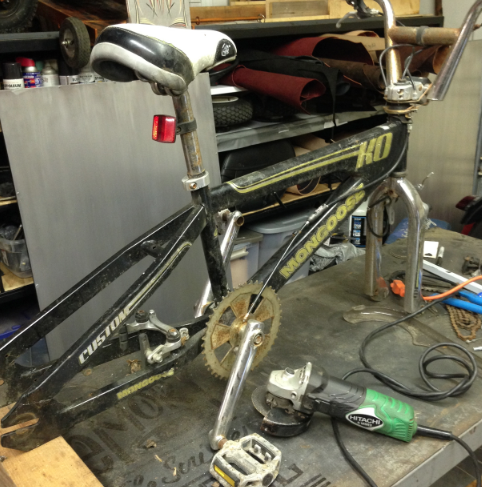
Old BMX bike about to go under the knife for surgery and amputation

Monday, September 29, 2014

Racing Through The Streets Of Mexico With All Eyes Watching BJ Baldwin

Monster Energy knows how to direct a video
Dan Bilzerian may be the current most interesting man of mystery, but the real star of this video is the driver BJ Baldwin. They are working to take a page out of Ken Block's Gymkhana videos but this is done with a rally truck and in Mexico. This feels like a video game commercial about to come on at any given second

"What better place than the city streets of Ensenada Mexico, the home of the Baja 1000, to set the stage for the sequel to Ballistic BJ Baldwin's viral hit Recoil. This short film by Monster Energy follows BJ and his 800hp Trophy Truck as he tears through this seaside Mexican city, ripping over every drop and jump the town has to offer in an attempt to win a bet set by his friend, and international playboy Dan Bilzerian. Will he win? What will he lose?"

Sunday, August 24, 2014

Turn Your Old Go Kart Frame Into A Gravity Racer

Custom built go kart frame for some gravity racing

Bringing new life to old parts that were never intended to go together, is a favorite past time of ours. Check out the gravity racing cart at about 95% done. A few tweaks here and there and need two quick support brackets and this project is a wrap. Cheers to the backyard builders world wide. Now its time for some downhill racing to begin.

Thursday, May 22, 2014

Blowing An Engine And Having A Team To Rebuild

Blown engine and friends line up to help out

This photo could have been taken from another era, but this is the type of vibe that we had at Steel In Motion, this past weekend. Group of friends gathered around an engine to help out when needed is true solidarity. This is how we operate as a music label and custom manufacturer, along with our friends for any mishap that life throws our way. Mopar Rob was quite bummed to blow his tricked out motor, but in the bigger picture, we are all here to help him rebuild.

Sunday, April 6, 2014

Want To Cut Your Grass Faster?


Photo: Honda
Worlds fastest lawn mower and one hell of a cool build


Many a time on the back stretches of my lawn I postulate on ways to cut it faster or how many cans of beer I can drink while mowing. Yes, these are time tested problems and ones in which this shorebilly tinkerer thinks of what else can be created with a lawn mower. Did you see our lawn mower pirate ship?

Knowing that there are other gear heads out there who aspire to greatness with what might be simple tools is a great feeling. My grease soaked hat sends a cheers out to these Brits that just conquered a Guiness Book World Record with a lawnmower that hit 116+ mph. Bravo!!!!


For some, there’s nothing better than spending a lazy Sunday cutting the grass on a riding mower. For others, ripping around a racetrack is the perfect way to unwind on the weekend. Honda thought they could combine the two, and the result is a 109-horsepower beast that just set the world speed record for lawnmowers. Yes, that’s a thing.

Honda’s U.K. division joined up with its British Touring Car Championship partner Team Dynamics and tore apart a Honda HF2620 Lawn Tractor before revamping the whole thing with a custom-fab chassis and a 1000cc engine from a Honda VTR Firestorm motorcycle. For good measure, the team took the suspension and wheels from an ATV to cope with the extra grunt.

Of course, this is a lawn mower we’re talking about. Guinness, sticklers that they are, required that the Mean Mower be able to actually cut grass. So Team Dynamics created a custom cutter deck out of fiberglass and installed a fuel tank, high-capacity oil cooler, and secondary water cooler for the radiator in the mower’s grass bag to preserve as much of the look of the original tractor as possible.

There’s a six-speed paddle shift tranny, along with a custom racing seat and exhaust, and since they couldn’t find the right size steering rack for something this small, they pilfered one from a Morris Minor. All that adds up to a mower geared for a top speed in excess of 130 mph with the 109 hp 1000cc engine propelling its 308 pounds from 0-60 in just 4 seconds.

Photo: Honda
Damn you Honda for beating me at something I have always dreamed of, worlds fastest lawn mower


Two electric motors were installed on the cutter deck, with 3mm steel cable spinning at 4000 rpm making to keep the judges happy. It can actually cut grass at up to 15 mph, more than double the speed of the machine on which it was based.

The world record was set at the IDIADA Proving Ground, in Tarragona, Spain on a 2km stretch of tarmac. Top Gear writer Piers Ward was behind the wheel, averaging 116.57 mph over two runs in opposite directions through a 100 meter speed trap, crushing the previous lawn mower speed record of 87.83 mph.

Ward wrote that the mower was stable, with “no wobbles, no drama.” Sounds safe enough, even if it doesn’t have a seat belt.


Wednesday, January 22, 2014

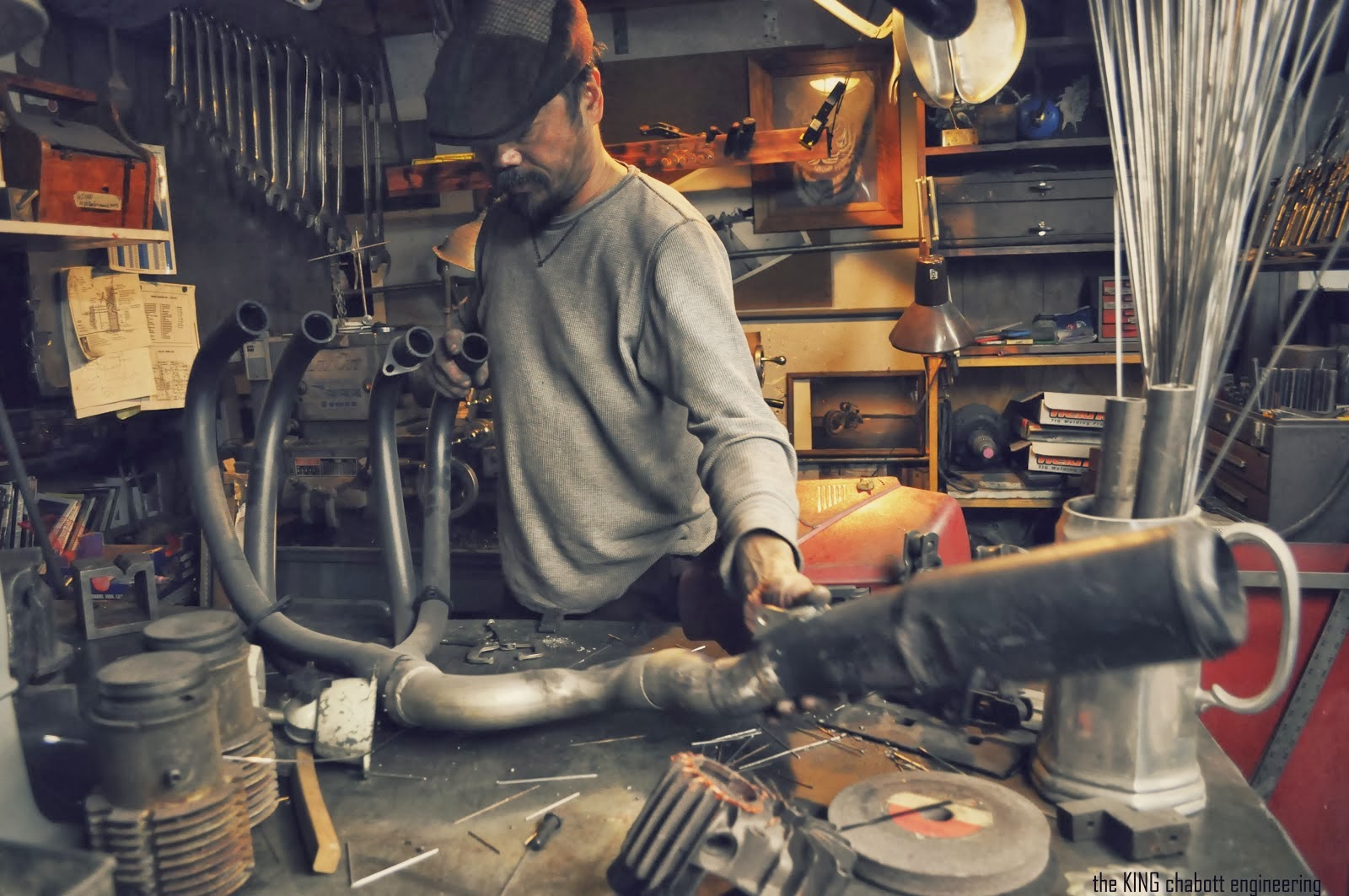
A Look Into The Shop Of Custom Builder Shinya Kimura

A look into the shop of custom builder Shinya Kimura

"What we are today comes from our thoughts of yesterday, and our present thoughts build our life of tomorrow: Our life is the creation of our mind.”


 - Hindu Prince Gautama Siddharta, the founder of Buddhism, 563-483 B.C.


Follow Shinya Kimura 


Machinery to create most anything is at his fingertips

A Bridgeport mill is a must have for a true custom shop

Thinking through all the lines and angles

Working on the 4 into 1 exhaust

A Honda CB 750 never looked so good


Monday, July 29, 2013

Experiments In Speed and Pushing The Limits

"Experiments in speed. Inspired by those great men of the salt flats, those men that in the 60s pushed the Land Speed Record from the 300s up towards the 600mph mark in jet-propelled cars built in their sheds. We decided to do what we do: build a bicycle, but this time, in the spirit of those pioneers of speed, build it to see how fast we could go…"

donhoubicycles.com
spindleproductions.co.uk

Director | Greg Hackett
Editor | Tim Swaby
Production Company | Spindle Productions
Sound Recordist | Adam Williams
Camera Assistant | Greg Harris
Production Assistant | Dickon Ireland
Aerial Cameras | Ben Kenobe Ben Sturgess Chris Ridley
Photographer | Tristan Conor Holden
Composer | Daniel J. Harvey


Experiments in Speed from SpindleProductions on Vimeo.

Wednesday, July 10, 2013

Indian Motorcycle: The Spirit of Munro

A look behind-the-scenes of the filming of the short film The Spirit of Munro. On May 5th, 2013, on a dry lake bed in California, Indian Motorcycle ran the Spirit of Munro, an all-metal tribute bike built to honor the great Burt Munro, and power the future of Indian Motorcycle.

ABOUT THE SPIRIT OF MUNRO: Fully custom-built, the Spirit of Munro is an all-metal tribute to the racers and mechanics throughout history who have collectively built the legacy of record-breaking racing performance and strength that is Indian Motorcycle.

The motorcycle is named in honor of Burt Munro's "Munro Special," the historic 1920 Indian Scout that broke the under-1000cc land-speed record in 1967 at the Bonneville Salt Flats as famously portrayed in the motion picture "The World's Fastest Indian."

The Spirit of Munro was constructed by Jeb Scolman of Jeb's Metal and Speed in Long Beach, CA. It was designed from the ground up to house the new Thunder Stroke 111™ engine and showcase its awe-inspiring power and performance.

IndianMotorcycle.com


Tuesday, June 11, 2013

Out of Nothing - Official Teaser Trailer

Sunday, February 17, 2013

Vintage Drag Racing Cars Never Get Old

Drag racing is one of those sports that you are either into or your not. There is no such thing as toeing the water to test it out. Going to the drags can be an interesting slice of life as it could be a run what ya brung type of night or it could be a specialty event. We dig hitting up both styles of events due to the nature of the fans involved. 

If you live in eastern North Carolina the Dunn-Benson Thursday night drags will bring out more gambling and shit talkin' than most sports bars. If ya hit up Rockingham, NC you can witness top fuel, local hero's and numerous touring sponsored teams with tricked out machines and huge advertising dollars. 

There is a great variety of events on hand all over the country. Go out and check some of these races to see what is happening in your area. Maybe a few of the vintage rides will show up and do some runs.


Friday, September 21, 2012

On the Salt - Bonneville Speed Week 2012, From Sympatico.ca


We found this great piece shot by Canadian film makers about Bonneville Speed Week. Its well done and captures some great folks and their stories. Cannot wait to get on the salt for the first time.

Link to Sympatico Autos

"Over seven days, 168 world land speeds records will be set here by amateurs in more than 500 hotrods, streamliners and motorcycles. But you’ll likely never hear about these record-setters. The outright land speed record is 1,228 km/h or Mach 1.02. RAF Wing Commander (ie: hot-shot fighter pilot) Andy Green broke through the sound barrier on the way to setting the record in a vehicle named ThrustSSC.

It was powered by a pair of afterburning Rolls-Royce turbojet engines, together producing as much thrust as 145 Formula One racecars. It does 0-1,000 km/h in an estimated 16 seconds. (That’s not a typo.) So you can see why these amateurs at Bonneville, however brave and skilled, will never make headline news. No, these land speed racers risk their lives for something else, although what that is, is hard to say.

“It took three years to build [the Studebaker] and we've been racing it for four years,” says Moreau. “This year is the best year, we went twice 200 mph and the third run we run 205 and we hope to make this run 210.” All land speed racers, even those from Quebec, talk in miles-per-hour, not kilometres.

“The first year we had an issue with learning the altitude of this place to make the motor work. The second year we had issue with high-speed unstable. And the third year we get better aerodynamic on the car. This year everything seems to work well,” says Moreau.

By “high-speed unstable” he means the car would dance from side to side across the salt, fishtailing at 100-plus mph (160 kph). “You have to concentrate to keep the car straight and just let your mind go with it, and everything will go well. Because it’s not on concrete, this is salt. And the car will do weird things sometimes when you shift gears… you never know what this thing will do to you.”

Soon after, Moreau lets the Hemi roar and disappears over the horizon, off on another run. On their last day on the salt, he set a new personal record: 210 mph. Perron sent us an e-mail with pictures of Moreau's Class A license. He's now a member of the 200 MPH Club.

At least 10 people have died at Bonneville chasing speed records. And for what? For a little receipt with numbers on it? To join the ranks of the “200 MPH Club” or 300, or 400. (There are only 14 members in the 400 MPH Club.)

No, for many it’s like climbing Everest—doing something to see if you can, to see what it’s like, to go where very few have gone before. For others, it’s the mechanical challenge of building a machine. Going fast is as much as a test of bravery as it is of engineering ability. There’s real creativity there."

Sunday, August 12, 2012

Bonneville Speed Week 2012, First Glance

Another year and another missed opportunity to make it out to the Bonneville Salt Flats for Speed Week. As the music label continues to grow at a rapid pace it is becoming more difficult to get to some of our other projects for which we have been planning for quite some time. Have a look at some of the photos we found over on Flickr from Rudy Van Bree. Can't wait to see more and hear about some of the racing.


Friday, May 18, 2012

Jeff Decker's Vincent Black Lightning

Certain bikes will always scream while standing still. It could be the stance or it could just be the power plant that begs to be revved up. Over the years we have grown to dig much more in depth into the lure of all that is Vincent Motorcycles. We are tip toeing around the edge as we know the water is warm, but we can't go quite full bore into them just yet as our pockets don't allow for that type of freedom. In the interim, enjoy a superb article posted on Cycle World with Jeff Decker and another one on BikeExif about this amazing Vincent Black Lightning.


"If you’ve been to the Harley-Davidson Museum in Milwaukee, you’ve already seen Jeff Decker’s work. His 16-foot, 5000-pound bronze Dynamic Hill Climber—a soaring sculpture depicting a 1930 H-D DAH-mounted hill-climber at the apogee of his ascent—occupies the place of honor on the museum grounds. Whether or not you’re a motorcycle person or an art person, it’s an awesome piece of work. If you are a motorcycle person, the level of detail and accuracy is amazing. If you’re a sculptor, you might appreciate that the final piece is, in fact, 200 castings welded together. After sculpting something that complex, piecing together a custom, even a Vincent custom, is Romper Room work. We sat down with Decker to find out how it all came together.

Jeff Decker's Vincent Black Lighting, from BikeExif
How does a guy who grew up in the Southern California suburbia of Thousand Oaks get to be a sculptor in bronze, anyway?

My dad was always building race cars, and we always had a shop that was bigger than our house. I was surrounded by a father and uncles who always worked with their hands: chassis, body, motor and machine work. It was really blue collar, but I was in a neighborhood where everybody was a doctor or lawyer. And I didn’t really appreciate how privileged I was. I drove a 356 Porsche to school that my dad and I restored, and people thought, “Oh, gee, poor Jeff can’t afford a new car.” I tried to explain how my car was better than their new BMW, but that’s how it was: The Deckers drove old clunkers. To this day, we’ve never owned a new car.

When I came to Brigham Young [University], they had a pretty weak art program. I studied art history and Spanish, and I found art pretty boring. Art programs today, whether prestigious art school or appendage of a university, they don’t really dig representational art. They see Norman Rockwell as an illustrator, not an artist. When I expressed interest in, you know—“I want to capture man’s quest for speed! I wanna synergize organic with mechanical!”—my teachers were like, it’s silly, you’re not expressing yourself. Well, for them, it’s silly. For me, it’s honest and sincere. I couldn’t throw up some silly abstract thing in front of a building in New York. That wouldn’t be me. You might not think I’m the greatest sculptor in the world, but what I do really does come from the heart, from the soul; it’s what I eat, breathe and live. 

Jeff Decker's Vincent Black Lighting, from BikeExif
When you think about it, guys on motorcycles are the most natural progression in the world from sculptures of guys on horses, which has been an art staple from Roman times, right? Or before then…

Absolutely. That is the quintessential theme of what I do, and it’s the paradigm shift it represents. When Frederic Remington did all these cowboys and Indians, he was glamorizing a chunk of American history with about only 20 years relevance. I mean, Roy Rogers was “realler” than Wyatt Earp. When the Transcontinental Railroad came through, that hybrid of the European cow and the Texas Longhorn, they just loaded them on the train. The cowboy became obsolete. Americans lost their identity but continued to want something “American” instead of the old world so many of them came from. So we fabricated the cowboy, and Remington helped do that.
Jeff Decker's Vincent Black Lighting, from Cycle World
What I think is more real is the synergy between America and the Industrial Revolution, that paradigm shift. For 4000 years, there was the man on the horse. That animal was transportation, wealth, power, food—suddenly it’s completely a pet, glue, the Kentucky Derby and women in silly hats. And the motorcycle replaced it. The motorcycle literally replaced the horse in the American psyche. We call it an iron horse, we use the same clichés about the wind in your face, the freedom—and it’s even realer, because a horse can eat and sleep and sh_t on its own. It doesn’t need man. The motorcycle is a useless piece of junk until you fill it with fuel, unless we tend to its needs.

How did your Vincent come about? 

Jeff Decker's Vincent Black Lighting rear view, from BikeExif
I did a sculpture in 1999 of Rollie Free laid out on his Vincent at Bonneville (“Flat Out at Bonneville”). When I began researching it, we were listening to an audio tape of Rollie, and he mentioned this mechanic named Mel Helde and Farmington, Utah—that’s an hour-and-a-half away from where I live. I looked in the phone book and there’s a Mel Helde, Jr., so I called this dude and asked him about Rollie Free, and he says, “Yeah, you’re talking about the scrapbook in the basement. I can’t really get to it today, can you come by tomorrow?”

So I get there, and this guy was a teenager out there on the salt, helping his pops wrench with Rollie. He turns this shoebox full of info over to me, and [Vincent aficionados/restorers/collectors] Herb Harris and Jay Leno and Mike Parti and Marty Dickerson and I all pooled our information to come up with a great body of work that helped Jerry Hatfield write his book [Flat Out! The Rollie Free Story]. Meanwhile, I’ve been collecting DNA, from patches that were on his jacket to original photos to bike insurance policies. Herb would pull stuff off his shelves and say, “This is the tire he set the speed record on.”

“I want it, Herb.”

“Well, Jeff, you can’t really run it. It’s not safe.”

“No, but I can take pictures of the bike with it on there.”

Then I’d say, “I want these motors,” and he’d say, “Well, these are Marty Dickerson’s cases. He was such a tightwad he’d never buy a Lightning bottom end because the factory would up charge you. He’d buy a standard Shadow bottom end and ‘Lightningize’ it with the big cams, use the two front heads.” So, in fact, my bike’s got more racing history than 90 percent of the Lightnings out there. 

Jeff Decker's Vincent Black Lighting, from Cycle World
What about purists who don’t believe Vincents should be customized?

I’d say, “Herb, I don’t want to be president of the Vincent Owners Club; give me a bastard—just give me the best DNA you can find.” So this bike really is a cobbled-together Frankenstein that I’m not ashamed of. Of course, these highbrow Brits look at it like, “Oh, how dare you,” and I’m like, “What? Mine starts up and rides, yours gathers dust in your living room.”

One of the things I don’t like about stock Vincents—I’m not a huge Vincent fan—is that I think once you strip about 100 pounds off of one, you find it was kind of like an overweight woman with a beautiful face: Once you take the red meat out of her diet, she transforms. When you take that horrible seat off, and those mudguards—when you throw away about 100 pounds of Vincent bulls__t—all of a sudden, that sexy broad comes out. And that’s what I wanted to do, strip it down to the bare necessities. If it did not need it absolutely, it went away.

Comparing your bike to a Lightning, it doesn’t really look like you changed all that much besides the seat.

Well, the Lightning, there are 31 of those left, we think, and they were sexy from Day One. But they were never street-legal; they were factory-prepped beauties. When I say strip one down, I mean a Rapide or Shadow, which had these big, clunky traveling packages, about three gauges more than they need, four levers on the handlebars, risers, all these kinds of things. The fact that you say mine doesn’t look that much different than a Lightning is a huge compliment, because that was my goal—to make a street-legal Lightning.

In fact, the greatest Black Lightning in existence is the Rollie Free bike [now owned by Herb Harris], and it’s a B Rapide; technically speaking, Lightnings were all C models, which came later. The factory did all the posters and photos and promo talking about Rollie Free’s Vincent Black Lightning [Free’s bike was the first to go 150 mph, at Bonneville in 1948.], and it’s a B, which is a contradiction.

My bike, if you do the numbers, it doesn’t fit into that “31” category. But when you show it to a guy who owns a Lightning, it bums him out. He says, “Wow, where’d you get those carbs?” or “Oh, you’ve got two front heads,” and “Jeez, are those real cams in there?” He goes through there and finds out most of this damn thing is Lightning.

So I registered it as a Black Lightning. Herb and I giggled about that. He says I should call it a Black Lightning all I want, since it’s a prepped racer—plus the Vincent motorcycle club’ll go nuts; they’ll sh_t! How dare you call it that?! So I call it a “Lightning” in a very sarcastic, politically incorrect way.

Of course, I still wanted to be respectful to the Lightning; I wanted it to look like one. But next to a Lightning, mine’s tinier and sexier, there’s even less on it. If you see it from the side, the profile of the tank is stock, but when you look down on it, it’s 4½ inches narrower. When you park it next to another Vincent, you say, “Wow, look how big and fat and dumpy that stock one is…” 

Jeff Decker's Vincent Black Lighting, from Cycle World
Give us a rundown of some build specifics.

Mine’s got the GP racing Amal carburetors and two front heads, so there’s no manifold. The hubs are specifically Lightning, with 21/20-inch rims, an impossibility to find and specifically Lightning. The brakes have heat sinks I fabricated from scratch. I exposed the springs under the seat and in front of the fork and built my own inner shock absorber because it bounced around too much. The tank’s actually 2½ inches narrower in front, 4½ inches in the rear: I took the widest measurement, at the cases, and wouldn’t go beyond that. The only things that stick out beyond the width of the motor are the pegs and handlebar. I put three-quarters of a front mudguard on the rear. And I kept all the quick-change elements: You can literally pull this thing apart—the front and rear end, the wheels—without tools. It’s all meant to be kicked apart; it’s all hand-break-downable.

You sit about 12 or 18 inches lower on mine than you would a stock Vincent—you’re down in it. I deliberately ran the exhaust pipes in front of the motor, protecting the magneto, then ran them into a heat-sink exhaust system that also acts as a skid plate, which kind of gives the illusion of it being a tighter bike. Then the gas tank is just sunk in and squeezed as tight as it’ll go—to really emphasize the bulk and the massiveness of the motor.

On the fringes of the bike, I just went as light as I humanly could. I wanted to exaggerate the freakness of, the massive nature of, the Vincent motor. The kickstand’s in a weird place, the seat’s off a Schwinn Sting-Ray, the rear fender struts are homemade. 

Rear tire, chain and sprocket detail on Jeff Decker's Vincent Black Lightning
The headlight on a Vincent weighs about four pounds and belongs on a Mack truck. I was digging through some stuff and found a beautiful little headlight from a 1970s Honda ATC; we cut a little dimple in it so it would fit tight down over the front spring, and the headlight’s actually smaller than the speedo. That speedometer is really ostentatious. I debated putting it on the bike—it sticks up like three inches. It’s really funny. That 150-mph gauge that came on Lightnings or Shadows was a very expensive upgrade, really a show-off piece. “Look! Our bikes go 150 mph, the record books show it!” It was really a bragging-rights piece. So I said, okay, I’ll play the Vincent game with the one big clunky item I probably would’ve skipped. In the end, it was just so vain, I had to go for it.

And going for it on his Vincent is no problem, Decker tells us. The old beast torques right up to 100 or so and bombs along nicely with a lot of throttle left to twist—just not with Rollie Free’s tires. Those are stashed safely away at Decker’s Springville, Utah, compound, along with a couple of Crockers, an original-paint 1914 Harley he did the Cannonball on (CW, March, 2011), another dozen or so collectible motorcycles and a warehouse or two full of whatever needs keeping, sculpting, driving or riding at the time. Leather helmets off to Jeff Decker. We don’t know anyone else who can cast a thing in bronze, blast down the road on rolling sculpture and thumb his nose at several sets of conventions simultaneously. Hard to argue with that kind of cool."