"Whoever appeals to the law against his fellow man is either a fool or a coward. Whoever cannot take care of himself without that law is both. For a wounded man shall say to his assailant, "If I Die, You are forgiven. If I Live, I will kill you." Such is the Rule of Honor."
These lyrics were written for Lamb Of God's song Omerta and how they ring true concerning Randy Blythe's plight for justice in the Czech Republic. Having met Randy a few times over drinks after shows, I can honestly say that he is a stand up dude and cannot imagine him intentionally trying to hurt or kill anyone.
The way he has held himself in public and his respect for another country's legal system should make us all proud. Not one ounce of shit talk, but straight ahead integrity. At a time when we are bombarded by false promises from our government and elected officials, here is one man standing up for his own freedom and good name, to make a living on his own terms.
Randy, hopefully the Czech Republic's legal system will see the truth and all charges will be dropped. Whether it be from your exceptional moral standing or that you would return to another country to face potential charges, the respect and honor towards the family whom has lost their son is what makes you have true character. If we could just instill this level of morality into the masses...
Greetings. This is D. Randall Blythe, checking in from my beloved hometown of Richmond, VA, United States of America. I was recently released on bail from Pankrác Prison in Prague, Czech Republic, after over a month of incarceration. Now that I am out for the moment, I would like to say a few things.
1. While in prison, I had minimal knowledge of how my case was viewed anywhere but the Czech Republic. I was told by my attorney that I had a lot support from peers in the music industry, my hometown, fans, and of course my family. I cannot express how emotional it made me upon my release to read about even a fraction of the voices that were raised on my behalf. From legends in my music community, to fans across the world, and even people who were previously unaware of my existence but sympathized with my plight- I am truly humbled. I cannot thank you enough for your thoughts and prayers. I would especially like to thank the people of Richmond, VA, for standing by me. In the 48 hours I have been home, many people I have never met before have stopped me on the street, waved and smiled as I passed by, or said hello in a restaurant. All have said "We are glad you are home, Randy". You all make me proud and grateful that I call Richmond home.
2. I would like state that I suffered no abuse, from either authorities or inmates, during my incarceration in Pankrác. I received no special treatment, and was in general population with everyone else- make no mistake, it was prison, not some celebrity rehab tv show. But I was treated fairly by the guards and kindly by my fellow inmates. People are dying of starvation all over the world. Men and women are losing their lives daily in the Middle East and other war torn regions. I had food, clothes, shelter, and no one was trying to kill me. I cannot complain over a short stay in prison while many people elsewhere fight to survive on a daily basis.
3. If it is deemed necessary for me to do so, I WILL return to Prague to stand trial. While I maintain my innocence 100%, and will do so steadfastly, I will NOT hide in the United States, safe from extradition and possible prosecution. As I write this, the family of a fan of my band suffers through the indescribably tragic loss of their child. They have to deal with constantly varying media reports about the circumstances surrounding his death. I am charged with maliciously causing severe bodily harm to this young man, resulting in his death. While I consider the charge leveled against me ludicrous and without qualification, my opinion makes no difference in this matter. The charge exists, and for the family of this young man, questions remain. The worst possible pain remains. It is fairly common knowledge amongst fans of my band that I once lost a child as well. I, unfortunately, am intimately familiar with what their pain is like. Therefore, I know all too well that in their time of grief, this family needs and deserves some real answers, not a media explosion followed by the accused killer of their son hiding like a coward thousands of miles away while they suffer. I am a man. I was raised to face my problems head on, not run from them like a petulant child. I hope that justice is done, and the family of Daniel N. will receive the closure they undoubtably need to facilitate healing. I feel VERY STRONGLY that as an adult, it would be both irresponsible and immoral for me not to return to Prague if I am summoned. This is not about bail money. This is about a young man who lost his life. I will act with honor, and I will fight to clear my good name in this matter. Thank you for reading this, and I wish you all peace.
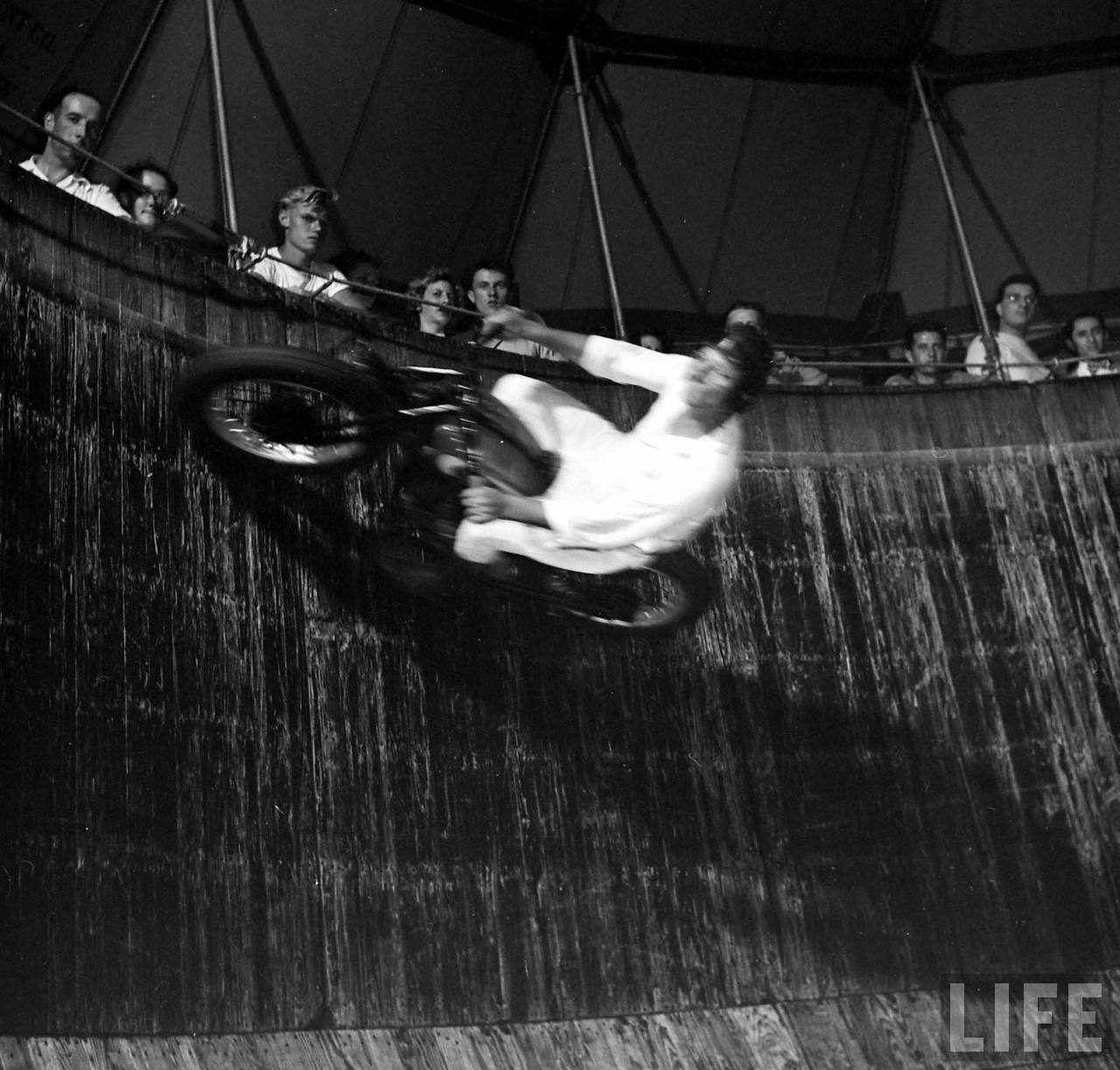
The Wall of death can mean several things. If you are in a pit at a metal show and Randy Blythe from a band such as Lamb of God starts dividing up the audience into two sides, pick your battle appropriately as Braveheart is about to begin. But for this here post and a solid history on the subject we are referring to the Wall of Death involving side show stunts and motor culture.
What is about the wall of death that is so interesting? Watching motorized vehicles go round and round is nothing new, but what we dig about it is the pure aspect of man conquering science with centrifugal forces and with some style. Indian Motorcycles were the primary steed for these and continue to be so in quite a few of the traveling shows. The short film below by Benedict Campbell is an amazing insight into a tight knit family that performs in England. Get out to see them if ya can and support more side show acts. This culture continues to shrink and will become harder and harder to see, get out there while you can.
The Wall of Death: A History of the Motordrome and Silodrome
Viewed from the outside, a wall is a defense.
Viewed from the inside, a wall is a trap.
The carnies start even before dawn. Everything is unpacked and each piece is carefully locked together. The grandstands are bolted up.
By noon it starts to fill; civilians munching cotton candy and popcorn, peering down into this strange barrel. A single motorcycle stands ready at the base of a shallow ramp. A rider appears.
The show is about to begin, and for those in the crowd who never quite grasped the laws of physics- farmers, shopkeepers and herders- something incredible will unfold.
Vélodrome d’Hiver
The Wall of Death originated from board track racing, which itself originated from the French bicycle velodromes. Originally the velodromes were built around existing athletic tracks and featured two shallow banked 180 degree turns connected by two straights, but during their heyday in the late 19th and early 20th century these tracks moved indoors and the shorter spans necessitated steeper banking. The new indoor tracks were constructed from wooden planks fitted end to end: this type of construction was not only relatively inexpensive but the boards were easy to shape and replace and provided a smooth track surface.
Hemingway wrote:
“I have started many stories about bicycle racing but have never written
one that is as good as the races are both on the indoor and outdoor
tracks and on the road. But I will get to the Vélodrome d’Hiver with the
smoky light of the afternoon and the high-banked wooden track and the
whirring sound the tyres made on the wood as the riders passed, the
effort and the tactics as the riders climbed and plunged, each one a
part of his machine… I must write the strange world of six-day races and
the marvels of the road-racing in the mountains. French is the only
language it has ever been written in properly and the terms are all
French and that is what makes it hard to write.”
The Motordromes
Los Angeles Coliseum Motordome, first trials 1910
In 1910 the first board track designed for motor racing opened as the Los Angeles Coliseum Motordome near Playa del Rey, California. The track was built from 2x4 boards set end to end and was banked at 25°, but by the end of 1911 board track speeds had noticeably spiraled upward due to refinements in engine technology and track design and banking on the motordromes was repeatedly increased until 60 degrees became the norm. Higher banking produced higher speeds, and it wasn't long before G forces began to take a toll on the drivers.
With spectators
looking down onto the track from bleachers at the top of the boards, any
loss of control in the turns could quickly turn disastrous:
centrifugal force would easily send both the rider and his machine over
the top of the track and slamming into the crowd.
On September 8,
1912, Eddie Hasha lost control of his Indian while doing 92 mph. at the
New Jersey Motordrome near Atlantic City. The bike rode the rail for
some 100 feet, decapitating a young boy who had put his head over the
rail to watch the race; it then struck a post, throwing Hasha into the
grandstands and killing him instantly along with four other bystanders.
The Indian fell back on the track killing another rider, Johnny
Albright. Several people had broken bones and flesh wounds as they
trampled each other to get out of the carnage. A front page story in the
New York Times dubbed the races "murderdromes".
Death on the Boards: Robert Williams
Nonetheless, around a half dozen tracks up to two miles long had opened by 1915, and by 1931 there were 24 operating board tracks in the USA. Although the tracks were usually used for motorcycle racing, auto racing was quickly added to the venue: by the 1920s most of the American National Championship races were held on board tracks. But by the early 1930s board track racing had fallen out of favor due to both its perceived dangers and the high
cost of maintaining the wooden surfaces for machine racing, which created considerably more stress than the French bicycles. Another factor was that as speeds rose due to more powerful engines, overtaking on the steep tracks became increasingly suicidal; as long as it held together, the first machine to take the lead would almost
always win the race. Fans soon turned their attention to
the less predictable races taking place on dirt and flat tracks. Although board track racing continued into 1940 at the Coney Island Motordrome and a few other places, by the beginning of WW2 it had basically faded into history.
Springfield, MO (?) Motordrome
Luna Park, Cleveland OH
But the motordrome had spawned a bastard offshoot; the silodrome, better known as The Wall of Death.
By 1915 traveling carnivals were an annual staple throughout America,
and the rising popularity of the motordrome wasn't lost on the
operators of these ventures. History is vague on the originator of the
first silodrome but the dimensions are said to be derived from the
standard diameter of a grain silo from that time, about 20 - 36 feet. The traditional silodrome was a single track, but later versions known as combination dromes used two tracks on top of each other; a shorter, steeply angled lower wall with a taller vertical top segment. Combination dromes were more portable and better suited for traveling shows.
The Wall of Death completely did away with the straights and was simply a
vertical sided wooden drum or barrel shaped track with an initial
ramped section at the bottom to give the rider enough velocity to drive
horizontally to
the floor: rather than racing the riders performed stunts and often
incorporated other acts into the show. Women riders were highly popular,
as were lions.
Yes, lions.
As in "Liondrome".
The Liondromes
"Fearless Egbert" was a British showman at the height of the motordrome era, and one of the earliest to ride the Wall of Death in the British traveling carnival "Collins Famous Death Riders & Racing Lion" run by Billy Butlin and Pat Collins in the 1920's and 30's. Not satisfied with riding a motorcycle horizontally at high speeds in a flimsy portable wooden barrel, Egbert used a custom built car which he rode along with his pet African lion, Monarch.
According to a news article from the Yorkshire Evening Post on
September 24, 1931:
"A ledge was fixed
to the side of the car, and there was never any need to coax him to sit
on it. He hopped aboard as soon as he was released from his cage, and
snarled and growled if the driver had any difficulty in starting.
"Nowadays,
Monarch is driven round the miniature track at speeds that would make
his more sedate father gasp. If Fearless Egbert stops the car too soon,
the young lion remains on the car. There are times however, when he gets
a little bored, and the driver knows it is time to stop when he
realises that Monarch's head is very close to his face."
The
report adds: "The owner of Monarch (said the) lion has never been
strapped on the car. He jumped on it when he was three weeks old and now
has thousands of miles of motoring to his credit."
Perhaps the combination of a "lion taming" act and the Wall of Death was simply inevitable, but it soon caught on and several venues began offering the show in various forms. Some carried various big cats in motorcycle sidecars or on their stunt cars, in other shows trained lions would be
released after the motorcycles were horizontal on the wall and would chase after them (on the ground of course) "...swatting with their
huge paws". The Pelaquin
family, icons of the American Wall of Death shows, owned and operated the last of the lion dromes along with their adult lion "King". King reportedly hated two things: alcohol and being grabbed by strangers, so when a drunken carnie stuck his hand in the cage and grabbed him in 1964 King grabbed him back. The police were called and unfortunately had to shoot the enraged animal, closing the last lion drome.
The Women Riders
Margaret Gast
Women in any shape, size or fashion were always a top draw in the sideshow circuits (see my earlier post on Transverse Alchemy The Sideshow Girls ) and of course the daring damsels took to the thrill of stunt riding right away.
One of the earliest female stunt riders, Margaret Gast immigrated to the United States from Germany in 1893. She first pursued a career in bicycle racing (1900 world record for 1,000 miles in 120 hrs.) and later in motorcycle racing on both flat tracks and motordromes. Billed as "The Mile A Minute Girl", she eventually began stunt riding both on The Wall of Death and on another portable board track known as an "amusement saucer" which appears to be some type of insane carousel. Gast rode a Flying Merkel Special Racer, and proudly claimed to be her own mechanic. Margaret Gast died in 1972 and was honoured and inducted in the United States Bicycling Hall of Fame in 1993.
Left: two more photos of Margaret Gast, Above: Hazel Marion Eaton Watkins (1939)
Below: Agnes (Lillian) LaFrance
Another famous early rider was Agnes LaFrance, a Kansas farm girl who ran away with a traveling carnival and went on to become a world renowned motorcycle daredevil. Dubbing herself Lillian LaFrance, she began Motordrome riding in 1924 at the age of 30 and gained a global reputation as one of the most skilled Wall of Death riders on the circuit.
Top left: Marjorie Kemp, Viola Pelaquin. Bottom: Alice Brady
Other early female riders included Marjorie Kemp, who was also an animal trainer and had a lion drome act with the World at Home Shows; Viola Pelaquin of the Pelaquin Motor Drome family, and Alice Brady (another Mile A Minute Girl).
Above: Cookie Ayers (Crum)
Cookie Ayers (now Cookie Crum) began stunt riding in 1949, crossing the eastern and southern United States with various carnivals
and shows as one of the prominent female riders of the Wall of Death through the 1950's. Once known as "Queen of the Hell Drivers", she was noted for her disdain for black leathers: Cookie always wore white in defiance of the "outlaw biker" model. Crum is one of the few women to have been inducted into the Sturgis (S.D.) Motorcycle Hall of Fame.
Samantha Morgan
One of the most notable modern stunt riders was Samantha Morgan (Storm). After running away from a troubled foster home in Long Island and living on the streets of East Coast cities for a few years,
she ended up at a carnival in Dade County, Fla. in the mid 1970's where she joined the Pelaquin Family. In her words, she "fell in love with the wall" and spent over 40 years as a stunt rider. Morgan rode with almost all the existing shows on her 1931 Indian 101 Scout ("Beth") despite numerous back injuries and broken bones sustained in her career. Also inducted into the Sturgis (S.D.) Motorcycle Hall of Fame, Sam Morgan passed away in 2008 due to medical complications from her injuries.
As of today only a few Wall of Death shows survive: in the USA the American Motor Drome, the California Hell Riders, and the less-than-creatively named World Famous Wall of Death are the only major existing shows. The UK is home to a few more, including the Ken Fox Troupe, Messham's Wall of Death and the (even less creative) Original Wall of Death. In Sweden the Sala Motordrome has been running since 1937, and there are a few shows around Asia as well as some independent stunt shows scattered around the world. But there's little doubt that the Wall of Death Silodrome is in it's twilight years. And with it wanes a once vibrant part of motorcycle history.
A post over at TrueCultHeavyMetal.com caught our attention this morning and that being the one and only Lamb Of God's announcement of their new album. These guys bring the thunder like no other and their tight ensemble harkens back to the amazing shows once displayed by Pantera. Will be interested to see the growth in their sound or will they continue to tread similar waters. Metal doesn't like to be pigeon holed and many folks enjoy their mix of medleys to be consistent, but with a talent such as Lamb of God, would be stoked to see just how far they can push their boundaries and yet still remain on point.
"Pure American metallers Lamb Of God have announced their new album, including the tracklisting and the album art.
Their sixth full lenth under the Lamb Of God moniker was produced by Josh Wilbur (who produced previous album 'Wrath') and will be released on January 24 via Roadrunner records.
Entitled 'Resolution', the album consists of 14 tracks, and was described to Terrorizer by bass player John Campbell as their "smartest" album to date.
"Every single time you read a band talking about having a new record come out, of course they're going to say it's the greatest thing they've ever done," says John. "But I think our body of work, if you look at it from 'Burn The Priest' on, every record is truly a progression. I think we've got a lot better at what we do, and I feel this record falls right into line with that. We've really topped ourselves, it's making some new waves, and it's my favourite and the best sounding record that we have to date."
And while he describes the album as being sonically closest to 'Wrath' out of all their records, there are some new tricks in the bag.
"There's one song on there that has some string arrangements and there's
another vocalist involved in a song – not a guest appearance, we don't
have Glen Danzig showing up on our record – but one song has a string
arrangement and operatic vocals."
Given how brilliant 'Wrath' was, we're beyond excited for this new
record. January 24 cannot come soon enough."He says: in the bag. He says: