


Showing posts with label Manufacture. Show all posts
Showing posts with label Manufacture. Show all posts
Friday, March 11, 2016
Tuesday, July 23, 2013
The Story of Musicol Recording Studio, From Pitchfork
Link to original post on Pitchfork
"Those famed music-making locales, and others like them, are long gone. But every weekday between 8 a.m. and 10 p.m., you'll find a Musicol employee pressing vinyl in the basement on two manual, steam-heated Finebilt record presses-- emphasis on manual. Vinyl collectors like to think of records as handmade treasures-- the earthiest, most tactile music format-- and at Musicol they're exactly that. Whereas larger pressing plants use an automated process to crank out records by the thousands, at Musicol a sweaty dude pours the PVC pellets from a coffee can into a hopper that funnels them into an extruder, which heats the pellets into a blobby substance and oozes it out like toothpaste from a tube. He makes the blob into a patty, affixes a label, and presses it like a pancake with a nickel stamper, carefully trimming off the dross around the edges and inspecting the final product. A run of 500 takes about eight hours. Musicol has turned out a few million records this way, doing runs of 100, 300, 500, or 1,000, all pressed by hand one at a time. (Eat your heart out, Etsy.)
 J.R. Ferguson pressing records at Musicol
These days, the basement pressing operation brings in more business than the studio. Local label Columbus Discount Records, run by Musicol house engineer Adam Smith, presses all of its records here, including releases by Times New Viking, Psychedelic Horseshit, Ron House, Cheater Slicks, and other Ohio lo-fi luminaries. Chicago's famed jazz/blues label Delmark Records (Junior Wells, Magic Sam) has pressed many of its records at Musicol since the early 90s. And Musicol presses records from all over the world-- Europe, Russia, South America, Australia, New Zealand, Japan. Even with overseas shipping, it's cheaper to press at Musicol.
The two recording suites still bring in business. Times New Viking recorded to 2" tape on Studio A's 16-track machine for their 2011 full-length, Dancer Equired, and the Black Swans recorded their 2012 album Occasion for Song at Musicol, as well. These Columbus bands are following in the footsteps of thousands who came before them, recording garage, soul, gospel, folk, country, and pretty much every other genre at Musicol since the 60s. Even Chicago's Numero Group, arguably the most respected archival label in operation, has noticed: The label is in the early stages of compiling music recorded at Musicol for a future release.
So how did Musicol do it? In the age of Pro Tools, home studios, and laptop recordings, why is this analog dinosaur not just surviving but thriving when the vast majority of its peers closed up shop decades ago? Sure, the oft-referenced "vinyl resurgence" has played a major role; sales of and interest in vinyl releases continue to rise annually. And even Clear Channel rockers are singing the praises of analog: Dave Grohl recently made a documentary about California's Sound City Studios after purchasing the famed studio's Neve 8028 recording console. But there's more to this survival story than the recent fetishization of a format, and it all starts with Musicol mastermind John Hull.
 John Hull mastering a record at Musicol
"On a rainy afternoon in December, 84-year-old John Hull stands over his 1944 Scully lathe in Musicol's lower level mastering suite, cutting grooves into an aluminum disc coated in lacquer for the London, Ontario, band Disleksick. The lacquer will be used to make the shiny nickel stamper that gets loaded into the press. This particular 7" is a brutal, punishing onslaught of sound. (The group requested Hull inscribe the words "West Coast Noisecore" into the record's innermost ring.) Some tracks on Side A last less than 10 seconds. Most octogenarians wouldn't stay in the same room as this music for even that long, but Hull-- a mild-mannered, Baptist Midwesterner prone to grandfatherly chuckles and plaid button-downs-- just grins, tweaks some levels, and watches as the Westrex cutting head transfers sound from electrical impulses to the motion of the heated stylus, which makes grooves in the spinning lacquer. It's the 491st side he's mastered in 2012, meaning Hull is on track to break Musicol's previous single-year record of 504.
"John is an expert mastering engineer," says Dante Carfagna, Numero Group's man in the field and an archivist with Columbus roots. "I went in there one day and he was in the mastering den downstairs, sitting there with an oscilloscope trying to figure out a basically inaudible signal from some experimental metal guy-- some 50 billihertz tone that he was trying to get right so it would show up on the LP. He's really, really good at figuring out what those things need to sound like when they get pressed to records. It's not often you get a guy, particularly of John's age, that would even have the tolerance for some harsh noise CD."
It's not exaggeration to say Hull has been perfecting this process for nearly 70 years. The latter half of World War II coincided with Hull's high school years in his hometown of Fort Recovery, Ohio, a literal stone's throw from the Indiana border. Settled by Catholic immigrants from northern Germany who refused to convert to Lutheranism, fewer than 1,000 people lived in Fort Recovery in the 40s. Among them, though, was a science teacher who encouraged Hull to pursue his interest in electronics and sound recording. Emboldened by the support, Hull and his brother started a pirate radio station, broadcasting music and high school football games for almost two years until the FCC shut it down.
Jim Cushman: "Say We're in Love"
Hull didn't have any way to record music, though, and that bothered him. Because of the war, metal was hard to come by, so Hull took parts from junked radios and other discarded electronics gear and built a lathe that would record onto discs. "I still have some recordings I made back in '45," he says.
After spending three years studying electrical engineering at the University of Cincinnati, Hull transferred to Ohio State University in Columbus to get his degree in engineering physics. He also enrolled in Ohio State's ROTC program and went on active duty in the Signal Corps in 1956, providing communications for tests on the atomic cannon in the swamps of Louisiana. He was discharged in 1958 and soon after went to work for North American Aviation (later becoming part of Rockwell International and now Boeing) developing antennas for airplanes.
Watch a mini-documentary about Musicol Recording Studio:
"I had been out of the recording side of things for some time," Hull says. "But some of the people at North American found out I had done recording in the past, and they started a concert band. A couple of the guys who were in the group said, 'Do you think you can get some equipment together and record it?' That was enough to light the fire. I recorded the first concert of the North American Aviation Concert Band in 1960."
Everything snowballed from there. Through a mutual friend, Hull found a like-minded business partner in Boyd Niederlander, and they began recording high school bands and choral groups. At first it was mostly field recordings, but Hull also did studio work in his family's suburban homes through 1965. As studio work escalated, the partners moved to the current location on Oakland Park Avenue in the North Linden neighborhood, incorporating Musicol (often written "Mus-I-Col" in the early days) in 1966. They were savvy businessmen from the get-go, able to run the enterprise out of a residence because the property originally housed the offices and model home for the builder of the surrounding neighborhood, so the lots were incongruously zoned commercial.
Hull's engineering acumen quickly earned him a reputation in the community. Gary Hedden, Musicol's first employee and longtime engineer, was recruited when he was just a high school freshman. He remembers an existing company doing most of the field recordings before Musicol came along, but Hull convinced the high schools and bands to hire him, too, and then choose the recording that sounded better. It was a shootout. "Every time we went up against this existing guy, we won," Hedden says.
 Vintage Musicol ads
 Musicol's Studio B
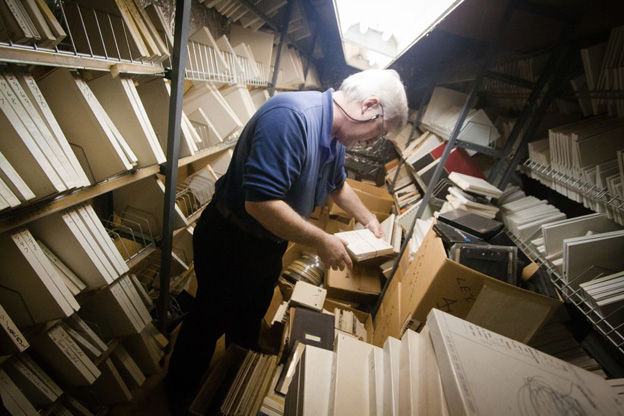 Warren Hull searching through old masters in a Musicol attic

 Engineer Adam Smith
 Times New Viking inside Musicol's Studio A. Photo by Jo McCaughey.
"Those famed music-making locales, and others like them, are long gone. But every weekday between 8 a.m. and 10 p.m., you'll find a Musicol employee pressing vinyl in the basement on two manual, steam-heated Finebilt record presses-- emphasis on manual. Vinyl collectors like to think of records as handmade treasures-- the earthiest, most tactile music format-- and at Musicol they're exactly that. Whereas larger pressing plants use an automated process to crank out records by the thousands, at Musicol a sweaty dude pours the PVC pellets from a coffee can into a hopper that funnels them into an extruder, which heats the pellets into a blobby substance and oozes it out like toothpaste from a tube. He makes the blob into a patty, affixes a label, and presses it like a pancake with a nickel stamper, carefully trimming off the dross around the edges and inspecting the final product. A run of 500 takes about eight hours. Musicol has turned out a few million records this way, doing runs of 100, 300, 500, or 1,000, all pressed by hand one at a time. (Eat your heart out, Etsy.)
J.R. Ferguson pressing records at MusicolThese days, the basement pressing operation brings in more business than the studio. Local label Columbus Discount Records, run by Musicol house engineer Adam Smith, presses all of its records here, including releases by Times New Viking, Psychedelic Horseshit, Ron House, Cheater Slicks, and other Ohio lo-fi luminaries. Chicago's famed jazz/blues label Delmark Records (Junior Wells, Magic Sam) has pressed many of its records at Musicol since the early 90s. And Musicol presses records from all over the world-- Europe, Russia, South America, Australia, New Zealand, Japan. Even with overseas shipping, it's cheaper to press at Musicol.
The two recording suites still bring in business. Times New Viking recorded to 2" tape on Studio A's 16-track machine for their 2011 full-length, Dancer Equired, and the Black Swans recorded their 2012 album Occasion for Song at Musicol, as well. These Columbus bands are following in the footsteps of thousands who came before them, recording garage, soul, gospel, folk, country, and pretty much every other genre at Musicol since the 60s. Even Chicago's Numero Group, arguably the most respected archival label in operation, has noticed: The label is in the early stages of compiling music recorded at Musicol for a future release.
So how did Musicol do it? In the age of Pro Tools, home studios, and laptop recordings, why is this analog dinosaur not just surviving but thriving when the vast majority of its peers closed up shop decades ago? Sure, the oft-referenced "vinyl resurgence" has played a major role; sales of and interest in vinyl releases continue to rise annually. And even Clear Channel rockers are singing the praises of analog: Dave Grohl recently made a documentary about California's Sound City Studios after purchasing the famed studio's Neve 8028 recording console. But there's more to this survival story than the recent fetishization of a format, and it all starts with Musicol mastermind John Hull.
John Hull mastering a record at Musicol"On a rainy afternoon in December, 84-year-old John Hull stands over his 1944 Scully lathe in Musicol's lower level mastering suite, cutting grooves into an aluminum disc coated in lacquer for the London, Ontario, band Disleksick. The lacquer will be used to make the shiny nickel stamper that gets loaded into the press. This particular 7" is a brutal, punishing onslaught of sound. (The group requested Hull inscribe the words "West Coast Noisecore" into the record's innermost ring.) Some tracks on Side A last less than 10 seconds. Most octogenarians wouldn't stay in the same room as this music for even that long, but Hull-- a mild-mannered, Baptist Midwesterner prone to grandfatherly chuckles and plaid button-downs-- just grins, tweaks some levels, and watches as the Westrex cutting head transfers sound from electrical impulses to the motion of the heated stylus, which makes grooves in the spinning lacquer. It's the 491st side he's mastered in 2012, meaning Hull is on track to break Musicol's previous single-year record of 504.
"John is an expert mastering engineer," says Dante Carfagna, Numero Group's man in the field and an archivist with Columbus roots. "I went in there one day and he was in the mastering den downstairs, sitting there with an oscilloscope trying to figure out a basically inaudible signal from some experimental metal guy-- some 50 billihertz tone that he was trying to get right so it would show up on the LP. He's really, really good at figuring out what those things need to sound like when they get pressed to records. It's not often you get a guy, particularly of John's age, that would even have the tolerance for some harsh noise CD."
It's not exaggeration to say Hull has been perfecting this process for nearly 70 years. The latter half of World War II coincided with Hull's high school years in his hometown of Fort Recovery, Ohio, a literal stone's throw from the Indiana border. Settled by Catholic immigrants from northern Germany who refused to convert to Lutheranism, fewer than 1,000 people lived in Fort Recovery in the 40s. Among them, though, was a science teacher who encouraged Hull to pursue his interest in electronics and sound recording. Emboldened by the support, Hull and his brother started a pirate radio station, broadcasting music and high school football games for almost two years until the FCC shut it down.
Jim Cushman: "Say We're in Love"
Hull didn't have any way to record music, though, and that bothered him. Because of the war, metal was hard to come by, so Hull took parts from junked radios and other discarded electronics gear and built a lathe that would record onto discs. "I still have some recordings I made back in '45," he says.
After spending three years studying electrical engineering at the University of Cincinnati, Hull transferred to Ohio State University in Columbus to get his degree in engineering physics. He also enrolled in Ohio State's ROTC program and went on active duty in the Signal Corps in 1956, providing communications for tests on the atomic cannon in the swamps of Louisiana. He was discharged in 1958 and soon after went to work for North American Aviation (later becoming part of Rockwell International and now Boeing) developing antennas for airplanes.
Watch a mini-documentary about Musicol Recording Studio:
"I had been out of the recording side of things for some time," Hull says. "But some of the people at North American found out I had done recording in the past, and they started a concert band. A couple of the guys who were in the group said, 'Do you think you can get some equipment together and record it?' That was enough to light the fire. I recorded the first concert of the North American Aviation Concert Band in 1960."
Everything snowballed from there. Through a mutual friend, Hull found a like-minded business partner in Boyd Niederlander, and they began recording high school bands and choral groups. At first it was mostly field recordings, but Hull also did studio work in his family's suburban homes through 1965. As studio work escalated, the partners moved to the current location on Oakland Park Avenue in the North Linden neighborhood, incorporating Musicol (often written "Mus-I-Col" in the early days) in 1966. They were savvy businessmen from the get-go, able to run the enterprise out of a residence because the property originally housed the offices and model home for the builder of the surrounding neighborhood, so the lots were incongruously zoned commercial.
Hull's engineering acumen quickly earned him a reputation in the community. Gary Hedden, Musicol's first employee and longtime engineer, was recruited when he was just a high school freshman. He remembers an existing company doing most of the field recordings before Musicol came along, but Hull convinced the high schools and bands to hire him, too, and then choose the recording that sounded better. It was a shootout. "Every time we went up against this existing guy, we won," Hedden says.
"Almost every person who ever started a studio in the 20th century comes from an electrical background," Numero Group's Carfagna says. "They were tinkerers. They would build their own circuit boards. [Hull] is in a long line that, for the most part, is gone."
Vintage Musicol ads
At Musicol, if you can build it, you do build it. One of the original consoles Hull built in the 60s is still in use today. When the record presses were put in the basement in the 70s, Hull couldn't get consistent quality, so he built control systems to regulate temperature and other variables.
"The term DIY gets thrown around a lot, but John actually did do all this stuff himself," says Musicol engineer Adam Smith. "The stuff he built around here is bananas. All the control systems, boxes that I still use, the bits and bobs that make a studio work-- he built all of it."
There was very little ego or showmanship that accompanied Hull's extensive know-how. As impressive a room as Musicol's high-ceilinged Studio A is, the place was and remains down-to-earth and unassuming. If some studios are sterile spaceships, Musicol is a dusty living room. "It's never bought into the glamorous side of studio recording equipment," Hedden says. "The quality of the product [at Musicol] has always been good even though the décor was never fancy."
Musicol's Studio B
Hull and Niederlander were frugal, always on the lookout for bargains on good equipment. Hull picked up RCA ribbon mics and Neumann tube mics on the cheap from radio stations and concert halls that grew tired of the maintenance required to keep them functional. (Hull could fix any of them, and those microphones are worth thousands today.) Even Musicol's trippy carpet was salvaged from the Cincinnati Convention Center in the 70s. You can still flip over boxes at Musicol and see "Army Signal Corps." "He doesn't sell anything," Smith says. "There's attics full of gear."
Unlike some of Musicol's contemporaries, Hull never aimed to run a studio that doubled as a label cranking out genre-specific hit records. Musicol is a custom studio providing a service. There were brief attempts at label imprints-- Hull Records in the early years, Ironbeat for garage, Now for gospel, Mus-I-Col for various genres-- but artists released their music however they desired, Musicol imprint or otherwise. Some recorded there but pressed elsewhere, others recorded elsewhere but pressed at Musicol. Sifting through the music made at Musicol would take years (and a lot of patience for white gospel, choral groups, and Ohio State Fair recordings).
There's no wall of fame at Musicol, but recognizable names did come through from time to time, usually to do voiceover work in Studio B: Lou Rawls, Dom DeLuise, Phyllis Diller, Pete Rose. Many early recordings weren't well-known at the time, but plenty of diamonds in the rough exist. Columbus soul legend Bill Moss recorded at Musicol before launching his own Capsoul label, which Numero Group chose for its first compilation. (Hull remembers Moss doing 180 takes before nailing a bass line.) A psych-rock outfit called Owen-B recorded a fantastic, but mostly forgotten, self-titled album and some singles at Musicol. (They payed it off by helping with the construction of Studio B.) Quite a few gems from 60s garage bands-- Ric Ocasek's little-known pre-Cars combo Id Nirvana, for example-- never saw release, but a punky 45 by the Myrchents titled "Indefinite Inhibition" remains a coveted collector's item. And J.C. Davis, who played sax with James Brown and Etta James, recorded the song "A New Day (Is Here at Last)" that was later reissued by Carfagna and his pal Josh Davis (aka DJ Shadow) on The Complete Mus-I-Col Recordings of J.C. Davis and subsequently sampled by Will.i.am on Justin Timberlake's "Damn Girl".
Many of Ohio's underground greats passed through Musicol, too. Twisted psychobilly outfit the Gibson Bros. and Ron House's post-punk band Great Plains made albums for Homestead Records there, as did countless Columbus rockers who were poised to break nationally but never quite did. Rappers came through from time to time, and still do; Bizzy Bone of Bone Thugs-N-Harmony once got angry during a recording session and punched a hole in the wall.
Like so many aspects of Musicol that remain unchanged, the hole is still there.
Warren Hull searching through old masters in a Musicol attic
After meeting Musicol's five staffers-- Hull, his son Warren, grandson Jonathan, engineer Adam Smith, and press operator/plumber/boiler repairman J.R. Ferguson-- you'd probably guess the Honda Gold Wing out front pairs with Ferguson, a 50-year-old jeans and sleeveless T-shirt kind of guy who's worked here since 1985. But the touring motorcycle actually belongs to Warren, a graying, doughy 51-year-old with a kind face and incisive eyes. You'll find him in slacks and a polo most days, reading glasses hanging around his neck. He's taller than his father and similarly amiable, though not as jolly. Warren keeps Musicol's wheels turning. He answers the phones, manages the record and CD orders-- billing, shipping, scheduling. He cuts the grass, blows the leaves.
This morning Warren sips from a coffee mug courtesy of No Idea Records ("Black coffee colored vinyl," it reads), then pauses to take a call from a Jose in Puerto Rico, who is checking on a test pressing. Afterward, he laughs while recounting the early days running around his dad's home studio poking holes in the speakers. He talks about the hard times, too, particularly the 90s. His dad doesn't remember the presses ever stopping, but it seems to be selective memory; during the down period, Warren says they were silent "for months at a time." Through the 70s and most of the 80s, the records pressed each year fill pages upon pages in Musicol's handwritten logs. Flip to the 90s, though, and each year gets just a few spiral notebook pages. Records were dying off. The CD was king, and CD duplication was not initially profitable. Warren remembers 63-minute blank CD-Rs going for $25 apiece. Cassette duplication still brought in some business, and people still used the studios occasionally, but times were tough. Niederlander, a founding partner, bowed out in 1990. John had to pump his own money into Musicol to keep it afloat. Then Bela Koe-Krompecher's Anyway Records came along.
Start listing the "important" bands to come out of Columbus in the 90s, and chances are they had a vinyl release on Anyway: Gaunt, New Bomb Turks, V-3, Bassholes, Jenny Mae, Thomas Jefferson Slave Apartments, not to mention Dayton's Guided by Voices and Cincinnati's Ass Ponys.
"Many of the early [Anyway] releases had inserts that were sort of a catalog that promoted Musicol," says Koe-Krompecher. "This wasn't an agreement we had with them. I just thought it was the right thing to do, to plug a local operation. At the time, there was only a few places that pressed vinyl-- Dixie in Tennessee and Erika in California-- but both had higher prices and you had to pay for shipping. Plus, Warren always gave me a break, and I love Musicol."
"Bela is the one who resurrected the records coming back," Warren says. "He was one of our biggest customers-- he actually was on the beginning edge of the resurgence of vinyl. It has probably picked up 10 to 15 percent every year since '95."
Record pressing is the mainstay of Musicol's business today. In fact, Warren says if it weren't for record pressing, "we probably wouldn't be here." Every weekday, Ferguson starts pressing around 8 a.m. Smith follows him around noon, and Jonathan works the 5 to 10 p.m. shift. Only about a dozen pressing plants remain in the U.S., and Musicol is one of a handful that can do small runs.
Diversification has served Musicol well over the years; if one part of the business was down, another picked up the slack. Even outside Musicol, John Hull stayed involved in other ventures. He helped launch a Christian radio station. He started and sold a medical company and a communications business-- hence Musicol's cell tower, which he still owns. He even worked full-time jobs in addition to Musicol through 1994.
Building and fixing your own equipment, resourcefulness, an eye for bargains-- they all factor into Musicol's survival. But there's another, rather obvious component: John Hull is still here. Most other studios of Musicol's vintage aren't around anymore because the founders aren't around anymore. And Hull isn't Owner Emeritus. When healthy, he's at Musicol every weekday afternoon mastering records.
Owen-B: "Mississippi Mama"
Much of the studio's strengths are a direct result of Hull's skills. Musicol isn't a top-flight digital studio because Hull isn't a digital guy. (There's a Pro Tools rig, but it's about 10 years old; when your studio's founder loves to talk about the studio's aircraft-quality Teflon wiring, Pro Tools projects will probably never be your bread and butter.) He's not an analog snob, mind you. He doesn't revel in Musicol's vintage-ness or wax poetic about recording to tape. He doesn't romanticize vinyl; he presses it. This is what he knows, what he was trained to do.
While Warren will likely inherit the business from his father, he admits he knows little about the recording side of things. Smith, 33, is John Hull's ideological heir. Very few modern engineers know anything about electronics, but Smith believes in the old-school ethic enough that after getting a degree in graphic design from the Columbus College of Art & Design, he went back to school at Columbus State for two years (at Hull's prompting) to learn electrical engineering. The technical, hands-on approach comes naturally to Smith, who describes his parents as "back-to-the-land hippies."
Engineer Adam Smith
"We built our own house, had a farm," he says. "I've always worked on my own stuff. That's why I like working here. [Musicol] is a pretty similar setup to what my mom and dad's house was like." John brought Smith on as an engineer about four years ago, when a previous engineer left. "It's not an easy thing to jump into," Smith says. "At this point, there's 100,000 tricks of the trade. For the first several sessions I was just terrified."
Smith picked up his shift pressing records about a year and a half ago. Now, mastering is the final frontier. John has always done the mastering, but last fall he went under the knife for quadruple bypass surgery. Orders had to be sent down to Nashville while he was laid up, and outsourcing did not sit well with Hull. He began training Smith to cut lacquers in December.
Smith's involvement at Musicol has given the recording side of the business a boost in recent years. There have been times when Smith says Studio A stayed locked up for months, and though it may be too early to call it a Renaissance, younger Columbus bands are returning.
"I believe in the vibe and history of rooms, not just the gear and engineers," says singer Jerry DeCicca of the Black Swans. "I wanted to record within the same walls where some of my favorite records from my own community were made. And once Adam stepped into the fold there, I knew we'd be comfortable."
Times New Viking inside Musicol's Studio A. Photo by Jo McCaughey.
Musicol was Times New Viking's first studio experience after doing mostly four-track recordings. "We liked the history of it," says TNV singer/drummer Adam Elliott. "And we've always been sticklers for analog. Adam had re-done these mics, and we could record on 2" tape. And the carpet-- we were going to make our album cover that pattern."
"It's pretty amazing that Musicol kept going," Elliott says. "The world wasn't looking, but it was still going. And it's still here.""


Thursday, May 17, 2012
Who Is Going To Build Our Infrastructure?
Using the new tools of the internet enjoys us to no end, but in the process as a nation of builders, are we losing our sense of how to do things by hand? The do it yourself mantra is one that we hope this nation never loses. As jobs and career paths move in different directions using new technology, losing hard fought skill sets and basic mechanical knowledge could be our ultimate downfall. A nation that cannot build and sustain its infrastructure is losing all footing for its base to grow.
Mark Cuban recently expressed his thoughts about the next big debacle of financial crisis in defaulting student loans, check it out here. What really got us thinking on this more than anything is not about how many folks go to college but what are they learning and how it relates to a solid career path.
When plying in a trade, you are taught all the facets of that particular job and in the actual job setting. Every day is continual growth as you learn more about the job at hand and your pay is directly tethered to your experience and drive to succeed. College on the other hand is teaching you how to learn about learning. There is inherently nothing wrong with that equation as knowledge is power. But, on the other hand, many more individuals are seeking out college instead of a pliable trade in which a solid future could be more within their grasp.
Have a look at these graphics below, from some years back talking on the decline and rise of jobs. Even though the information is a bit older the trend is easy to see. We are losing much of our skilled workforce to high technology, which shifts as often and regular as the tide. Does this mean that instantaneously all perspective students will graduate into a white collar work force, not at all. What bothers us the most, from looking at the thirty thousand foot view, is the overall loss of skilled craftsmen on a large scale.
 |
| Chart is from The Atlantic article on job growth and decline - http://tinyurl.com/7f358qm |
 |
| Chart is from The Atlantic article on job growth and decline - http://tinyurl.com/7f358qm |
With all that in mind, take a read on the article and videos below about Ford Motor Company and the innovative TechShop in Detroit. Employees are allowed to access the facilities whenever they want and to work on their own projects. Perks are even given out to potential windfall projects that could be used on new vehicles. Needless to say, that is an amazing idea on how to help innovate for the future while keeping hands on skills at the ready, bravo to Ford!
 |
CNC router carving the Ford logo at TechShop. © Ford Motor Company
|
Ford employees who invent something that the company ends up patenting receive a free three-month membership to TechShop, where they can flex their creative muscles. Project sponsor Bill Coughlin, CEO of Ford Global Technologies, has high hopes for the partnership. He expects it to supply Ford with innovative new features for its fleet of automobiles and also to act as a catalyst for Detroit’s economic recovery, generating new businesses and jobs.
It’s easy to see why the program is appealing to Ford’s designers and engineers. The Detroit TechShop is an amazing 17,000 square feet, stocked with $750,000 worth of laser cutters, 3-D printers, CNC machine tools, and staffed with “Dream Consultants” whose job it is to help you fabricate pretty much anything.
Ford employees are free to use the space day or night, for projects related to their work or personal projects. So far, employees have used the tools to prototype new features for car doors and for more fanciful pursuits like one employee’s “Whirlygig,” a plastic sculpture made with a laser cutter that spins in the wind and reflects light in interesting ways.
 |
| Ribbon-cutting ceremonies are a little different at TechShop © Ford Motor Company |
Since launching the program, patent disclosures are up an impressive 30 percent, but Coughlin thinks there are more long-term organizational benefits. Disruptive ideas, for example, are more likely to be taken seriously.
“An idea on paper is easy to kill, but when you create a prototype of it and a supervisor can see it and experience it, it’s harder to say no,” Coughlin says. “Once someone starts thinking creatively it’s hard to turn that off. People stop seeing problems and start seeing opportunities.”
The partnership also promises to forge deeper relationships between Ford, its suppliers, and the maker community. How? The automaker recently asked a manufacturer of an environmentally friendly material to bring samples to TechShop to see what members could make with it.
Coughlin is a lawyer by training, But decided to temporarily trade in legal briefs for a bandsaw. He posed a simple question to himself: “Could I do better than Ikea?” After taking a couple of classes, he successfully designed a flat-pack end table and worked on another prototype using a ShopBot (an industrial-strength CNC cutter). He won’t comment on whether it is IKEA-worthy, but does say that it is at least “dimensionally stable.”
 |
Water Jet Cutters - The world's most dangerous squirt gun © Ford Motor Company
|
Still, the program raises some thorny legal issues for inventors. If an engineer designs something in his free time and funds it on Kickstarter, say, would Ford own the patent?
Coughlin says there is a process for employees to clear after-hours projects, and in all but one case, they’ve been free to pursue their ideas without fear that Ford might claim ownership. And employees who create patentable projects related to the auto industry receive a portion of revenues generated from the patent.
 |
| Soon to be quaint. A Milling machine operated by a human. © Ford Motor Company |
At every level, Ford seems to realize that the days where customers could “choose any color as long as it’s black” are long over. The future of innovation lies in the hands of customers and employees who identify automotive design problems. Giving those employees passes to a hackerspace is a giant step toward finding solutions."
All photos courtesy of Ford Motor Co.
Wednesday, February 15, 2012
Evolution Of Automobile Logos
Design and illustration are a huge part of what we enjoy, so it should come as no shock that once we found this article on the evolution of a few automobile logos we just had to repost it. Ever curious about where Buick or BMW got their start, well read on. To understand a logo that is complex and exhibits a deeper meaning, is a direct window into the soul of a company.
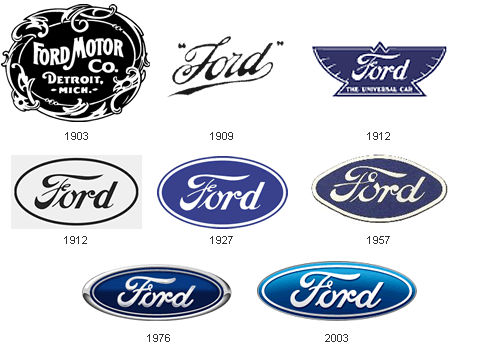
In our current cookie cutter culture, logos are a bit more modern and clean, but they still strive to reflect the culture or "perceived" depth they are supposed to represent. Seeing how Ford Motor Company logo has evolved, is peering back into the progression of our 20th century history and for each logo iteration we can easily compare it to the era, it reflected. Personally I am a huge fan of the 1912 period Ford logo as its elegant, futuristic and looks as if it they were predicting what an electronic gauge might look like, in the wing area of the shape.
"This article should come in handy for the next time you’re stuck in traffic: have you ever wondered why the Audi in front of you has a logo of four interlocked rings? Did you know that the Cadillac emblem was inspired by a family crest of a nobleman who later turned out to be a fraud? Or that Volkswagen was Hitler’s idea?
We took a look at the evolution of tech logos before. Today, let’s take a look at the fascinating stories behind the logos of some of the most popular cars in the world:
Alfa Romeo
 |
| History of Alfa Romero Car Logos |
Source: Cartype
Surprise! Alfa Romeo, the car manufacturer and pride of Italy, traced its beginnings to France. In 1910, Milan aristocrat Cavaliere Ugo Stella collaborated with the French car company Darracq to market the line in Italy. When the partnership failed, Stella moved the company and renamed it Anonima Lombarda Fabbrica Automobili (Lombard Automobile Factory, Public Company) or A.L.F.A.
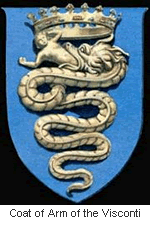
Alfa Romeo’s distinctive logo was created in 1910 by a draftsman named Romano Cattaneo. One day, while waiting for a tram at the Piazza Castello station in Milan, he was inspired by the red cross in the Milan Flag and the Coat of Arms of the noble House of Visconti, which featured a biscione (grass snake) with a man in its jaws, symbolizing "Visconti’s enemies that the snake [was] always ready to destroy." (Source) Two Savoia dynasty knots separated the words ALFA and MILANO.
The Romeo part came in 1916 when Neapolitan businessman Nicola Romeo bought the company and converted its factories to produce munitions and machineries for World War I. After the war, the company went back to producing cars and took on its owner’s last name to become Alfa Romeo.
Aston Martin
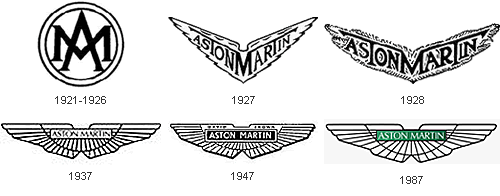 |
| Aston Martin logos |
In 1913, Lionel Martin and Robert Bamford founded a company that later would become Aston Martin. At the time, Martin & Bamford Limited produced Singers racing cars, but the duo wanted to create a more sophisticated model of their own. They named their first car Aston Martin after the founder Lionel Martin and the Aston Clinton hill climb racing course where their Singers car had won previously.
We can’t talk about Aston Martin without mentioning James Bond. In 1959, Ian Fleming put his super spy James Bond in an Aston Martin DB Mark III. When it was made into a movie in 1964, Bond drove an updated, supersleek silver Aston Martin DB5 (complete with machine gun, passenger ejector seat, and revolving number plates!)
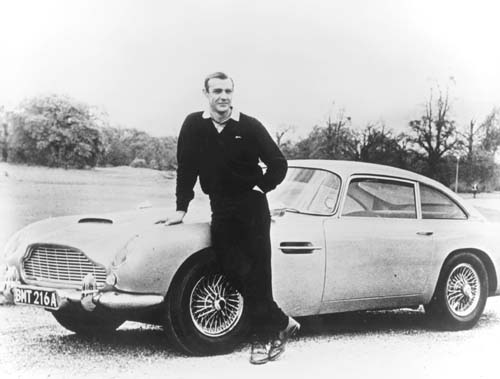
James Bond and his Aston Martin DB5 in Goldfinger
Interestingly, Ian Fleming himself didn’t drive Aston Martin. He preferred the 1963 Studebaker Avanti!
Audi
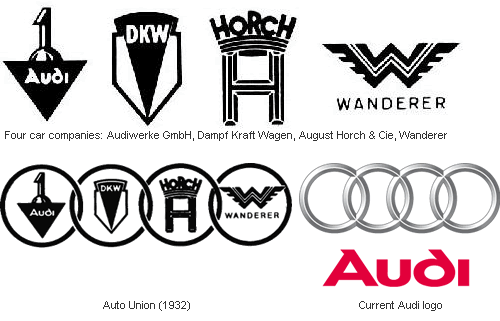 |
| Audi Logos |
German engineer August Horch, who used to work for Karl Benz, founded his own automobile company A. Horch & Cie in 1899. A decade later, he was forced out of his own company and set up a new company in another town and continued using the Horch brand. His former partners sued him, and August Horch was forced to look for a new name.
When Horch was talking to his business partner Franz Fikentscher at Franz’s apartment, Franz’s son came up with the name Audi:
During this meeting Franz’s son was quietly studying Latin in a corner of the room. Several times he looked like he was on the verge of saying something but would just swallow his words and continue working, until he finally blurted out, "Father – audiatur et altera pars… wouldn’t it be a good idea to call it audi instead of horch?". "Horch!" in German means "Hark!" or "listen", which is "Audi" in Latin. The idea was enthusiastically accepted by everyone attending the meeting. (Source: Wikipedia, A History of Progress (1996) – Chronicle of the Audi AG)
And so Audiwerke GmbH was born in 1910. In 1932, four car makers Audi, Horch, DKW, and Wanderer merged to form Auto Union. The logo of Auto Union, four interlinked rings that would later become the modern Audi logo, was used only in racing cars – the four factories continued to produce cars under their own names and emblems.
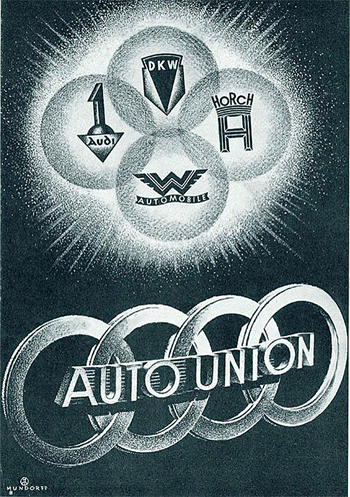
Four car companies became Auto Union (1932)
Fast forward to 1985 (skipping a whole lot of history), when Auto Union ultimately became the Audi we know today.
BMW
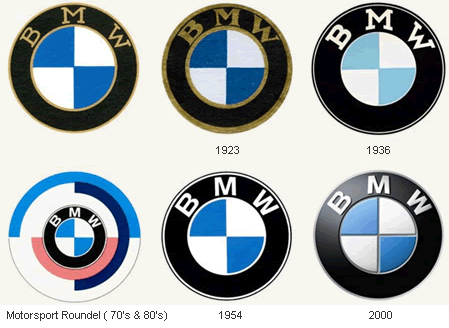 |
| BMW logo changes and redesigns |
Source: Motorcycle
In 1913, Karl Friedrich Rapp and Gustav Otto founded two separate aircraft factories that would later merge to form BMW or Bayerische Motoren Werke AG (Bavarian Motor Works). Rapp and Otto actually had little to do with BMW’s manufacturing of cars. Josef Popp, Max Friz and Camillo Castiglioni were the ones who played big roles in making BMW a modern car manufacturer.
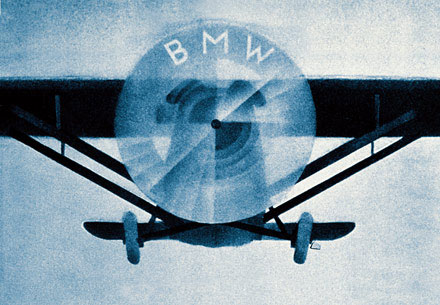
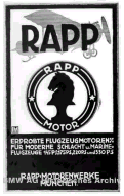
The circular BMW logo was a representation of a spinning propeller of a Bavarian Luftwaffe. At the time, aircrafts were painted with regional colors and the colors of the Bavarian flag were white and blue. It is said that the pilot saw the propeller as alternating segments of white and blue, hence the logo. The roundel was a nod to Karl Rapp’s original company.
During World War I, BMW was a major supplier of airplane engines
(and later airplanes such as the Red Baron)
(thanks Redditors!) to the German government. After the war, Germany was forbidden by the Treaty of Versailles to manufacture airplanes and BMW was forced to change its business: it first made railway brakes before making motorized bicycle, motorcycles and cars.
Update 3/6/08: Neatorama readers Dan S. and Bruce Kennedy who pointed out that the idea of BMW logo being derived from spinning propeller was actually an advertisement by the company (scroll down about halfway). Also thanks to klaus who pointed us out to the logo of EMW, which BMW took over in 1928.
Buick

Early Buick emblems (source: Buick Car Club of Australia)
The Buick Motor Company was founded in 1903 by David Dunbar Buick, a Scottish-American inventor who invented the overhead valve engine. If you didn’t recognize the name, you’re not alone – but remember this: Buick, a high school drop out founded a company that later became the world’s largest auto company, General Motors.
At 15 years of age, Buick dropped out of school to work for a plumbing fixture manufacturer. When that business failed, Buick and his friend took it over – but within a few years, Buick had an argument with his partner because he preferred to spend his time tinkering with car engines. Buick sold his share in the company and quit.
With the money, Buick founded the Buick Motor Company and within a few years ran it to the ground. He was kicked out of the company by his partner William "Billy" Durant in 1906 and later sold his stock for a mere $100,000. Had he held on to his shares, it would’ve been worth well over $100 million today. In his later years, Buick held low-paying jobs and couldn’t even afford a telephone. He died penniless as an inspector at the Detroit School of Trades. Ironically, years later Durant himself would be forced out. General Motors, the company that Durant built, refused him pension and he died almost penniless. (Source)
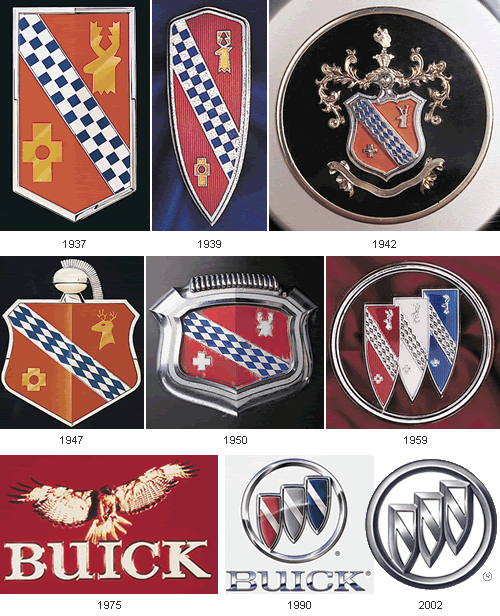
Buick crests and tri-shields (source: Buick Car Club of Australia)
Back to the logo story: Early Buick logos were variations of the cursive word "Buick." In 1930s, General Motor Styling researcher Ralph Pew found a description of the Scottish "Buik" [sic] family crest and decided to use it as a radiator grille decoration. In 1960, the logo incorporated three such shields, to represent the three Buick models then built: LeSabre, Invicta, and Electra.
In 1975, Buick changed their logo to a hawk named "Happy" with the launch of their Skyhawk line. However, in the late 1980s, as the Skyhawk car was retired, Buick went back to the tri-shield logo.
Cadillac
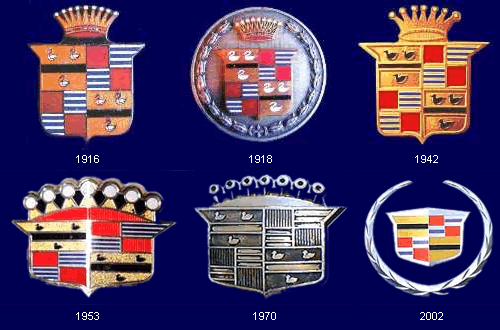
When Henry Ford left his second automobile company, Henry Ford Company (see below), his financial backers tried to liquidate the company’s assets. An engineer named Henry M. Leland persuaded them to continue the company instead. They listened, and so Cadillac was born.
Cadillac’s first logo was based on a family crest of a minor aristocrat that the company was named after: Antoine de La Mothe, Seigneur de Cadillac (Sir of Cadillac). In 1701, de La Mothe founded Fort Pontchartrain which would later become Detroit. Cadillac was named after de La Mothe in 1902, following a bicentenary celebration of the founding of the city.
Problem was, de La Mothe was never a nobility! Born Antoine Laumet, de La Mothe was forced to leave France for America under a mysterious circumstance (some say he committed a crime or was unable to pay his debt). In the New World, he was able to assume a new identity and cobbled together a famiy crest with elements "borrowed" from, shall we say nobler sources.

In 1998, Cadillac had a new design philosophy called "art and science" and had its logo redesigned. Gone were the six birds called the merlettes, the crown, and the entire fabricated de La Mothe family crest as the company tried to shake up its stodgy image. The new logo made its debut a few years later, looking positively like it was made by Piet Mondrian!
Fiat
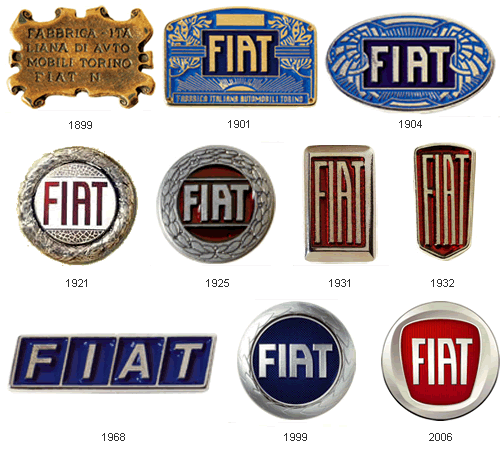
Fiat, then named Fabbrica Italiana Automobili Torino (Italian Automobile Factory of Turin), was founded in 1899 by a group of investors, including Giovanni Agnelli who later became its Managing Director. Agnelli bought his shares for $400 (about $10,000 in 2007 money). It’s worth billions now, and there had been an Agnelli in Fiat management ever since. Regardless or perhaps because of its wealth, the Agnelli clan remained a fractious and complicated group of people.
Supposedly, the famous Fiat "scrabble tiles" logo of the 1960s was designed by the company’s Chief Designer who was driving past the Fiat factory during a power outage and saw an outline of the factory’s neon sign against the dark sky (Source: The Language of Auto Emblems)
Ford
 |
| Ford Motor Company logo changes over the years |
Most people know that Ford was founded by (who else?) Henry Ford. What most people didn’t know was that this was his third automobile company. Ford experimented with cars while working for Thomas Edison, and left to found his first auto company, The Detroit Automobile Company, which went bankrupt in just 2 years. He then built a race car and founded Henry Ford Company. Ford left that one after just one year (the company later became Cadillac – see above).
In 1902, Ford went on to create his third automobile company, the Ford & Malcomson, Ltd., and almost lost that one when sales were slow. He was unable to pay his bills to John and Horace Dodge, who supplied parts. Ford’s partner brought in a group of investors and even convinced the Dodge Brothers to accept shares in the company, which was renamed Ford Motor Company. Later, the Dodge Brothers went on to form their own car company (can you guess what?)
In 1909, Childe Harold Wills, Ford’s first chief engineer and designer (who also help to design the Model T), lend a script font that he created to make his own business card, to create the Ford logo. The famous blue oval was added later for the 1927 Model A – it remained in use until today.
Mazda
Mazda began its life in 1920 as the Toyo Cork Kogyo Co. in Hiroshima, Japan. At the time, there was a cork shortage because of World War I, so the company was founded to process a cork substitute made from the bark of an Abemaki or Chinese cork oak tree. It was a good idea at the time, but shortly afterwards Japan could get real cork again and the company foundered.
In 1927, Jujiro Matsuda came onboard and the company began manufacturing tools, three-wheeled "trucks" and then cars. After World War II, the company formally adopted the name Mazda, which depending on who you ask, stood for the Zoroastrian god Ahura Mazda or an anglicized pronunciation of Matsuda the founder’s name (or both).
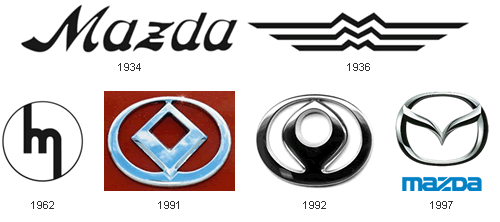
In the 1936 logo, the M shaped curve was inspired by the emblem of Hiroshima city. The 1991 and 1992 logos symbolized a wing, the Sun and a circle of light. Mazda’s current logo, nicknamed the "owl" logo, was designed by Rei Yoshimara in 1997. The stylized "M" was meant to look like stretched wings, but many people saw a stylized tulip instead.
Mercedes-Benz

The modern Mercedes-Benz traced its lineage to a 1926 merger of two car companies, Daimler-Motored-Gesellschaft or DMG, founded by Gottlieb Daimler (along with Wilhelm Maybach), and Benz & Cie, founded by Karl Benz. Both Daimler and Benz worked independently to invent internal combustion-powered automobiles. Their factories were actually just 60 miles apart, yet they didn’t know of each other’s early work.
After World War I, the German economy was in tatters, and to survive, the two companies formed a syndicate in 1924, where they would continue to sell their separate brands but would standardize design, share purchasing and advertising. In 1926, however, the two companies merged into Daimler-Benz.
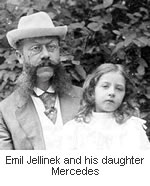
The name "Mercedes" came about in 1900. A wealthy European businessman and racing enthusiast named Emil Jellinek began selling Daimler’s cars. He wanted a faster car, and specified a new engine to be designed by Maybach and to be named after his 10-year-old daughter’s nickname, Mercédès or Spanish for
"Mercy" (See below)
Jellinek was quite a character. He used to pepper DMG’s engineers with colorful suggestions and criticism such as "Your manure wagon has just broken down on schedule" and "You are all donkeys". However, as he actually sold a lot of cars, he was tolerated and even listened to. Later, Jellinek would add Mercedes to his own and became Emil Jellinek-Mercedes. (Source: My Father Mr. Mercedes by Guy Jellinek-Mercedes and MBUSA Biographies)
The star in Daimler’s logo came from an old postcard where Gottlieb Daimler had drawn a star above the picture of his house and wrote that "this star would one day shine over [his] own factory to symbolize prosperity." The three-pointed star symbolized Daimler’s ambition of making vehicles "on land, on water and in the air." (Source: Daimler)
After the merger, a new logo was designed. It combined the symbols of the two companies: the three-pointed star of DMG and the laurel wreath of Benz.
Update 2/18/08: There’s a dispute on the origin of the name “Mercedes.” According to Baby Names World, Mercedes is a girl’s name of Spanish origin meaning “Mercy.” It was taken from the Virgin Mary’s liturgical title “Maria de las Mercedes” (Mary of the Mercies; ‘Our Lady of Ransom’):
Latin ‘mercedes’ originally meant ‘wages’ or ‘ransom’.
In Christian theology, Christ’s sacrifice is regarded as a ‘ransom for the sins of mankind’, hence an ‘act of ransom’ was seen as identical with an ‘act of mercy’.
Mitsubishi
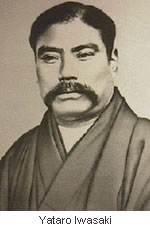
In 1854 feudal Japan, a man named Yataro Iwasaki, son of a provincial farmer whose grandfather sold the family’s samurai status to settle some debt, began his career on the wrong foot: he was called home from school at the age of 19 when his father was injured in a dispute with the village leader. Iwasaki asked a local magistrate to hear his case, and when refused, accused the man of corruption. Iwasaki was promptly jailed for seven months.
Fast forward to 1868: Iwasaki was working for the Tosa clan when the Meiji Restoration abolished Japan’s feudal clan system. He acquired Tsukumo Shokai, the Tosa clan’s shipping business and renamed it Mitsubishi in 1873.
It was a fourth-generation Iwasaki, a man named Kayota Iwasaki, who turned Mitsubishi into a giant corporate group that included an automobile manufacturing company, Mitsubishi Motors.
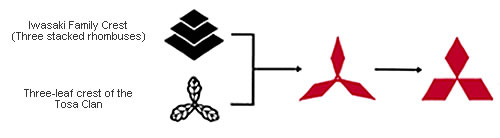
The name Mitsubishi was a combination of the words "mitsu" (three) and "hishi" (water chestnut, used in Japan to mean a rhombus or a diamond shape). The official translation of the name was "three diamonds."
The Mitsubishi logo was a combination of the Iwasaki family crest, three stacked diamonds, and the three-leaf crest of the Tosa Clan.
Peugeot
Peugeot got its start in 1812 in Montbeliard, France, when two brothers, Jean-Pierre and Jean-Frédéric Peugeot converted their windmill into a steel mill. Their first products were rolled steel for saw blades and clock springs, as well as cylindrical steel rods. For decades, the Peugeot family business made metal goods, machine tools, crinoline dresses, umbrellas, wire wheels, irons, sewing machines, kitchen gadgets and by 1885, bicycles.
Indeed, Peugeot’s entry into the automobile business was by way of bicycles. At the time, the company was one of the largest bicycle manufacturers in France. In 1889, Armand Peugeot created the company’s first steam-powered car. A year later, he abandoned steam in favor of gas-powered internal combustion engine after meeting Gottlieb Daimler.
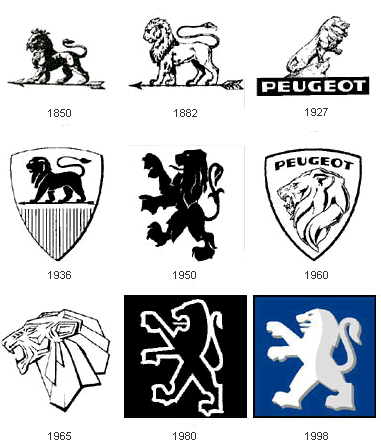
The Peugeot "lion" logo was designed by jeweler and engraver Justin Blazer in 1847. It was based on the flag of the Région Franche-Comté. The logo was stamped on Peugeot kitchen gadgets to denote the quality of their steel. It took Armand 14 years to convince his family that cars could be a moneymaker. Only then did they allow him to use the Peugeot lion logo. (Source: Independent)
Now, you may not drive a Peugeot car, but I bet you’ve used a Peugeot invention of 1842: the peppermill. The mill’smechanism was so reliable that it remained virtually unchanged until today.
Renault
Louis Renault was 21 when he made his first car in the backyard of his parent’s home. He soon got orders for cars, so in 1898, along with his brothers and friends, Louis opened the company Société Renault Frères in Boulogne-Billancourt, France.
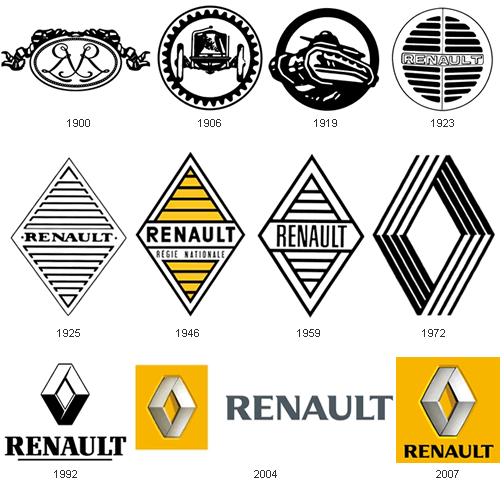
The first Renault logo, drawn in 1900 featured the three initials of the Renault brothers: Louis, Ferdinand and Marcel. In 1906, the logo changed to a front end of a car enclosed in a gear wheel.
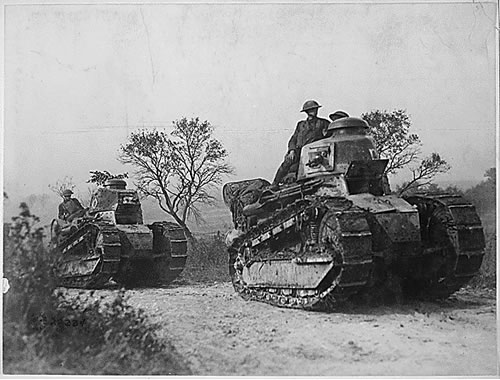
Renault FT-17 tank, driven by American troops, going forward to the battle line in the Forest of Argonne. (Source: The National Archives)
During World War I, Renault manufactured light tanks for the Allies called the Renault FT-17. This was so popular that after the war, Renault actually changed its logo into a tank. The diamond shape was introduced in 1925 and remained until today. The modern Renault logo was created in 1972 by Victor Vasarely [offical website | wikipedia], the father of Op art (or optical art).
Saab
If you’ve ever seen a Saab car commercial, then you’d know that the company was "born from jets". You wouldn’t know it from the car’s staid style, but historically this was accurate: In 1937, an aircraft company called Svenska Aeroplan Aktiebolaget ("Swedish Aeroplane Limited" or simply SAAB) was created to meet the needs of the Swedish Air Force.
When World War II ended, SAAB the airplane company started making cars to diversify its business. The first car it made was a prototype called the the Saab 92001 or ursaab (meaning "original Saab") in 1946. It was test-driven for nearly 330,000 miles (530,000 km) in utter secrecy, usually on narrow and muddy forest roads in the early mornings or late nights.
In 1947, the Saab Automobile company was incorporated. The company’s first car was the Saab 92, named because it was simply the company’s 92nd design project (the previous 91 had all been aircraft).
The griffen logo, featuring the head of a mythological beast that had a body of a lion and head and wings of an eagle, came from Vadis-Scania, a truck manufacturer that merged with SAAB (airplane) company. The griffen was a coat of arms of the province Scania.
In 2000, Saab Automobile company was bought out by General Motors, and thus no longer had any connection with SAAB outside of its history and logo similarities.
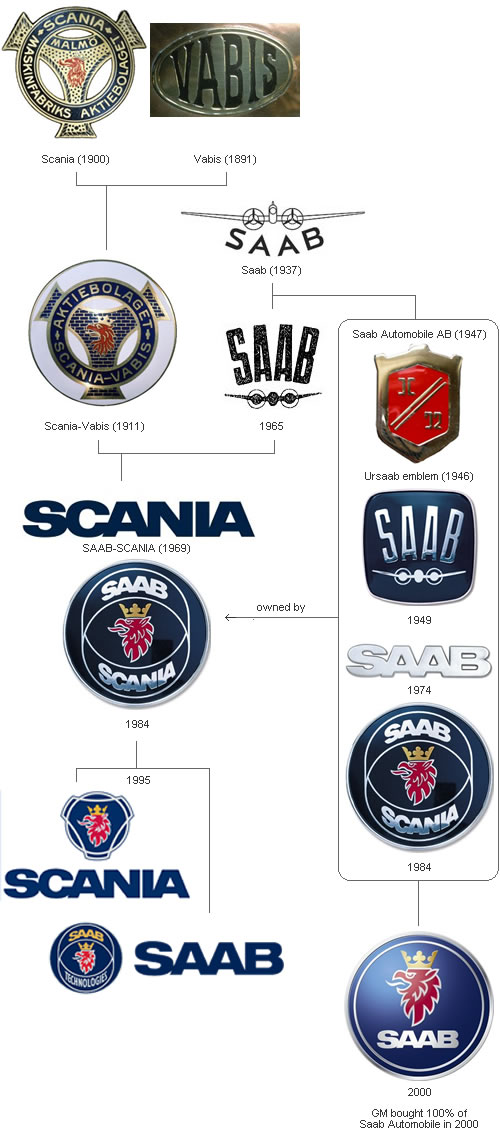
Confused? Don’t worry about it, just enjoy the pictures.
Volkswagen
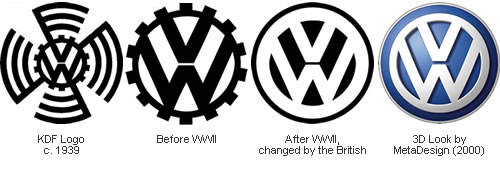
You wouldn’t know it from the company’s website but Volkswagen (German for "People’s Car") can trace its history straight to the villain of World War II: Adolf Hitler.
Here’s the short version of the story: After World War I, Germany’s economy was shot and cars cost more than most people can afford. When Hitler rose to power and became Chancellor, he spoke at the 1933 Berlin Auto Show of his idea to create a new and affordable car.
At the same time, Ferdinand Porsche (yes, that Porsche) was designing an odd-looking yet inexpensive car (which would later become the Volkswagen Beetle). Porsche met with Hitler in 1934, who asked that the car to have the following specifications: it should have a top speed of 100 km/h (62 mph), a fuel consumption of 42 mpg, and could carry 2 adults and 3 children. He said the car should look like a Maikaefer – a May beetle and even gave Porsche a sketch of the basic design. Porsche promised to deliver the design, with prototype cars to be built by Daimler-Benz.
In 1937, the Gesellschaft zur Vorbereitung des Deutschen Volkswagens mbH was created (it became simply Volkswagenwerk GmbH a year later). In 1938, Hitler opened the state-funded Volkswagen factory in Wolfsburg, which was to produce the KdF-wagen (kraft durch freude, meaning "strength through joy"). Few were actually built, instead, the factory (employing forced labor) churned out military car, based on the same chassis: the Kübelwagen, Schwimmwagen, and Kommandeurwagen
It was later found out that Hitler had this in mind all along. He added an extra secret specification to Porsche’s design: the car was to be able to carry 3 men, a machine gun, and ammunition.
After Germany was defeated in World War II, the British took over the Volkswagen factory and the KdF-Wagen was renamed the Beetle. The British then sought to give control of the company – first they asked the Ford Motor Company, then the French Government, other British car manufacturers and lastly, Fiat. All turned down this "free offer" because they thought the Beetle’s design was inferior and that the company would be a money drain. (Source: The Auto Channel)
So, the British gave the Volkswagen company back to the German government in a trust. Later, having sold more than 21 million cars, the Volkswagen Beetle would become one of the world’s best selling cars ever.
The VW logo itself was supposedly designed by Franz Xavier Reimspiess, an employee of Porsche, during an office logo design competition. He was given a one time payment of 100 Reichsmarks (about $400).
If you didn’t see your favorite car’s logo history, chances are it is because its logo didn’t change much over the years. There are also dozens of large car companies in the world (many more if you counted the defunct ones), and we couldn’t fit every single one in this article. If I missed anything, please let me know in the comment.
Tuesday, January 17, 2012
Pirates Press Record Of The Week Collection
The manufacturing side of vinyl records has very few players and we have talked on a few here in the news section, but another great one is Pirates Press Records out of San Francisco. They continually produce great packaging and high quality vinyl products. One cool site they have is their Pirates Press Record of the Week. So if you are looking for ideas on your next vinyl album for art and vinyl color ideas, have a gander.
 |
| She's Still Dead 12" vinyl LP |
 |
| Movers & Shakers from Cigar Box Recordings |
 |
| Lacuna Coil from Century Media Records |
 |
| Speedwolf from Hells Headbangers Records |
 |
| Goatwhore from Metal Blade Records |