


Back in November 2015, word went out that Third Man Records would open a vinyl pressing plant in label boss Jack White’s adopted hometown of Detroit. Just over a year later, the label has released a video teasing its imminent opening.
Showing posts with label Detroit. Show all posts
Showing posts with label Detroit. Show all posts
Thursday, January 19, 2017
Third Man Records Slated to Finally Open Vinyl Pressing Plant in Detroit
Another giant leap for vinyl, courtesy of Jack White.
Back in November 2015, word went out that Third Man Records would open a vinyl pressing plant in label boss Jack White’s adopted hometown of Detroit. Just over a year later, the label has released a video teasing its imminent opening.
Back in November 2015, word went out that Third Man Records would open a vinyl pressing plant in label boss Jack White’s adopted hometown of Detroit. Just over a year later, the label has released a video teasing its imminent opening.


Friday, April 3, 2015
Custom Guitars Made From Reclaimed Wood In Detroit, From CBS News
 |
| The final product of Mark Wallace's guitars, made from reclaimed wood in Detroit |
Check out the original post on CBS News
"Detroit has more than 70,000 abandoned buildings. Among them is an old Cadillac plant that houses piles of wood. Where others see trash, Mark Wallace sees buried treasure.
Wallace started making guitars out of Detroit's reclaimed wood a year and a half ago. He not only enjoys making the instruments but also playing them.
"It feels great, as an instrument. It's also great to know that it's something I built and something that came out of the city of Detroit," Wallace told me.
Decades ago the wood for the city's buildings came from old growth forests where trees grew slowly. Wallace says the lumber has tight grain patterns and provides great resonance and sound.
Tuesday, December 4, 2012
Hellbound Glory, Kid Rock and Buckcherry Conquering Stadiums On The Rebel Soul Tour
The Kid Rock Rebel Soul tour featuring Buckcherry and Hellbound Glory is starting to generate quite a bit of attention and it will be well deserved for Leroy and the fellas. Day after day and mile after mile, Hellbound Glory has been living out of a van for the last few years and now they are getting a shot at breaking into a much bigger audience. Congrats fellas, so get on those stages and earn thousands of new fans each night.
White Wolf by RustyKnuckles
White Wolf by RustyKnuckles
 |
| Rebel Soul tour featured in Louisville, Ky |
 |
| Rebel Soul tour featured in Detroit, MI |
 |
| Rebel Soul tour featured on Loudwire |
Wednesday, August 22, 2012
Antiseen Brought Southern Hostility To Tesco Fest In Detroit
Detroit city got rocked this past weekend with one hell of a lineup at the Tesco Fest. Packed elbow to elbow and punk rock pulsating from the speakers, what is not to like. More footage coming soon.
 |
| Negative Approach's Jon Brannon, Jeff Clayton of Antiseen and Tesco Vee of the Meatmen |
 |
| Tesco Fest went down in Detroit, MI on August 18th, 2012 |
Monday, July 30, 2012
Antiseen At Tesco Fest In Detroit On August 18th
A public service announcement from Tesco Vee:
1 NIGHT / 2 STAGES OF PUNK ROCK FURY!!!
Tesco Vee..the very name strikes fear in the cockles of god-fearing
farts all over the world! After a 32 year career spent in the trenches
of the Punk Rock Undergound, The Dutch Hercules hath proclaimed that the
time is nigh to host a GODDAMN HARDCORE PUNK FEST that befits his
name...Seriously butt hurt and smarting at being snubbed by every major
fest this side of the Rio Grande, Vee has decided to ven- ture off on
his own, hand-assembling some of his angriest old school chums to reek
havoc on the Motor City Aug 18, in THE FIRST ANNUAL TESCO FEST at the
Magic Stick.
Get a load of this line up!!!!!
THE MEATMEN /NEGATIVE APPROACH ANTISEEN / GANG GREEN IRON CROSS / HELLMOUTH AGAINST THE GRAIN / BILL BONDSMAN / GOLDEN TORSO
Thats right Klingons, Uncle Tesco ain’t fuckin around!!! He remembers
a time when punk was about vitriol, volatility and vulvas!!
Your Masters of Ceremonies will be Tesco Vee along with special
guest, Squared Circle Revue’s ringside announcer, “The Voice of Reason,”
Mark Pants!
If you miss this nite you will miss a slice of Punk Rock History...
This will be the show of the summer in Detroit...no the Midwest...no the
WHOLE GODDAMNED COUNTRY! SO DONT MISS IT! WEENBAGS!!!
The Majestic
The Majestic
Midtown Detroit - 4140 Woodward Ave.
313 833 9700
Saturday August 18, 2012
Get your tickets now!
Saturday August 18, 2012
Get your tickets now!
 |
| Tesco Fest, featuring Antiseen, The Meatmen, Negative Approach, Gang Green and more |
Thursday, May 17, 2012
Who Is Going To Build Our Infrastructure?
Using the new tools of the internet enjoys us to no end, but in the process as a nation of builders, are we losing our sense of how to do things by hand? The do it yourself mantra is one that we hope this nation never loses. As jobs and career paths move in different directions using new technology, losing hard fought skill sets and basic mechanical knowledge could be our ultimate downfall. A nation that cannot build and sustain its infrastructure is losing all footing for its base to grow.
Mark Cuban recently expressed his thoughts about the next big debacle of financial crisis in defaulting student loans, check it out here. What really got us thinking on this more than anything is not about how many folks go to college but what are they learning and how it relates to a solid career path.
When plying in a trade, you are taught all the facets of that particular job and in the actual job setting. Every day is continual growth as you learn more about the job at hand and your pay is directly tethered to your experience and drive to succeed. College on the other hand is teaching you how to learn about learning. There is inherently nothing wrong with that equation as knowledge is power. But, on the other hand, many more individuals are seeking out college instead of a pliable trade in which a solid future could be more within their grasp.
Have a look at these graphics below, from some years back talking on the decline and rise of jobs. Even though the information is a bit older the trend is easy to see. We are losing much of our skilled workforce to high technology, which shifts as often and regular as the tide. Does this mean that instantaneously all perspective students will graduate into a white collar work force, not at all. What bothers us the most, from looking at the thirty thousand foot view, is the overall loss of skilled craftsmen on a large scale.
 |
| Chart is from The Atlantic article on job growth and decline - http://tinyurl.com/7f358qm |
 |
| Chart is from The Atlantic article on job growth and decline - http://tinyurl.com/7f358qm |
With all that in mind, take a read on the article and videos below about Ford Motor Company and the innovative TechShop in Detroit. Employees are allowed to access the facilities whenever they want and to work on their own projects. Perks are even given out to potential windfall projects that could be used on new vehicles. Needless to say, that is an amazing idea on how to help innovate for the future while keeping hands on skills at the ready, bravo to Ford!
 |
CNC router carving the Ford logo at TechShop. © Ford Motor Company
|
Ford employees who invent something that the company ends up patenting receive a free three-month membership to TechShop, where they can flex their creative muscles. Project sponsor Bill Coughlin, CEO of Ford Global Technologies, has high hopes for the partnership. He expects it to supply Ford with innovative new features for its fleet of automobiles and also to act as a catalyst for Detroit’s economic recovery, generating new businesses and jobs.
It’s easy to see why the program is appealing to Ford’s designers and engineers. The Detroit TechShop is an amazing 17,000 square feet, stocked with $750,000 worth of laser cutters, 3-D printers, CNC machine tools, and staffed with “Dream Consultants” whose job it is to help you fabricate pretty much anything.
Ford employees are free to use the space day or night, for projects related to their work or personal projects. So far, employees have used the tools to prototype new features for car doors and for more fanciful pursuits like one employee’s “Whirlygig,” a plastic sculpture made with a laser cutter that spins in the wind and reflects light in interesting ways.
 |
| Ribbon-cutting ceremonies are a little different at TechShop © Ford Motor Company |
Since launching the program, patent disclosures are up an impressive 30 percent, but Coughlin thinks there are more long-term organizational benefits. Disruptive ideas, for example, are more likely to be taken seriously.
“An idea on paper is easy to kill, but when you create a prototype of it and a supervisor can see it and experience it, it’s harder to say no,” Coughlin says. “Once someone starts thinking creatively it’s hard to turn that off. People stop seeing problems and start seeing opportunities.”
The partnership also promises to forge deeper relationships between Ford, its suppliers, and the maker community. How? The automaker recently asked a manufacturer of an environmentally friendly material to bring samples to TechShop to see what members could make with it.
Coughlin is a lawyer by training, But decided to temporarily trade in legal briefs for a bandsaw. He posed a simple question to himself: “Could I do better than Ikea?” After taking a couple of classes, he successfully designed a flat-pack end table and worked on another prototype using a ShopBot (an industrial-strength CNC cutter). He won’t comment on whether it is IKEA-worthy, but does say that it is at least “dimensionally stable.”
 |
Water Jet Cutters - The world's most dangerous squirt gun © Ford Motor Company
|
Still, the program raises some thorny legal issues for inventors. If an engineer designs something in his free time and funds it on Kickstarter, say, would Ford own the patent?
Coughlin says there is a process for employees to clear after-hours projects, and in all but one case, they’ve been free to pursue their ideas without fear that Ford might claim ownership. And employees who create patentable projects related to the auto industry receive a portion of revenues generated from the patent.
 |
| Soon to be quaint. A Milling machine operated by a human. © Ford Motor Company |
At every level, Ford seems to realize that the days where customers could “choose any color as long as it’s black” are long over. The future of innovation lies in the hands of customers and employees who identify automotive design problems. Giving those employees passes to a hackerspace is a giant step toward finding solutions."
All photos courtesy of Ford Motor Co.
Wednesday, April 18, 2012
What Makes Jack White Tick? The New York Times Found Out
Jack White might very well be the greatest guitarist of our generation, but that is just one sliver of the character he exudes at any given time. Entrepreneur, label executive, curator and upholsterer are all equally refining in their depiction of the virtuoso that is Jack White. One of the biggest reasons we respect what he does is the simple fact that he is confident in his ideas and doesn't give a rat's ass what anyone thinks.
He could have been laughed at for producing a track for the Insane Clown Posse or called pompous for his recordings with Loretta Lynn but that is just it, the dude understands character. Pop culture, adoration and the "hip" factor come and go like the tide, but to see and understand resilience in your core ideas and continue to put a fresh perspective on all things you touch, now that is a stroke of genius.
 |
| Photo of Jack White by Jessica Dimmock/VII, for The New York Times |
By JOSH EELLS
Published: April 5, 2012"In an industrial section of south-central Nashville, stuck between a homeless shelter and some railroad tracks, sits a little primary-colored Lego-block of a building with a Tesla tower on top. The inside holds all manner of curiosities and wonders — secret passageways, trompe l’oeil floors, the mounted heads of various exotic ungulates (a bison, a giraffe, a Himalayan tahr) as well as a sign on the wall that says photography is prohibited. This is the home of Third Man Records: the headquarters of Jack White’s various musical enterprises, and the center of his carefully curated world.
“When I found this place” White said one day last April, “I was just looking for a place to store my gear. But then I started designing the whole building from scratch.” Now it holds a record store, his label offices, a concert venue, a recording booth, a lounge for parties and even a darkroom. “The whole shebang,” White said. It’s a one-stop creativity shop as designed by an imaginative kindergartner — a cross between Warhol’s Factory and the Batcave.
White, looking like a dandyish undertaker in a black suit and matching bowler, was in the record store, which doubles as a tiny Jack White museum. He is most famous as the singer for the White Stripes, the red-and-white-clad Detroit duo that played a stripped-down, punked-up take on Delta blues; their gold and platinum records adorned the walls. Albums from Third Man artists, including White’s other bands, the Raconteurs and the Dead Weather, filled the racks. The décor reflected his quirky junk-art aesthetic: African masks and shrunken heads from New Guinea; antique phone booths and vintage Victrolas.
White is obsessive about color and meticulous in his attention to detail. Inside, the walls that face west are all painted red, and the ones that face east are all painted blue. The exterior, meanwhile, is yellow and black (with a touch of red). Before he made his living as a musician, White had an upholstery shop in Detroit, and everything related to it was yellow and black — power tools, sewing table, uniform, van. He also had yellow-and-black business cards bearing the slogan “Your Furniture’s Not Dead” as well as his company name, Third Man Upholstery. When he started the record label, he simply carried everything over. “Those colors sort of just mean work to me now.”
Roaming the hallways were several young employees, all color-coordinated, like comic-book henchmen. The boys wore black ties and yellow shirts; the girls wore black tights and yellow Anna Sui dresses. (There were also a statistically improbable number of redheads.) White stopped in front of one cute girl in bluejeans and Vans. “Can you guess which Third Man employee is getting fined $50 today?” he asked, smiling.
Some have called Third Man a vanity project, like the Beatles’ Apple Records or Prince’s Paisley Park. But White’s tastes are far more whimsical. He has produced records for the ’50s rockabilly singer Wanda Jackson; the Detroit shock rappers Insane Clown Posse; a band called Transit, made up of employees of the Nashville Metropolitan Transit Authority. (Their first single was called “C’mon and Ride.”) And gimmicks like Third Man’s Rolling Record Store, basically an ice-cream truck for records, show he’s as much a huckster as an artist.
“I’m trying to get somewhere,” White, who is 36, said, reclining in his tin-ceilinged office. He’s an imposing presence, over six feet tall, with intense dark eyes and a concerningly pale complexion. On his desk sat a cowbell, a pocketknife, a George Orwell reader and an antique ice-cream scoop. There was also a stack of business cards that read: “John A. White III, D.D.S. — Accidentist and Occidental Archaeologist.” “The label is a McGuffin. It’s just a tool to propel us into the next zone. There aren’t that many things left that haven’t already been done, especially with music. I’m interested in ideas that can shake us all up.”
White walked back to a room called the Vault, which is maintained at a constant 64 degrees. He pressed his thumb to a biometric scanner. The lock clicked, and he swung the door open to reveal floor-to-ceiling shelves containing the master recordings of nearly every song he’s ever been involved with. Unusually for a musician, White has maintained control of his own masters, granting him extraordinary artistic freedom as well as truckloads of money. “It’s good to finally have them in a nice sealed environment,” White said. I asked where they’d been before, and he laughed. “In a closet in my house. Ready to be set on fire.”
White said the building used to be a candy factory, but I had my doubts. He’s notoriously bendy with the truth — most famously his claim that his White Stripes bandmate, Meg White, was his sister, when in fact she was his wife. Considering the White Stripes named themselves for peppermint candies, the whole thing seemed a little neat. “That’s what they told me,” he insisted, not quite convincingly. I asked if I needed to worry about him embellishing details like that, and he cackled in delight. “Yes,” he said. “Yes.”
A few days later, White was sitting behind the wheel of his 500-horsepower black Mercedes. Howlin’ Wolf was on the stereo. He wore black sunglasses and a tight black T-shirt, and he drove fast, steering with one hand while ashing an Al Capone cigarillo with the other. “I quit smoking cigarettes like six years ago,” he explained, rolling through a stop sign. “These are just baby cigars. I don’t inhale.”
He pulled into the parking lot of United Record Pressing, the largest vinyl-record plant in the country. United has been pressing records since 1949. The first White Stripes single was made here in 1998, and now Third Man was its third-biggest customer. The label excels at vinyl novelties: glow-in-the-dark Halloween 45s; peach-scented albums; a “triple-decker” record featuring a 7-inch single sealed inside a 12-inch LP. (You needed a Swiss Army knife to get it out.) Third Man’s slogan is “Your Turntable’s Not Dead.”
White walked the factory floor, pausing now and then. There were massive gray bins full of rainbow-colored vinyl pellets (“like the flooring you’d see in your aquarium”), large extruders to melt and shape the raw vinyl into pucks, steel presses that employed 6,000 pounds of steam pressure to flatten the pucks into records. “It’s a really beautiful process,” White said. At the labeling station, an employee handed him a pressing of an old Robert Johnson LP that was being rereleased, and he weighed it in his hand. “That’s killer,” he said. “It’s not as heavy as mine, though. I’ve got the real one.”
 |
| White rehearsing for a Raconteurs show in Nashville in 2011. Photo by Jessica Dimmock/VII, for The New York Times |
White famously doesn’t own a cellphone, but he isn’t the Luddite he’s often made out to be. He has an iPod; he knows how to Skype. His friend Conan O’Brien says he’ll occasionally e-mail to say he laughed at a tweet. Yet there is a bit of curmudgeon to him. “This generation is so dead,” he said at one point. “You ask a kid, ‘What are you doing this Saturday?’ and they’ll be playing video games or watching cable, instead of building model cars or airplanes or doing something creative. Kids today never say, ‘Man, I’m really into remote-controlled steamboats.’ They never say that.”
White once wrote a song called “This Protector,” about rescuing traditions from the march of progress. In a way, that’s what Third Man is — 21st-century monks of Kells, defending the catacombs against the digital horde.
Back in the car, White played a song he recently produced for Tom Jones. “Seventy-one years old, and he just came in and murdered it,” White said. Then he told a story about the time he was in Transylvania, filming the movie “Cold Mountain” (he played a minstrel). Every morning on his way to the set, the driver would be listening to Tom Jones. Later he went to a local record store, and there were something like 60 Tom Jones records. No one could explain what the deal was, so White asked Jones about it. It turned out that everyone in Transylvania thought Tom Jones was a Gypsy. He insisted that he wasn’t, but they still didn’t believe him.
“What an incredible story,” White marveled, no doubt jealous of a narrative that brought together slippery notions of identity, misleading your audience, dubious Romanians. “They really thought he was a Gypsy, and he was hiding it. He didn’t think that was the answer, but it seemed to me like it was the answer. Even if it wasn’t,” he said, “I’d make it that.”
One day last summer, with the flowers in bloom, White was at home in Nashville having some work done. A few days earlier, he and Karen Elson, his supermodel wife, announced they were divorcing. They claimed they were having a party to celebrate — “a positive swing bang humdinger,” according to the news release. White said that the split was amicable, and that not much would change — but he was keeping the house, and there were a few things he wanted done. At the moment he was in the driveway, leaning up against his cream-colored 1960 Ford Thunderbird, talking to his head carpenter, a Texan named Cowboy, about making sure some cedar planks were being stained the proper shade of green.
White’s mansion is on seven hilly acres in southwestern Davidson County, just down the road from Hank Williams’s old house. There was a barn-red guesthouse out back, but the main house was almost all white — stately columns, a white porch swing and a white veranda straight out of “Gone With the Wind.” Only the front door and the two chimneys were red.
White led the way inside, past collections of Mexican dolls and two stuffed hyenas, into his den. The walls were covered in flocked-velvet wallpaper, and in the stairway hung a portrait of Claudette Colbert. On the floor were two small pairs of jellied sandals belonging to his daughter, Scarlett, and on the kitchen counter sat a red, white and blue toy accordion — it belonged to his son, Henry.
Henry, whom White calls Hank, would be 4 in a couple of months; Scarlett had just turned 5. “They’re little vaudeville kids,” White said. “They’ve been onstage for school plays and stuff, and they’re not nervous at all.” He’d already noticed some differences in their personalities. “You can see in Henry’s eyes that he really watches the creation of things,” he said. “And Scarlett is very much a producer — she likes to tell how it’s going to happen. We were messing around a couple of weeks ago, and she was like, ‘I’m hearing two pianos. . . . ’ ”
White said the kids had formed their own band, which they’d named Coke. “They’ve never had a Coke,” he said. “I think they just liked the syllable.” He opened his MacBook and pulled up an old video of Scarlett drumming along to the White Stripes’ version of “St. James Infirmary Blues,” keeping perfect time while White sang. “Check out the big finish,” he said as she hit the snare for the finale. “She’s 2 here.”
The kids were with Elson in New York. White said the couple would remain close. “I wouldn’t stay in a band if we weren’t moving forward and progressing,” he said. “It’s more like we’re best friends, pals, so we should be pals, and not pretend we’re something bigger.” He was wearing his wedding ring, a black diamond set in ivory, on his right hand.
White said he hated the limitations society imposed when it came to relationships. “I’ve always felt it’s ridiculous to say, of any of the females in my life: You’re my friend, you’re my wife, you’re my girlfriend, you’re my co-worker,” he said. “This is your box, and you’re not allowed to stray outside of it.” I told him it sounded as if monogamy might not be for him, and he laughed. “You think?” he said. “I gave that up a long time ago. Those rules don’t apply anymore.”
White led the way upstairs to the master bedroom, where a man in a Music City Masonry T-shirt was setting dropcloths around the fireplace. “Whoever lived here before built this ridiculous tan bedroom,” White said, spitting out the word “tan.” He was redoing it in green and black — what he termed “rustic art deco.” He was also installing microphones under the eaves outside his window. Thanks to some quirk of acoustics, he said, “I can’t hear the rain.” He wanted to pipe in the noise to speakers in his bedroom and listen to the rain while he fell asleep.
White headed back downstairs, stepping over a blue plastic wagon, and out to the backyard to a yellow-and-black brick building with a sign on the wall that read, “It Pays to Upholster.” “This is my workshop,” he said. There were brown burlap sacks draped over some chairs, and sewing and woodworking equipment scattered on the floor. There were also some tools for welding, which White said he was getting into through his friend Bob Dylan. “I’d never done it before, and he’d been doing it for a while, so he kind of gave me the lowdown,” he said. One day the two of them were sitting on White’s front porch, just enjoying the view, when Dylan turned to him and said, “You know, Jack — I could do something about that gate.” “That would be pretty cool,” White said, laughing. “I don’t know what kind of discount I’m going to get.”
White walked through the backyard and over to his recording studio. He said he’d never taken a journalist there before. “I can’t let you write about some of the things in it,” he cautioned, switching on the lights. (What those things were, he never said.) Inside, every inch of the place was red and white, from the acoustic tiles to the electrical cords. “This is from a South African TV studio in the ’70s,” he said, pointing to the mixing board. “The writing is all in Afrikaans.” Next to it was a large reel-to-reel machine stocked with tape.
White thinks of computer programs like Pro Tools as “cheating.” He records only in analog, never digital, and edits his tape with a razor blade. “It’s sort of like I can’t be proud of it unless I know we overcame some kind of struggle,” he said. “The funny thing is, even musicians and producers, my peers, don’t care. Like, ‘Wow, that’s great, Jack.’ Big deal.”
It’s easy to overlook amid the stylistic trappings, but White is a virtuoso — possibly the greatest guitarist of his generation. His best songs, like “Seven Nation Army,” are firmly rooted in the American folk vernacular, yet catchy and durable enough to be chanted in sports arenas worldwide. That he does it with such self-imposed constraints — for instance, his favorite guitar in the White Stripes was made of plastic and came from Montgomery Ward — makes it all the more impressive.
White was brought up Catholic, and he still feels an affinity for the martyrs and saints. He likes their devotion, the purity of their sacrifice — especially St. Sebastian, the patron saint of endurance, and St. Rita, the patron saint of the impossible. He also admired Simeon Stylites, a Christian ascetic in fifth-century Syria who spent almost 40 years living atop a huge stone pillar, despite frequent entreaties to come down and not a few doubts about his motives.
White seemed to relate. “People were saying, ‘You’re just doing this for show, you’re not really devoted, you’re crazy, you’re self-indulgent,’ ” he said. “So he came down and stood on the ground and said: ‘I’m down here. Now what? Am I proving to you that this is not what it’s about?’ ”
Then, White said, “he went right back up.”
White once said he has three dads: his biological father, God and Bob Dylan. Dylan was the first concert he ever saw — he says he had seat No. 666 — and he shares with his hero a love for manipulating and obscuring his own persona.
Some things we know. He was born John Anthony Gillis, the 10th of 10 children, and — in a rare instance of mythology dovetailing with reality — the seventh son. His father, Gorman, was a maintenance man at the archdiocese of Detroit; his mother, Teresa, was the cardinal’s secretary. They named him after John the Baptist.
The Gillises lived in southwestern Detroit, in a neighborhood known as Mexicantown, where they were one of the last middle-class white families who hadn’t fled to the suburbs. He remembers looking out his bedroom window one night and seeing an abandoned car on fire in the street. “I suspect it was a neighbor who’d gotten sick of them not picking it up,” he said. “So he waited until the middle of the night and set it on fire — like, Now they’ll pick it up.”
White says he was “tacked on” — his next-oldest sibling was 7 when he was born, and the oldest was 21. He says his parents were “senior citizens” and “pretty tired by that point,” so a lot of the parenting was left to his brothers and sisters. “It could be brutal at times,” he said of growing up with nine older siblings. “I don’t recall hearing the words ‘good job’ very often.” These days, except for White, all the Gillis kids are in Michigan. One is a child psychiatrist, one is a postal inspector, one is a pastry chef. One plays keyboards in an oldies cover band. His brother Leo Gillis is a Buckminster Fuller enthusiast who for a while lived in Detroit’s only geodesic dome.
The upside to being the youngest was a lot of hand-me-down musical instruments. At 11, White taught himself to drum on a kit he found in the attic; later he taught himself guitar and piano so he could accompany himself on recordings. At one point he moved his bed out of his room to clear space for a drum kit and slept instead on a piece of foam.
Near the end of high school, he met a girl from Grosse Pointe named Megan White. They started dating, and by the fall of 1996, when he was 21, they were married. White took his wife’s name and taught her to play the drums. He has said that she didn’t really want to, that he had to push her. But he had an idea for a two-piece blues band, and he thought her untutored style would be perfect.
White says he had the concept for the White Stripes from the beginning: the two-piece, the brother and sister, the red and white. The point was to be as cartoonish as possible, to distract from the fact that they were white kids playing the blues. Ben Blackwell, a nephew of White’s who was also the band’s roadie and their unofficial historian, casts doubt on this official story: he says they also considered the names Bazooka and Soda Powder, and distinctly remembers White inviting a bass player to join at one point. But it’s clear that White was always fiercely devoted to his vision. At one point, the band was close to signing with a tiny Chicago label called Bobsled, but the deal fell apart when the label insisted on putting its green logo on the CD spine. “Red, white and black was a sacred part of what Meg and I were doing,” White told me. “For a label not to understand that meant there were a lot of other things they wouldn’t understand.”
 |
| Jack White (right) and his tour manager, Lalo Medina, in the musicians’ apartments at the United Record Pressing plant in Nashville. Photo by Jessica Dimmock/VII, for The New York Times |
In the summer of 2007, when they were at the peak of their fame, the White Stripes staged a Canadian tour featuring a string of unusual side gigs. They played a bowling alley in Saskatoon, a flour mill in Ontario, a senior citizens’ center in Nunavut. In Newfoundland, they played a show that lasted for a single note. (It was an E. The crowd chanted, “One more note!”) Afterward they had a week of U.S. dates scheduled, followed by a break and more shows in the fall. But before their last show, in Southaven, Miss., Meg came to a decision.
“I mentioned this to Jack years later, and he didn’t know anything about it,” Blackwell told me. “But Meg came up to me and said, ‘This is the last White Stripes show.’ I said, ‘You mean, like, of the tour.’ And she was like: ‘No. I think this is the last show, period.’ ”
She was right. The band canceled the rest of the fall dates, citing Meg’s “acute anxiety.” They reunited briefly in 2009, as a favor to O’Brien on his last episode of “Late Night,” performing their song “We’re Going to Be Friends,” with Meg on guitar. (O’Brien remembers watching White teach her the chords during rehearsal.) But they never played in public again, and in February of last year, they released a statement saying they were through.
“Some people can live their whole lives in limbo,” White told me one morning at his favorite East Nashville cafe. “I’d rather cut the lifeline so we can move on with our lives. There came a point where I said, ‘If we’re not doing this, we need to put an end to it right now.’ And that’s what she wanted to do.”
I asked him why. “You’d have to ask her,” he said. “I don’t know what her reasons are. Having a conversation with Meg, you don’t really get any answers. I’m lucky that girl ever got onstage, so I’ll take what I can get.”
There was always something slightly condescending in the way White talked about Meg, praising her drumming the way you might encourage a promising 5-year-old. He may have had a point — The Onion once ran a headline that read, “Meg White Drum Solo Maintains Steady Beat for 23 Minutes” — but it also seemed somewhat passive-aggressive, especially after she’d been drumming for a decade.
But White insisted he was never controlling — if anything, it was the other way around. “It was more like groveling,” he said. “Even when we were touring 200 days a year, I would have said: Can we do this? Can we do that?” He added: “Meg completely controlled the White Stripes. She’s the most stubborn person I’ve ever met, and you don’t even get to know the reasons.” (Reached through her husband, the musician Jackson Smith, Meg White declined to comment for this article.)
White said if it were up to him, the band would still be together. “I’d make a White Stripes record right now. I’d be in the White Stripes for the rest of my life. That band is the most challenging, important, fulfilling thing ever to happen to me. I wish it was still here. It’s something I really, really miss.”
From the White Stripes to the Dead Weather to his albums with Lynn and Elson, most of White’s success has come working with women. He said he liked their lack of ego. “When you’re in a room of five guys, it becomes a bunch of gorillas in a cage,” he said. “Girls don’t have those hang-ups.”
Then he started telling a long, rambling story about a dream he had the night before, involving a dead body, a basement and a bunch of kids in 1920s newsboy caps. Eventually he came to the crux of the dream, when he came across a beautiful woman. “She was smiling at me the whole time like she knew I was attracted to her,” he said. “And then in front of my eyes she started rising up, turning into this 30-foot giant. As she got bigger, she also got blurrier, like she was going out of focus. And that’s when I woke up.
“This metaphor was haunting me all morning,” White said. “Not only was she becoming larger and more important than me, and able to crush me or destroy me — but at the same time she’s going out of focus, and I’m less in touch with how to connect with her. It’s really interesting.”
I asked him what he made of it. “I don’t know,” he said, seeming perplexed. “I don’t know who that girl is. Maybe she’s all girls.”
At the end of January — almost a year to the day after the White Stripes’ breakup — White announced he was putting out a solo record. He’d been avoiding doing one, mainly because it was what everyone expected. But when the rapper RZA of the Wu-Tang Clan failed to show up for a session at his house last summer, White decided he might as well work on some of his own songs. The album, “Blunderbuss,” grew from there.
One morning at the end of February, White picked me up in the Mercedes. He’d just come from the house, where he and Elson were tending to Henry, who was sick with whooping cough. White stayed up all night working on artwork for the record, and his eyes were red and sleepy.
We headed for Third Man, where White was squeezing in a quick rehearsal. He’d assembled two new bands for the record — one of them all women, the other all men. He was taking both on tour, but only one would perform each night. He wasn’t announcing which until the morning of the show — even the bands would be surprised. He’d barred them from listening to each other, because he wanted them to evolve separately.
He also had a new color palette: blue. There were blue P.A. cabinets, a blue drum kit, blue guitars. He was having some new blue suits made for himself, and a new blue logo. He said the band, meanwhile, could wear whatever they wanted — as long as it was blue.
White plugged in his guitar, and the band launched into a muscular version of the White Stripes’ “Dead Leaves and the Dirty Ground.” His new drummer, Carla Azar, vigorously pounded away. White looked stoked.
White said he never would have done a solo album if the White Stripes were still together. “I could have made ‘Revolver,’ and people would still say, ‘Where’s Meg?’ ” I asked if it felt weird to play the songs without her. “Maybe it should,” he said. “But it doesn’t. I wrote the White Stripes songs myself. It always felt like the two of us covering my songs.”
White has long organized his albums around a central theme: cowardice, happiness, “the death of the sweetheart.” He said if he had to choose one for “Blunderbuss,” it would be death. “I was writing the liner notes the other day, and it seemed like it had a lot to do with that,” he said. “For some reason, that was overwhelming throughout the lyric writing.”
Last April, White’s oldest brother, Ray Gillis, died unexpectedly at age 54. “Blunderbuss” is dedicated to him. “He was a really interesting guy,” White said. “He was a Redemptorist brother, a priest, for a while. After that he became a private investigator and opened a spy shop in Detroit. We spent a lot of time together growing up. He’d take me to the movies — he was the only person who took me to the movies, as a matter of fact. All the movies that I’ve been involved in since, I always brought him with me to the opening, to pay him back.”
White, meanwhile, said he hadn’t thought about his own death much, but as always, he was mindful of his myth. “I told my wife: If we’re on a road trip, and we pull into a Kentucky Fried Chicken, and I die in the car — can you please drive across the street to the hardware store?”
The next week White was giving a birthday party for Third Man, another swing bang humdinger. There would be cocktails, party favors (a limited-edition LP that played at 3 R.P.M.), a yellow-and-black candy buffet. He had recently bought the building next door and was in the process of expanding. Two days later he was starting his tour, and then he was eager to make another record. He also wanted to open a shop in Nashville specializing in high-end gentlemen’s hats. “I would sleep better at night,” he said, “knowing this town had a store like that.”
But of everything, he seemed most excited about those rain microphones. He’d finally got around to installing them, and they were already paying off. “A few weeks ago, the kids were in my bed,” he said. “Six in the morning — it was still dark. I said to Scarlett, ‘Is it raining?’ and she said no — which goes to show you really can’t tell. She hadn’t seen the trick yet. So I said: ‘Let me see. Let me turn the rain on.’
“And it wasn’t just sprinkling — it was storming. And she said the greatest thing — she said, ‘Can you turn the sun up, too?’ ”
White laughed. “I had a big choice there. Should I keep letting her think I have control of the weather? You want your children to think you can control the weather if you need to. At this point,” he said, “she still thinks I control the rain.”
Saturday, April 14, 2012
Meet Allan Hill, The Man Who Lives In Detroit’s Abandoned Packard Auto Plant
Beauty comes in many shapes, sizes and forms but what Alan Hill has found, is his own personal utopia. We can be quick to think on all the things we want and need, but what is the ultimate price that we will pay to get it? Not to wax too poetic or dive too deep philosophically, but take a gaze around your humble abode. Is this exactly where ya want to be or could you change up the setting to fit more into your ideal conditions. He truly has one of the largest live work spaces on the planet, damn cool in my mind. The running water might be a tough one to get around though.
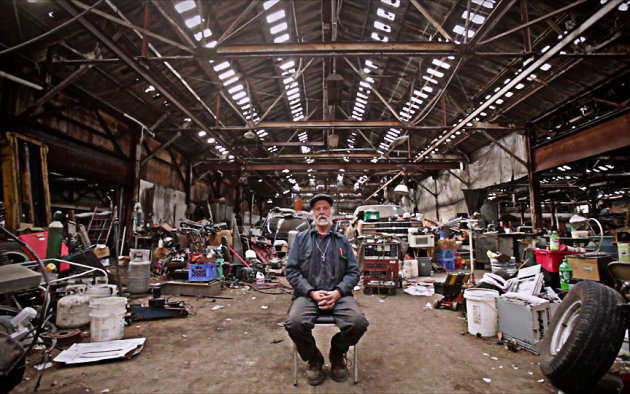 |
| Alan Hill in the abandoned Packard factory he calls home |
What's most surprising about this moving mini-documentary is Hill's "quality of life" doesn't look as terrible as you'd imagine, nor does his reasoning for choosing to stay in the largest abandoned factory in the world seem so unsound.
The whole creation is a huge gut-check to our biases. Yes, the Packard Plant is so giant and empty and strange they shoot Michael Bay movies there. And, occasionally, kids push a dump truck out a window.
Yet, Hill has power, Internet access, a welding setup, and a small kitchen. He even maintains a webcam. The owner apparently gave him his blessing so long as Hill works as a custodian of the property.
He reminds me of the Prophet Amos, whom God appointed to tell the Israelites to stop letting the wealthiest few prosper at the hands of the poorest. This was not a popular message as it came at a time when Israel was doing fairly well. Amos also told them to prepare themselves for judgement, especially from a foreign nation.
Amos 9:13-15
"The days are coming," declares the LORD, "when the reaper will be overtaken by the plowman and the planter by the one treading grapes. New wine will drip from the mountains and flow from all the hills, and I will bring my people Israel back from exile.
"They will rebuild the ruined cities and live in them. They will plant vineyards and drink their wine; they will make gardens and eat their fruit. I will plant Israel in their own land, never again to be uprooted from the land I have given them," says the LORD your God."
This video is part of the series This Must Be The Place. The title, of course, is taken from that other great prophet David Byrne. He of the many heads talking.
 | |
| 1937 Packard Sedan made at the factory where Alan Hill calls home |
Friday, February 24, 2012
RIP Mike Davis of MC5 and Destroy All Monsters
Really sad to hear the news on Mike Davis passing on but in the few times that I was able to hang out with him and talk music and art, he was truly a stand up individual. Mucho thoughts go out to his wife Angela and their kids.
Below is a great write up from Billboard about Mike Davis and his legacy.
 |
| RIP Mike Davis, long live Rock N Fuckin' Roll |
As word of his Feb. 17 death spread, musical colleagues remembered MC5 bassist Michael Davis of the MC5 as a key ingredient in the group's "Kick Out the Jams" chemistry that combined ferocity with creative ambition, creating a template for punk rock during the late 60s.
"Michael was a major force in shaping the sound and attitude of Detroit's foremost band of the 1960s and beyond," said Dick Wagner, whose bands the Frost and Ursa Major hailed from the same southeast Michigan scene. "The MC5 was a Detroit music leader and scene-maker, and Michael Davis played his role as foundational driving force as the band's bass player. His place in rock history is firmly held."
Wayne Kramer, the MC5's guitarist, said that, "Michael and I experienced so much together over our nearly fifty years of friendship. We shared great adventures when we were young and even had a few when we grew up. Despite life's twists and turns, and there were many, we maintained our connection. "I loved him dearly and told him so the last time we spoke."
Ted Nugent, whose Amboy Dukes tread the same territory, noted that, "The MC5 were such a powerful musical/spirit force to reckon with, and so very influential to all who witnessed their might, that it is a sad day when half of their incredible rhythm section is gone. Michael was a dedicated musician and a good man. In our Motor City musical wind, he will always be alive and kickin' out the jams."
Davis, 68, died in Chico, Calif., after being hospitalized during the past month with liver disease. His wife, Angela, announced his death on Feb. 18. He's the third member of the MC5 to pass away, following singer Rob Tyner in 1991 and guitarist Fred Smith in 1994.
Davis was studying fine arts at Wayne State University when he dropped out of school to join the MC5, replacing the group's original bassist Pat Burrows. He played on all three of the group's albums and stayed with the band until it ended in 1972. He took part in a 1992 tribute concert to Tyner in Detroit and was part of the DKT/MC5 with Kramer and drummer Dennis "Machine Gun" Thompson as well as guest musicians.
"It was always like a huge fantasy that there would be another day in the sun," Davis said when the group began touring in 2004. We've been sitting on the sidelines watching the legendary status of the MC5 grow over the decades.
Now it's not a fantasy anymore. The call is out. People want to see the real deal, and they want the MC5, or what's left of it, to show up in their town and play.
"I'm just happy to carry on the thing that I started."
Between the MC5 and DKT/MC5, Thompson played in the bands Destroy All Monsters and, after moving to Arizona, in Blood Orange and Rich Hopkins & Luminarios. He also worked as a producer and, after surviving a May 2006 motorcycle accident in Los Angeles, set up the Music Is Revolution Foundation support public school music programs. He had also returned to painting in recent years.
"(The MC5) really was a band, so everyone contributed -- Michael as much as anyone else," said Scott Morgan, who led the Rationals and once lived at Davis' house in Detroit. "He was a really solid bass player and a totally good guy."
Destroy All Monsters frontwoman Niagra says Davis was recruited for that band by the late Stooges guitarist Ron Asheton. Davis, according to Niagra, "was sly and funny, rock 'n' roll savvy and witty with lots of energy. A true Gemini....But like most musicians, he wasn't really a tough. It was a convenient pose, a test and a game. He was suave and charming, a drifter and a grifter. He was always gentlemanly to me."
Niagra adds that Davis "used to put his amp on like 10 just for practice. The guys made me tell him to turn down. He made them nervous."
Davis also played in Sillies leader Scott Campbell's band during the late 80s, and Campbell remembered that "Mike's abilities as a bassist barely scratched the surface in the MC5...Mike was the one guy I knew and played with who could dance around the fundamental of a chord and never lose sight of the actual melody. He could complicate the hell out of a bass line, and it always worked in the context of the song."
Iggy Pop, whose Stooges paired with the MC5 as the twin titans of the Michigan rock scene at that time, posted a simple "R.I.P. Brother" on his Facebook page, while Johnny "Bee" Badanjek, drummer for Mitch Ryder & the Detroit Wheels and the Rockets, wrote "We had many good times on the road together. You were part of the Detroit Music Scene and all the World knows it. Much love. God bless you." The Romantics' Mike Skill addressed his Facebook note to the MC5 in general, noting that "you guys were a huge influence...I grew up with your music...Thank you."
David Draiman, frontman of the hard rock band Disturbed, was among the scores of fans who posted Twitter messages about Davis' passing.
Davis is survived by his wife, their three sons and a daughter from a previous marriage. Funeral and memorial plans have not yet been announced.
Thursday, November 17, 2011
Brown Dog Welding Interview
Not quite sure how we exactly found out about Brown Dog Welding, but maybe it found us. Seems to be the way thee ol' inner web starts to find similarities. Maybe our google query was "cool metal fabrication" or it could have been "way too talented metal workers" but we happened to find Josh over at Brown Dog Welding and have been hooked on his cool projects ever since.
After a few emails back and forth, we asked Josh if we would be into a quick interview showcasing his work and ideas. He happily obliged, so here ya go folks, an interview with an amazing fabricator, artisan and all around good dude.
To take a page out of QBall's vernacular, "Long may you fabricate!" Thanks again Josh, we dig your fast response, interesting approach to applied metal craft and all around creativity in what might be scrap metal to the masses.
To take a page out of QBall's vernacular, "Long may you fabricate!" Thanks again Josh, we dig your fast response, interesting approach to applied metal craft and all around creativity in what might be scrap metal to the masses.

Where are ya from?
I'm originally from just south of Grand Rapids, Michigan....a little
town called Middleville. I'vebeen in Detroit for the last 10
years, and in between was a year and a half stint in SoCal.
What makes you stop and think "I could do that and do it better"
I remember having one of the welding instructors at Chrysler's tech center tell me that it was way too difficult to make money in art.....the time, the traveling to shows....it just wasn't worth it. That was never the route I wanted to take though. With the internet I can reach an audience larger than the "craft" circuit will ever touch. I looked at the sites that existed for metal art, and most were pretty poorly done. Blurry pictures, generic web templates, boring descriptions, and a handful of items that were basically from a blueprint made over and over and over again. So I spent a little more money and time up front to create a better presentation. From the site to the pictures to the packaging, I wanted it to be slick. And really the same goes for the art. There are a lot of guys out there that do scrap metal "sculpting." There aren't a lot of guys that take the time to make it look right, proportional...a polished finished product. Kinda like there are rat rod guys who build cool rides with character AND craftsmanship versus guys who use it as an excuse to be lazy and do shit work.
 |
| The Devil is in the details, holy shit talk about technique |
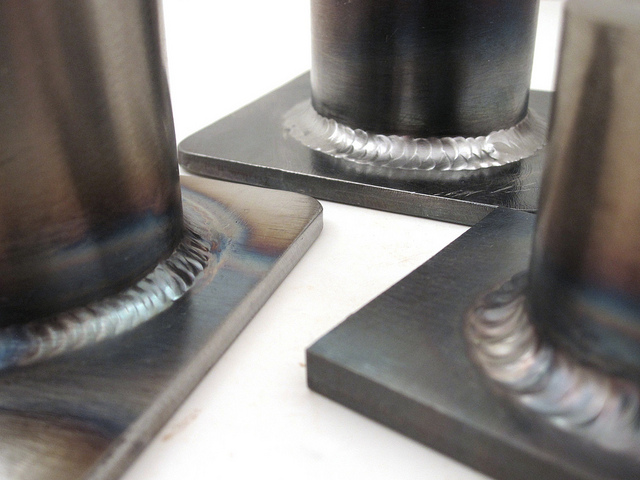 |
| Only TIG Welding can look this good |
On the other side, you've got a bunch of "fine" artists who come up with a metal concept, think they can grab a mig gun and make it happen. I was at the DIA(Detroit Institute of Arts) two summers ago and there were several pieces that fit into this category. I can't paint, and even if I've got a brilliant idea for a painting I'm not gonna pick up a brush, it would be a mockery to the genre. But for some reason these guys think piss poor metal work isn't gonna detract from their "metal art". Welding has always been first for me. The art has always been an extension of that.
And with the welding....I showed an aptitude for it right off the bat, and just kept challenging myself to get better, more consistent, proficient in different techniques. I was surrounded by experienced guys I could learn from, and they pushed and encouraged me. I'm not a "with hard work you can do anything" kind of person. Drives me nuts, because it's such a common cliche we hear every day. But you gotta have talent, passion, AND a work ethic. 1 or 2 out of 3, and you'll be alright. Just the work ethic, and you'll reach your potential. Put all three together, and the sky is the limit. I'd like to think that's where I am, and I keep pushing myslf.
How did ya get into welding or thinking that glowing hot metal is better than splinters and saw dust?
Dumb luck. Long story short, despite growing up with a dad and grandfather who were both gifted craftsmen, I had no desire to get my hands dirty. I didn't take so much as a shop class growing up. After breezing through high school, I went to college and quickly realized that wasn't for me. What I did get out of college were some great friends and my future wife, Darla. Her dad was a millwright at Chrysler, and he helped me apply there. Once I got my foot in the door I took the skilled trades test. Shortly after that was a layoff from Mopar, then a move to SoCal, the wedding, and a move back to Michigan. I got the call to begin my millwright apprenticeship at Chrysler in the fall of 2002. At some point during the first few weeks of training at the Chrysler/UAW tech center, one of the instructors snuck us out back and fired up a generator. He handed me a stinger with a 6010 electrode in it, and once the arc was struck I was hooked. I set myself on fire, too. Was the first time, definitely not the last.
 |
| 5 Window Coupe Engine Details |
 |
| 5 Window Coupe |
If not working in metal, what other area do you think you could
excel?
I'd pry start a cult and prey on the naivety of youth. Or maybe I'd be a concert pianist.
 |
| TIG Strings are just purdy |
 |
| Cult conviction is required for all the details on these builds |
How often on a job site do you get to be creative or weld your way out of a corner?
Working in prototype, every day.
Does production work fuel your creative work?
Nope. I don't do production work, and never have. I've got a very limited attention span, I'd never make it! My current full time gig is at General Dynamics working in their prototype shop, and I love it. Always something different.
 |
| Matchless G50 Race Bike |
 |
| Alien Robot and Dog |
If you didn't have any size limits or worry on shipping what kind
of sculptures would you build?
I've thought about doing some large scale stuff, but that would require taking my time and planning! I'm not much for either. Maybe one of these days...
Get tech with the readers, what is your current shop setup for
welding, cutting and machining?
In my personal shop I've got a Miller DVI 2 mig machine, a Miller Dynasty 200DX for tig/stick and a Hypertherm Powermax 30 plasma cutter. I've also got a oxy/acy setup, drill press, band saw, ect. Basic stuff as far as that goes, I don't do any machining. The Dynasty is definitely the shop workhorse.
 |
| Recycled Die Grinder Sculpture |
Do ya think good machines are overkill with too many features or
should everyone learn to gas weld at first to understand puddle
flow?
As an apprentice taking the intro to welding course at Macomb CC, we did gas welding... and I really haven't done much of it since. It's cool because it's traditional, and there can be some benefits using it on chromoly and even aluminum, but tig welding really just blows it away as far as versatility, precision, and ease of operation. Learning to weld with tig as opposed to gas isn't much of a negative in my eyes.
And the new inverter machines are super sick. I've got the 200dx at home, and at work we've got a shop full of Dynasty 350s and a 700. Maybe you don't need all the features, and personally I'm not much of a "geek" when it comes to studying the waveforms and whatnot, but a few of them are handy doing fab work you'd do in your garage. The ability to crank up the pulses per second on stainless steel really helps control warping and increases corrosion resistance. The frequency and balance adjustment in A/C can help you dial in a bead for welding aluminum, and on the 350/700 machines you can adjust it even farther for cleaning or penetration with separate wave controls.
The flip side of that is that folks (usually, but not always, beginners) often get too caught up in the settings and features. I get asked all the time "what settings are you using? What tungsten? What cup? how many amps?" ...like if you set it all up the same, it's just gonna work like magic. In reality, it's nice to have the ability to fine tune a machine for a particular joint, position, or material, but you've still gotta have the skills to pay the bills. Half the time I sit down at a machine in the shop I don't even look at how it's set up, I just turn it on and go. And if you've got an older transformer machine, there's nothing wrong with that either. I learned on a monster Miller Syncrowave, and I've seen some beautiful work done with ancient Linde Heliarc machines too.
 |
| Nuts, Bolts and Bulldogs |
 |
| Metal Head Elephants |
Material prep and cleanliness, however, can't be overstated. Cleanliness is godliness when it comes to welding.
If you're learning, do yourself a favor and take a community college class. Preferably one that does, at the very least, some type of destructive testing. I've pissed off a lot of self taught DIY guys in the past by saying this, but you don't know what you don't know. So much goes into make a weld strong.
What music do ya dig listenin' to in the shop?
Chopin, Rachmaninoff, or even some old school Ennio Morricone scores. They make you feel ten foot tall and bullet proof. If I listen to Tool, RATM, or Nirvana I end up losing my patience, cursing and throwing junk everywhere. Daft Punk, Justice, or Deadmau5 you can weld to...but no rap or hip hop. Totally throws my rhythm off.
 |
| Commission work of Fat Tire Bicycle |
 |
| F16 Fighter Plane |
 |
| 1941 Flathead Indian Bobber |
 |
| Scrap Metal Bike Build |
 |
| Beauty is in the eye of the beholder |