A perfectly balanced engine that pennies will not roll off of
To get something done fast, easy and cheap seems to be the modern approach to just about anything under the sun. Sadly, this lazy approach has become cancerous in so many areas, that finding anyone really putting a lot of care and effort into their work can be a daunting task. This is where a man by the name of José Manuel Hermo Barreiro walks into the picture and lets his work speak volumes. His work is a masters class in precision, patience and engineering and I can sit here for hours and watch this come to life over and over again.
Maybe you are asking yourself, what the hell is Maker Faire? Maybe you already know all about it or have heard of Make Magazine. Anyhow, you are now hearing all about it from us. What it is in a nutshell is a gathering of tinkerers, craftsman and anyone that wants to share their knowledge of DIY building principles and push the boundaries. This type of event left me scratching my head with ideas and thinking on just how we can be a part of it next year.
Do yourself a favor and dive into the links and become part of this of great cast of characters.
Mechanical devices never fail to intrigue our imagination. When these devices are created using trompe l'oeil, the viewer can become engaged in a vastly different way. Not only are you as the viewer witnessing a device that operates for a specific function, but several of the characteristics that define it's visage are also part of the design. Automaton's are a pre-cursor to the modern computer as they were designed to be highly programmable and they also function in the visual realm. Have a look below at a few of the amazing automaton's that were created by talented engineers whose curiosity and artistic flair merged together for timeless entertainment.
More on Pierre Jacquet-Droz from Wikipedia (1721–1790) was a Swiss-born watchmaker of the late eighteenth century. He lived in Paris, London, and Geneva, where he designed and built animated dolls, or automata, to help his firm sell watches and mechanical birds.
Constructed between 1768 and 1774 by Pierre Jaquet-Droz, his son Henri-Louis (1752-1791), and Jean-Frédéric Leschot (1746-1824) were The Writer (made of 6000 pieces), The Musician (2500 pieces), and The Draughtsman (2000 pieces).
His astonishing mechanisms fascinated the kings and emperors of Europe, China, India, and Japan.
Some consider these devices to be the oldest examples of the computer. The Writer has an input device to set tabs that form a programmable memory, 40 cams that represents the read-only program, and a quill pen for output. The work of Pierre Jaquet-Droz predates that of Charles Babbage by decades.
The Jaquet-Droz automata
The automata of Jaquet-Droz are also considered to be some of the finest examples of human mechanical problem solving. Three particularly complex and still functional dolls, now known as the Jaquet-Droz automata, are housed at the art and history museum in Neuchâtel, Switzerland.
He once constructed a clock which was capable of the following surprising movements: There were seen on it a negro, a dog, and a shepherd; when the clock struck, the shepherd played six tunes on his flute, and the dog approached and fawned upon him. This clock was exhibited to the King of Spain, who was delighted with it. "The gentleness of my dog," said Droz, "is his least merit; if your Majesty touch one of the apples, which you see in the shepherd's basket, you will admire the fidelity of this animal." The King took an apple, and the dog flew at his hand, and barked so loud, that the King's dog, which was in the room, began also to bark; at this the Courtiers, not doubting that it was an affair of witchcraft, hastily left the room, crossing themselves as they went out. The minister of Marine was the only one that ventured to stay. The king having desired him to ask the negro what o'clock it was, the minister obeyed, but he obtained no reply. Droz then observed, that the negro had not yet learned Spanish.
Pierre Jaquet-Droz
Back of automaton by Pierre Jaquet-Droz showing the complex cam system
Back of automaton by Pierre Jaquet-Droz
Complex detail photo of movable type used in automaton by Pierre Jacquet-Droz
We have come extremely far in technology, but once an automaton such as the bird chirping box below reveals its secrets, it is fair to realize how great inventive minds were over a 120 years ago. You needn't be an ornithologist to appreciate this fine piece of machinery. Do yourself a favor and watch the gears and air box moving, while thinking on the sound you are hearing. This craftsman was a true visionary. View original post on This Is Colossal "Get out the headphones or turn up your speakers and prepare to be impressed by archaic 19th century engineering. Relying on dozens of moving parts including gears, springs, and a bellows, this small contraption built in 1890 was designed to do one thing: perfectly mimic the random chatter of a song bird. At first I expected to hear a simple repeating pattern of tweets, but the sounds produced by the mechanism are actually quite complex and vary in pitch, tone, and even volume to create a completely realistic song. I think if you closed your eyes you might not be able to tell the difference between this and actual birdsong. It’s believed the machine was built 120 years ago in Paris by Blaise Bontems, a well-known maker of bird automata and was recently refurbished by Michael Start over at The House of Automata. Can any of you ornithologists identify the bird? If so, get in touch. (via the automata blog) Update: And if you liked that, check out this pair of matching signing bird pistols that sold at auction last year for $5.8 million."
Sustainable materials are all around us. Now, it is just a matter of reformulating their original purpose and repurpose these materials into new and challenging solutions. Who woulda thunk that cardboard could be crafted into functional bicycle or that wood could be potentially stronger than kevlar or carbon fiber? Necessity is the mother of invention and hearing about stories such as a bike being built from cardboard keeps us awake at night. We know of the amazing building properties within bamboo, concrete, hemp and an array of other materials, so now we are seeking out a plethora of interesting stories such as this. Neil Fallon sings it best in the Clutch song You Can't Stop Progress Link to short film on Vimeo
Questions and answers, original post and info here What was the biggest challenge in working with cardboard?
The biggest challenge of the Cardboard Bike project was to learn and develop a whole new know how of cardboard. Our challenge was to take the cardboard material, and pass it through a set of treatments, to replace the raw materials of plastic, wood or metal.
What did you learn from the experience?
What start up nation learned: That Nothing is impossible if you have patience and you are persistent.
How far along is the development of the Cardboard Bikes?
The development started 3 years ago. Since there was no know how with regards to the cardboard material, the first 2 years were devoted to learning the properties and behavior of the material; from all aspects of engineering tools, strength calculations and analysis and establishment of the IP that protects all of this know how. The "packaging box on wheels" as seen in our video was the third prototype, the Alfa commercial model (with the letter A on the chassis), is the first operational model that is made of a 100% recycled materials (with the electric motor as an add-on option).
Is it patented?
All know how, working procedures and production techniques are fully patent protected worldwide by Israel’s leading patent Reinhold-Cohen.
When will the company get to the point where it is manufacturing?
The Company is now in the process of raising funds that will bring the company within 6 months of investment to the point in which we will have a full and detailed manufacturing plan for the first 2 platforms.
The commercial/Urban bikes (BOM – $9, 9 KG), and the kids/youth bike (BOM - $5, 3.5 KG). These models will be made of almost 100% recycled materials and will have the option of adding an electric motor.
At this stage we have only the prototype for the commercial bikes as shown on the video.
How do you have the knowledge to take it from here to the market?
The inventor, Mr. Izhar Gafni, is a mechanical engineer and a multi-disciplinary systems developer.
Izhar developed the recycled cardboard bikes combining his knowledge in 2 main areas: being an expert in building and designing custom made carbon fiber bikes for high end riders and his experience as a production line expert. Izhar is known for his former developments of the Pomegranate Peeling Machine (for which he has won a prize by the American Association of Engineers), a Smart Robot for sewing shoes, a Disabled Climbing Machine and more.We believe we have the knowledge and the ability to reach our goals and that nothing is impossible.
What is your vision?
Cardboard Technologies is all about making a better world for us to live in by two main principals: creating the ability to produce almost any daily product from at least 95% recycled materials and building auto production lines, with a simple post production assembly that will be performed by people with difficulties or disabilities.
Unlimited and incentivized raw materials and incentivized manpower will help us create working places in every location which we will find a local partner at.
Our vision is also to bring the factories back from China (starting with the green ones).
What is your business model, and what will be the end user cost of your bikes?
The principals of our vision above, will allow our partners and manufactures to receive almost all of the of the production costs of our products back from governmental and global incentives, making our products available to almost any person in any philanthropic or commercial business model.
We can add any design or logo to the bike chassis for example and with by adding a simple electric motor, making it the most classical urban clean transportation.
This will allow our bikes to be given away as a commercial transportation or as a gift for Christmas from your Mayor.
Another important attribute of our bikes, is that they need no adjustment or maintenance, making them available directly to consumer at low price, and not through the regular marketing chains that will bring it to an end cost of X5 post assembly."
There is just something special about old iron. We know it has aged and been worn in by use, but is that what gives it soul? Or is it our mind wandering around the details of the stories it has been a part of. Any of these ideas could be applicable just depends on how you relate to the story.
"Only the finest machines ever built by man will ever grace the Pebble Beach Fairway, and all entrants of this event are here by invitation because of their machines are of historic significance. Chronologically, you are going to see:
1 - 1885 Daimler Reitwagen 0:05. This is the world’s first gasoline-powered motorcycle. Built by Gottlieb Daimler and Wilhelm Maybach. 2 - 1968 Munch Mammoth 1:07. The world’s best performing superbikes between the years of 1966 and 2001. 3 - 1951 Konsul II 501 OS-T 1:56. 68 mph on 2 wheels. 4 - 1965 DKW Hummel 155 2:36. Das Kleine Wunder (the little wonder) was capable of cruising at 45 mph and was a legendary shock to conventional motorcycle design in Germany. 5 - 1954 BMW Rennsport 3:16. Riders complained it was unstable. Sidecars fixed the stability issue. It did become one of the most successful side-car racing bikes anyone could want. 6 - 1932 BMW R32 4:15. It was the first motorcycle produced by BMW. Designed by Max Friz, top speed on this motorcycle was just under 60mph. 7 - 1934 BMW R7 5:24. This bike never saw production, thanks to Hitler. This one won Best-In-Class! It was a prototype. 1 of a kind. 8 - 1953 Adler M250 6:36. One of the most winning motorcycles in European racing. Adler became the strongest driving forces pushing racing competition on both circuit courses and endurance events and powering the careers of many of Germany’s finest road race riders. 9 - 1930 Opel Motoclub Model T 8:02. Restored to its original appearance. 10 - 1950 Imme R100 10:50. Germany’s steel industry was devastated when it was constructed, which contributes to its minimalist design. 11 - 1894 Hildebrand & Wolfmüller 13:29. This is the world’s first production motorcycle. A 1.5L single-can machine with “no real brake”. Listen to the engineer who restored it. Priceless."
A few months back we were hangin' out while eating some breakfast and cruisin' through youtube videos looking at various motorcycles, engine builds and killing time listening to music. But while sorting through our mental catalog of upcoming projects, we happened to see a particular video and an idea struck us.
Now as much content is uploaded to youtube daily or lets say by the minute (roughly 48 hours of footage is uploaded every minute,) the progression of the site seems to indicate that it truly is becoming the new FM station du jour, for your favorite music. With a world wide audience at the ready and the ability to stream 24/7, youtube is the future of content programming. The best part is that you can sift through to exactly what you want to hear or see and its free.
Our default some days might be watching vintage motorcycles fire up or our absolute personal favorite is to view process videos of objects being made. So that lands us square into another big project that we have cookin', but we needed some outside help on this one.
As y'all know, we are workin' with the one and only Billy Don Burns and his new album will be coming out on July 10th. For as great as the music sounds, we knew that we needed a better way to help get his songs out to fans world wide and to take a different approach. The same way Billy Don might craft a new song, was our guiding path to hatch a new plan to grow his fan base. Luckily we happened along to one cool dude by the name of Richard Peek. After numerous emails back and forth about our idea, he was on board to help build a truly unique element for this album.
Tomorrow we will launch part one in a series of process music videos to shine light on Billy Don Burns new album with the help of Rpeek, our new favorite back yard builder!
Below is quick write up on Richard Peek and what makes him tick, read on and enjoy the videos as they roll out...
Richard Peek - Backyard Builder Extraordinaire
1. tell us about yourself, what drives you to work through new ideas and seek out new possibilities?
I don't think of myself that way at all. I'm still trying to catch up with all the old idears that's been stuck in my head for the last 50 years that I never had the time or the money to mess around with.
2. What really got you started into making Gas Can Banjo's?
I can't take credit for it. I seen one on ebay many years ago. Someone stuck a 4 string banjo neck on a can and was sellin' it for $45 bucks. I figured it seemed like a good idear, only I converted a 4 string neck to a 5 string. At first I thought it sounded like crap, but over time I learned to make it do what I wanted it to do. Still got that first gas can banjo too, and I think it's the best one I ever made.
Gas can we won on Ebay is going to turn into something really cool for Billy Don Burns
Just one of Richard Peek's ornate back yard builds
3. How many have you made so far?
The one I'm making for you will be #10. Every one is different. Each has its own personality and sound. I never know how one is going to turn out. I had a girl bring me a 5 qt oil can she found in the woods and asked me to make it into a banjo for her so I did, and that rusty old can had the best tone quality of any I've made so far...
4. If you could pick out new type of musical instrument to build what would it be?
Oh I don't know. Maybe tractor music. Like let's crank a tractor, get it to lope along, get some guys to squeel their tires in the background. Mess around with different types of rubber to adjust the tone of the squeel and see if we can make music out of it. hahaha
5. Is the journey to creating a new piece, enjoyable most in the process or at the conclusion of a job well done?
Oh I don't ever think I've done a job all that well. I just get idears and throw things together. Sometimes they delight me. If'n they don't I come up with somethin' else. I don't think about it much.
6. When it comes to building a hot rod, where do you like to start?
Frame. I think about the frame. I'm old enough to know frames. Model A frame. '32 Ford frame. '33 Chevy frame. 55 Chevy frame. 69 Camaro sub frame. Each tells it's own story, makes it's own project happen on it. I know frames, how they should be set up, how they used to be setup and what people do now days, makin' new frames like the old frames didn't matter. I like a car with an old reworked frame best. It's just part of being old enough to understand 'em I guess..
7. What is in store for some future projects?
I've got to build me a bigger garage to put some of this junk in. hahaha
The Cardboard Robot Rumble seeks to make awareness on these delicate issues Link to Them
Should it be a legitimate worry of ours that robots will eventually be designed with enough artificial intelligence to have rationale thoughts and a conscious? At the rate to which the robotics field is moving, it is truly a potential future. In our blue collar mindset, all these robots will do is to make more folks even lazier. Imagine what will happen when the robots then get lazy? Doomsday?
Can ya just imagine picking up your new robot from Lowes and within hours of getting home, the robot is already on duty fetching beers. Well that is maybe our scenario of how to put them to good use, but will they attack? Yep, that is our main concern. Maybe a kill or trigger switch is put into them, sort of like in Zoolander and they will be at someone's beck and call.
Think we are crazy, watch these videos...
We are not just crazed in our thoughts on this notion as it has been of big concern to many think tanks and well document in pop culture with films such as I Robot and Terminator. Laws are already on the books about preventing such measures, such as what has been reported in the Wall Street Journal alluding to the person who owns the robot becoming responsible for the actions.
Below is quite the interesting article on a particular Robot called ECCERobot built in conjunction with the University of Belgrade. From the photos and quite informative video, leave it up to the imagination, but we know for sure where the future is heading.
"Robots being part of our daily lives seems less of a question of “if” than “when.” Yet there’s no consensus on how they’ll look or work. Will they be Asimovian metal bipeds or something we haven’t even imagined?
Researcher Owen Holland from the University of Belgrade’s ETF robotics department has a vision of the robot future that’s equal parts grotesque and convincing. His vision (built by Rob Knight of The Robot Studio), ECCERobot, is a robot built with the body of a human. It has most of our same bones (though fashioned from plastic rather than calcium), and its muscles work much like ours (though they’re driven by kitestring). ECCERobot looks like a human with much of the skin and connective tissue removed, and that’s entirely the point.
“We didn’t want to build a robot that worked perfectly--we wanted a robot that worked exactly like a human being, so it’s more complicated than other robots, and the large number of joints and the elasticity of the muscles and tendons make it much more difficult to control,” Holland tells Co.Design. “We wanted ECCERobot to move exactly like a human being, so that its interactions with the world would be human-like, and so its cognitive abilities would be shaped by the same factors as human cognitive abilities. We also wanted to find out how to control a human-like body--this information would help us to understand how the brain controls our bodies.”
Now ECCERobot isn’t quite a 1:1 humanoid robot. It’s clearly missing articulating legs. And some components were simplified by engineering necessity--we can’t precisely duplicate human wrists and thumbs because no engineer can manufacture their small, strong muscles and tendons yet. All the same, the robot’s body functions a lot like a human, to the point that the discs between segments in its spine gradually compress during the day (just as they do in our own bodies). “We have to lie it down every night to allow the discs to recover their shape, and so the spine goes back to normal,” Holland says. As silly as a robot that “sleeps” may sound, it’s these very human limitations that make ECCERobot so promising as an android companion.
“This way of building robots doesn’t just produce a robot that moves like a human, but it also produces a robot that is safe for humans to interact with, because the elasticity of the 'muscles’ and 'tendons’ makes it compliant and soft, unlike conventionally engineered robots,” Holland explains. “We believe that this factor alone means that future robots will be more like ECCERobot than the current generation of hard, stiff metallic robots.”
This human “softness” counterintuitively creates a more durable robot, as its body can absorb impacts better than a rigid structure. Iron Man may stop a bullet, but our organic jelly bodies are inherent experts at taking a fall or a punch. Yet the most interesting aspect of ECCERobot’s design might be the most unanticipated one. This robot was, from the start of the project, built for scientific observation, and its post-autopsical body would seem anything but approachable. But it is. “Lots of people are attracted by the robot, and naturally want to interact with it, even though we have made no attempt to make it cute or cuddly,” says Holland. “We think that people unconsciously recognize that it is somehow very similar to them, and so they feel comfortable with it.”
Personally, I want to get the poor robot a shot of morphine and a decent coat of skin. Then, and only then, will I give it one of my world-renowned hugs (because the poor guy sure looks like it needs one)." - Mark Wilson
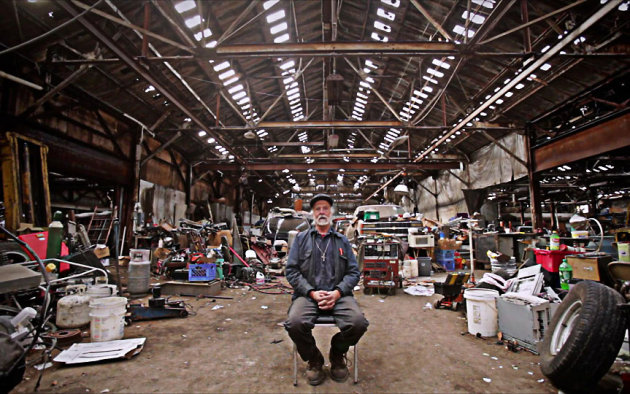
Beauty comes in many shapes, sizes and forms but what Alan Hill has found, is his own personal utopia. We can be quick to think on all the things we want and need, but what is the ultimate price that we will pay to get it? Not to wax too poetic or dive too deep philosophically, but take a gaze around your humble abode. Is this exactly where ya want to be or could you change up the setting to fit more into your ideal conditions. He truly has one of the largest live work spaces on the planet, damn cool in my mind. The running water might be a tough one to get around though.
Alan Hill in the abandoned Packard factory he calls home
Perhaps the biggest shortcoming of Detroit "ruin porn" is it inherently ignores the very real people who still live in the city. Now there's a convergence — the amazing story of Allan Hill, the man who legally lives inside the city's abandoned Packard Auto Plant.
What's most surprising about this moving mini-documentary is Hill's "quality of life" doesn't look as terrible as you'd imagine, nor does his reasoning for choosing to stay in the largest abandoned factory in the world seem so unsound.
The whole creation is a huge gut-check to our biases. Yes, the Packard Plant is so giant and empty and strange they shoot Michael Bay movies there. And, occasionally, kids push a dump truck out a window.
Yet, Hill has power, Internet access, a welding setup, and a small kitchen. He even maintains a webcam. The owner apparently gave him his blessing so long as Hill works as a custodian of the property.
He reminds me of the Prophet Amos, whom God appointed to tell the Israelites to stop letting the wealthiest few prosper at the hands of the poorest. This was not a popular message as it came at a time when Israel was doing fairly well. Amos also told them to prepare themselves for judgement, especially from a foreign nation.
"The days are coming," declares the LORD, "when the reaper will be overtaken by the plowman and the planter by the one treading grapes. New wine will drip from the mountains and flow from all the hills,
and I will bring my people Israel back from exile.
"They will rebuild the ruined cities and live in them. They will plant vineyards and drink their wine;
they will make gardens and eat their fruit. I will plant Israel in their own land, never again to be uprooted from the land I have given them," says the LORD your God."
This video is part of the series This Must Be The Place. The title, of course, is taken from that other great prophet David Byrne. He of the many heads talking.
1937 Packard Sedan made at the factory where Alan Hill calls home