McSwain Guitars Proves That One Off Custom Gear Is Just As Important As A Great Song
If you choose to use a guitar to speak your language and also as a visual selling point, McSwain Guitars might just be right up your alley. Amazingly precise detail work and known for their solid sound, these guitars aren't just works of art, but maybe the muse you need to kick out the jams. I found out about them through links on Vimeo and once I started to explore, I just had to report back and show what I had found.
Learn more about Alex Bishop and his luthier work "My passion as a guitar maker comes from a life-long obsession with making things. From a young age I have always tried to manipulate objects and materials in order to create something entirely different. I find that working with wood is a way for me to connect with nature. The simple act of shaping wood to make something functional or beautiful brings me endless satisfaction.
Having left a degree in Aerospace Engineering in Bath, I moved to London in 2007 to pursue the possibility of becoming a guitar maker. I studied for a BSc degreee in 'Musical Instruments' at London Metropolitan University, and I graduated in 2010 with a First Class Honours degree, the 'Top Thirty Student' award, and the 'University Recognition Award For Academic Excellence' award. Working for three years under the expert guidance of Nicholas Blishen, Norman Myall, Martin Bowers and Godefroy Maruejouls, I developed a flair for guitar making.
Who wouldn't want to learn how to play guitar and to be able to do it in an easy manner, such as learning it through youtube. The more technology progresses the cooler the apps become, along with new innovative ideas. We are true fans of adding new arrows to the quiver and a tool such as Soundslice, just might help the budding guitarist, go from good to great.
Learn how to play guitar through youtube, via soundslice
"As of yesterday, there were only two ways to learn guitar music from the web: Googling a tablature file and emulating another guitarist on YouTube. While both are easier (and cheaper) than buying a book of sheet music, they are not without tedium.
Tablature files (or “tabs” — a simplified guitar notation in plain text format) are aggregated by shady content farms with strong SEO and dubious quality control. YouTube videos provide audio and visual instruction, but require patience and the ability to “read the fingers” of the performer.
That’s why Soundslice is a revelation for self-taught musicians. Built on YouTube’s API, it’s a transcription interface that syncs tablature and videos so players get the best of both worlds. You can also play the video at half speed (without changing the pitch) and loop small sections if you’re trying to pin down a tricky riff. Everything functions in your web browser or iPad — there’s no software or apps to install.
While these tools are outstanding in their own right, the big promise here is in creating a rich trove of living, accurate guitar tutorials for everyone on the web to enjoy.
“My goal was to make something for myself, to make transcription less painful,” the site’s founder Adrian Holovaty tells Mashable. “I’d spend hours transcribing stuff, either on paper or in lousy text files, then I’d come back to it later and have to re-listen to the music to make sense of my own tab. I started to think, it would be so much easier to learn if the tab were synced with the original audio.”
Holovaty has been working on this project for the last three-and-a-half years, and is no stranger to the web startup world. He launched EveryBlock, a network for “microlocal” journalism, in 2007. It was acquired by MSNBC.com in 2009, and Holovaty stayed on, working on Soundslice in his spare time. He left the company in August looking to do something new, and ended up focusing on the music project. “This is actually the third incarnation of Soundslice. The first version was in Flash and used MP3s, the second version was a really bad HTML5 MP3 version, the third works only on YouTube.” Soundslice uses YouTube’s official HTML5 JavaScript API, which allows developers to control videos using their own interface. Users can work from any YouTube video, not just their own. The transcription editor UI is similar to multi-track recording software. Add a track for chords, tab notation, song structure (chorus, verse, bridge) and start plotting.
Drag the length of the note on the string and add the fret number. Space bar will start and pause the video. You quickly realize that Soundslice adds a temporal dimension to tablature without need of time signature or measures. If the community takes off, it could fundamentally change how the Internet thinks about, creates and shares this kind of notation.
I asked Holovaty about the potential for Soundslice to become a social network. “It can become a commons for user-generated musical annotations and transcriptions,” he says. “At the moment, social interaction is very limited — you can see other people’s annotations and see all the other videos they’ve annotated and that’s it. But obviously, there’s a ton of potential to do more.”
Holovaty envisions the classic 20/80 split — 20% of users will create the content for the other 80%. “Originally I imagined it to be for relatively advanced musicians, but I’ve already seen some simpler stuff come through the system. Never underestimate the power of bored high school or college students who want to learn music!”
Why would someone painstakingly transcribe a song into tablature and give it away for free on the Internet? The fact is, people have been doing that for years. “If you’re already doing the work of transcribing something — which is very labor intensive — you might as well do a tiny bit of extra work to make an incredible synced video thing. The end result is just so much better than a text tab, and it benefits other people who want to learn that tune in the future.”
That work will also be connected to your Soundslice account. Savvy transcribers might sync their own videos to teach, thus generating views and ad revenue from YouTube’s partner program. There’s a lot of potential for power users.
Quality Control of UGC
Current tab repositories are a cluttered mess. A song might have 20 versions, each with its own errors or embellishments. Quality control of user generated content can be a challenge, but Holovaty sees two potential modes.
“I’m considering both a revision-control model (like GitHub) or a Wikipedia model,” he explains. “What would make more sense for annotations: “branching” changes where everybody owns their own data and accepts pull requests, or a more shared wiki-style thing where anybody can edit anything, with revertible history? I’ve been thinking about it for a long time and am still not sure.”
Business Model
The other challenge for UGC networks is monetization.
“I’m planning to add a pay-for version, where you can upload your own tracks as opposed to relying on YouTube,” Holovaty says of his future business model. “Plus, you’d get some niceties like a graphical waveform display, more fine-grained slowdown and an automated first-pass at the transcription (which would be imperfect but at least a starting point). I’d also like to talk to music education companies who might want to pay me to embed the interface into their own sites.”
Regarding that automated transcription, Holovaty is experimenting with software created by The Echo Nest — algorithms that power music analysis apps like Spotify and iheartradio. Turns out, auto-generating sheet music from a complex recording is still a long way off. It’s a computational feat akin to sentient artificial intelligence, says Holovaty, who has been studying this kind of technology for some time.
“The Echo Nest has some nice APIs that make automated guesses at the underlying musical information in an audio recording,” he says. This means that a human could provide the framework for the transcription, and an algorithm could work from that to fill in the gaps, speeding up the process. Holovaty hopes to include this in future paid accounts.
For now, he and his designer PJ Macklin (the only two people working on Soundslice at the moment) are looking forward to seeing what users create, and adding features based on feedback. “Next up is the long list of feature additions and improvements. And of course, paying the bills and getting people to use it!”"
Are you curious if strange musical instruments will ever make a resurgence? Hell, maybe you think that those who tinker with unique sound quality are pure artists. You could very well be right, but damn if we haven't found some tinkerers that were looking for more than just a new sound. These folks were down right engineers seeking a whole new level of opportunity. Check out the original article on Popular Science
Known to woo sirens of any sort and as a precursor to prog metal, the Harpitar in the right hands was a lethal instrument
The Harpitar, September 1918 Finding the guitar to be a "sweet-toned instrument, but [lacking] in projection power," R.E. Bates created a Franken-instrument: a combination of a guitar and a harp, aptly called the Harpitar. It has six strings, and it's strung like a guitar with a key difference: The strings are stretched across the body of a harp. All six strings are at the center, where "the greatest volume of tone is obtained." The result, Bates said, is that "it combines the simple chromatic scale of the guitar with the peculiarly beautiful tones of the harp."
Who cares about a one man band, when you could have a one man orchestra. Solo folks, take note...
One-Man Orchestra, July 1922 If you know how to play one instrument, you are suddenly able to play three, using this device invented by William J. Maxwell. When the player strikes a chord on the "master instrument," two other instruments chime in with harmonious chords. This is made possible by "electrical contact on the fingerboard of the master instrument." In the photo here, the banjo is the master instrument.
Anton LeVey and his Theremin would be no match for this Sound and Light show, who's composer also looks like Houdini
Sound and Light Show, March 1926 The luminaphone turns beams of light into music, with 37 possible notes on its keyboard. When you strike a note, it releases a light beam from a projector. The beam then passes through a perforation in a revolving disk, hitting a selenium cell, which changes the light into an electrical vibration. A tube amplifier magnifies the vibrations and emits the sound through a loudspeaker, turning the flickering lights into a beautiful song.
Coconut milk giveth and taketh away, in this case musically
Singing Coconut, March 1926 We've all heard of the ukelele. But what about that other Hawaiian export, the singing coconut? A stringed instrument whose body was made from the polished shell of a coconut, we predicted these singing coconuts would be produced at a rate of 50,000 per year, at factories such as this one in Honolulu, pictured at left.
Rockabilly should take note, no matter how much you slap that neck, yours is still tiny in comparison
World's Largest Fiddle, April 1935 An elderly gardener-cum-violin maker in Ironia, New Jersey, built this 14-foot fiddle as his magnum opus. The sound box alone is seven feet high. Just think of the jigs he could play! You could have a square dance that stretched for miles. It boggles the mind. But this master craftsman did not stop there, oh no. His other creations include a hybrid harp/cello, a dwarf cello and a violin with three necks.
Want to get really folky with your vegetables? Make an instrument from them.
Make Your Own Vegetable-Shaped Instruments, November 1935 A clay whistle called an ocarina is also known as a "sweet potato" because, well, it's shaped like one. PopSci determined that using plaster of Paris, you can make an ocarina at home, modeled after almost any fruit or vegetable that tickles your fancy ("carrots, turnips, Irish potatoes, beets, parsnips and bananas were all tried with equal success"). As long as you make sure the air chamber is irregular and the air is blown in from the side, not the end. Of course, you won't be playing any sonatas on these vegetables: "Though not extremely melodious, it is easily played and affords a great deal of entertainment."
This is totally the wrong person in this illustration, it should be a dude with really tight pants, curly Q mustache and be singing about the rapid decline of squirrels in city parks or something else completely random and hipsterish
The Cello-Horn, October 1936 This device that looks like a squirrel-sized playground slide debuted at a Chicago trade show under the name "cello-horn." It's played like a cello and "produces a unique tonal effect," making the player just one woodwind short of an orchestra.
Really? A bow on a mop handle? C'mon!
Extracting Music From Anything, August 1937 Ohio State University professor Charles C. Weideman had more than 100 home-built instruments made from strange materials such as garden hoses, cardboard tubes, canceled bank checks and turkey bones. This peculiar predilection began early, when, "as a boy of ten, he tuned the pickets of a fence in front of his home by cutting them to various lengths, and played melodies on them with mallets." Pictured here clockwise from the top, Weideman plays the world's largest xylophone made with cardboard mailing tubes, trumpets on a length of garden hose and plays a wire strung on a mop handle.
Typing music? Wasn't this meant for assistants or maybe scribes known as umm... secretaries?
Typing Music, December 1939 If this instrument were available now, we could turn every blogger in the nation into a virtuoso worthy of Carnegie Hall. The "score" for a song is just words on a page, and by copying them on this typewriter invented by court reporter Alexander Rose, the words become music as the keys strike strings inside, much like a piano. Suddenly typing 120 words per minute becomes more than just a recipe for carpal tunnel syndrome.
For video part four of the gas can banjo build for Billy Don Burns, Rpeek focuses on the neck of the banjo and the hardware for adding the strings. This video part features the song "Gaylor Creek Church" from the forth coming album, Nights When I'm Sober, Portrait Of A Honky Tonk Singer available July 10th.
"A while back I got an email from someone asking me to build them a gas can banjo. I said no. I always say no. I'm just too busy to put the kind of time it takes into building one for someone, and I've found that people are generally too hard to please to make it worth my while. Plus there's no money in it.
Anyway, this guy wrote back and said it was for a special project for Rusty Knuckles Music to promote an album being put out by a guy I'd never heard of named Billy Don Burns.
Now, having drivin' truck for 20+ years I've had all the opportunity I'll ever want to listen to the radio, and generally decided years ago that I don't really much like anything they play on the radio. But what I heard when I went to rustyknucklesmusic.com was different. It was music so cool that I wanted to be a part.
So, I'm building this gas can banjo for Billy Don Burns. I've never met him, but I can hear by the sound of his voice that I know the places he's been and his singing makes me understand....
So these are not going to be a set of "how to make a gas can banjo" videos. Instead, I'm going to make the can, without my own words, and let Billy Don's music fill in the empty spaces. I'll post the videos as I go along, probably about one a week. I'm not sure how many there will be. Enough to finish the banjo. Not sure how long it will take either. It'll be done when it's done.
Billy Don Burns new album, Nights When I'm Sober (Portrait of a Honky Tonk Singer) will be coming out on July 10th through Rusty Knuckles Music. You can get it through their store, itunes, amazon and many more, but most of all get out to see Billy Don Burns live.
The music in this video is the property of Rusty Knuckles Music and Billy Don Burns and used with their permission.
Billy Don Burns new album, Nights When I'm Sober (Portrait of a Honky Tonk Singer) will be coming out on July 10th through Rusty Knuckles Music. You can get it through their store, itunes, amazon and many more, but most of all get out to see Billy Don Burns live.
A few months back we were hangin' out while eating some breakfast and cruisin' through youtube videos looking at various motorcycles, engine builds and killing time listening to music. But while sorting through our mental catalog of upcoming projects, we happened to see a particular video and an idea struck us.
Now as much content is uploaded to youtube daily or lets say by the minute (roughly 48 hours of footage is uploaded every minute,) the progression of the site seems to indicate that it truly is becoming the new FM station du jour, for your favorite music. With a world wide audience at the ready and the ability to stream 24/7, youtube is the future of content programming. The best part is that you can sift through to exactly what you want to hear or see and its free.
Our default some days might be watching vintage motorcycles fire up or our absolute personal favorite is to view process videos of objects being made. So that lands us square into another big project that we have cookin', but we needed some outside help on this one.
As y'all know, we are workin' with the one and only Billy Don Burns and his new album will be coming out on July 10th. For as great as the music sounds, we knew that we needed a better way to help get his songs out to fans world wide and to take a different approach. The same way Billy Don might craft a new song, was our guiding path to hatch a new plan to grow his fan base. Luckily we happened along to one cool dude by the name of Richard Peek. After numerous emails back and forth about our idea, he was on board to help build a truly unique element for this album.
Tomorrow we will launch part one in a series of process music videos to shine light on Billy Don Burns new album with the help of Rpeek, our new favorite back yard builder!
Below is quick write up on Richard Peek and what makes him tick, read on and enjoy the videos as they roll out...
Richard Peek - Backyard Builder Extraordinaire
1. tell us about yourself, what drives you to work through new ideas and seek out new possibilities?
I don't think of myself that way at all. I'm still trying to catch up with all the old idears that's been stuck in my head for the last 50 years that I never had the time or the money to mess around with.
2. What really got you started into making Gas Can Banjo's?
I can't take credit for it. I seen one on ebay many years ago. Someone stuck a 4 string banjo neck on a can and was sellin' it for $45 bucks. I figured it seemed like a good idear, only I converted a 4 string neck to a 5 string. At first I thought it sounded like crap, but over time I learned to make it do what I wanted it to do. Still got that first gas can banjo too, and I think it's the best one I ever made.
Gas can we won on Ebay is going to turn into something really cool for Billy Don Burns
Just one of Richard Peek's ornate back yard builds
3. How many have you made so far?
The one I'm making for you will be #10. Every one is different. Each has its own personality and sound. I never know how one is going to turn out. I had a girl bring me a 5 qt oil can she found in the woods and asked me to make it into a banjo for her so I did, and that rusty old can had the best tone quality of any I've made so far...
4. If you could pick out new type of musical instrument to build what would it be?
Oh I don't know. Maybe tractor music. Like let's crank a tractor, get it to lope along, get some guys to squeel their tires in the background. Mess around with different types of rubber to adjust the tone of the squeel and see if we can make music out of it. hahaha
5. Is the journey to creating a new piece, enjoyable most in the process or at the conclusion of a job well done?
Oh I don't ever think I've done a job all that well. I just get idears and throw things together. Sometimes they delight me. If'n they don't I come up with somethin' else. I don't think about it much.
6. When it comes to building a hot rod, where do you like to start?
Frame. I think about the frame. I'm old enough to know frames. Model A frame. '32 Ford frame. '33 Chevy frame. 55 Chevy frame. 69 Camaro sub frame. Each tells it's own story, makes it's own project happen on it. I know frames, how they should be set up, how they used to be setup and what people do now days, makin' new frames like the old frames didn't matter. I like a car with an old reworked frame best. It's just part of being old enough to understand 'em I guess..
7. What is in store for some future projects?
I've got to build me a bigger garage to put some of this junk in. hahaha
With the passing of Earl Scruggs this past week, we thought it fitting to pass along this article we found over on Collector's Weekly about vintage Banjo's. Earl Scruggs is a foundation in the bluegrass community after his work with Bill Monroe and Lester Flatt paving the way for new forms of melody and picking. The article below gives much more incite into the history of the Banjo and goes into detail on the beauty of the instrument in the design compared to a variety of other pieces, enjoy.
Vintage banjo collector Lowell Levinger is perhaps best known to 1960s music fans as “Banana,” the bushy-haired guitarist and keyboards player for The Youngbloods. Today, Levinger is the proprietor of Players Vintage Instruments, where he buys and sells vintage guitars, mandolins, banjos, and other musical instruments. He also performs bluegrass and folk music for families under the name Grandpa Banana. Recently we spoke with Levinger about vintage banjos and the evolution of the instrument, from its African roots to its role as a bluegrass staple.
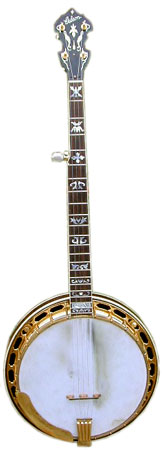
I bought my first really good bluegrass banjo in 1963 from a banjo player who lived in New York. His name was Winnie Winston, and he was a mentor of mine. It was a great banjo, a Gibson RB-1 Mastertone, and I played it for a few years. Then, in 1966, it was stolen out of my Lower East Side apartment. I looked in vain for it in pawnshops and all the old instrument shops. Finally, I gave up.
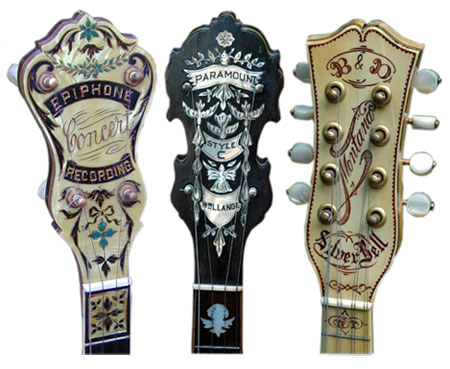
From left to right, headstocks (pegheads) for a 1928 Epiphone Concert Recording five-string, a 1929 Paramount Style C, and an eight-string B&D Silver Bell mandolin banjo from 1927.
Then, about four, five months ago, it showed up on online. I got in touch with the guy who was selling it, and of course he had no idea what the history of it was. He had just bought it from somebody a year ago. I told him my story, but put yourself in his place: it’s a hard story to accept, and I didn’t have any proof. I filed a police report back then, but the New York City Police Department had more important stuff to do.
I wasn’t absolutely positive from the pictures and descriptions that it was mine, but it sure looked like it. We went back and forth, and he offered to sell it to me for what he had in it, which was quite a bit of money. I bought it for 600 bucks back in 1963. I had so many banjos anyway that I didn’t really need another, especially if I wasn’t totally sure it was mine. So I said, “I don’t think I’ll do it,” and he said, “Well, I think I’ll just hang on to it rather than sell it.”
Then about a month ago, I was looking through a drawer and I found this little piece of paper. I’d written down the instruments I owned in 1964. And here was this banjo and here was the serial number. I checked back through my correspondence with the guy and, sure enough, it actually was my banjo. So I paid his price, and I now have my very first bluegrass banjo back, and it plays and sounds great. To me, it’s like an old part of me has been returned.
Collectors Weekly: How did you get into music?
Levinger: My mother was a pianist, so we had a piano in the house. As soon as I could touch the keys I started messing around, and I began taking piano lessons probably at about the age of five, or something. I didn’t pick up a guitar until I was probably 14 or 15 years old and I discovered, wow, that sounds great! But I never really took lessons or anything. I just learned to play. And then when I was in my senior year of high school, I heard Earl Scruggs for the first time, and it changed my life. I had to get a banjo and learn to play the banjo, and that’s just what I did.
My first guitar was a really cheap, horrible Stella with an action that was impossible to play. After that, I got a Gibson. It must’ve been one of those mahogany B-25s or B-15s. I hated it, but at least you could play it. I had a Gibson J-50 after that, which I also didn’t like very much. I never really got a good guitar until I went to college in Boston, where I met Rick Turner.
At that point, we were both beginning to realize that new guitars were not what you wanted. And so we started cruising the antiques stores and old-instrument shops of Boston. They mostly had violins but a few guitars and banjos, too. We also traveled to the little towns on the North Shore and the Cape and found some banjos and Martin guitars.
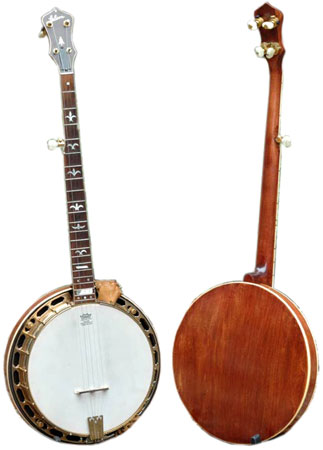
Lowell Levinger's 1933 Gibson RB-1 "Mastertone" banjo was stolen in 1966 and recovered in 2009.
This was circa 1962. We knew that the Martins were really good and we knew that Vega banjos were really good and Gibson banjos were really good. We also learned about Lyon and Healy and Weymann. And all of them were better than buying a new Gibson, or something like that. Old instruments are better, because of the sound you can get out of them, especially if you’re willing to put a little work into it to get them set up really nicely. The sound is more focused, warmer, and has more character. It’s not jangly. They feel better and are more enjoyable to play.
I currently own maybe 15 or 20 banjos. I play them all every once in a while. For bluegrass I play my Gibson Mastertone. Well, for everything these days, I play my Gibson Mastertone. For gigs, I’m only playing the one that I just got back.
I’m also a big fan of Paramount banjos. Paramount made really nice banjos back in the late 1920s. William L. Lange was involved in a few early banjo companies and then went off on his own and formed Paramount banjos. He made banjos under a lot of other names, too. Orpheum was one of them, and Lange Style was another. And boy, did he put out a lot of banjos. He was in New York. He must’ve made thousands of banjos a year. He published these very nice catalogs that are pretty readily available.
In the early years of the Depression, 1930, ’31, Lange had Martin build some guitars for him. Everybody was having hard times, but I’m surprised Martin stooped to this. They had a very radical design. You can see a few of those on the Museum page of my website. They made some tenor guitars and some six-strings, and they have these crazy resonators with the holes in the top around the edges. They made about 30 or 35 of these very strange guitars. The Martin-Paramount connection, however brief, is fascinating.
But Lange’s banjos were some of the very best for the type of music that was popular at the time. They were the precursors to the B&D Dixieland banjos, which were probably the most popular for that style of playing. Lange’s workmanship, his intricacy of design, and the complexity of the inlay—he had a really great eye. But they also sound good.
William L. Lange. I’d love to know what the L stands for. I have a feeling it might be Leo because there are these guitars called Leo Masters that really have the William L. Lange look to them. There are a couple of them on my website. And I’ve never been able to get much history on them, but I have this suspicion that they might have been made by Regal for Lange. But I have nothing to back that up, no documentation.
Paramount banjos are generally not rare. They made gazillions of them, especially the tenors. They also made a lot of plectrums, which are four-string banjos that have a longer scale length than a tenor—they have 22 frets instead of 19 and they’re tuned a little bit differently. You can find Paramount tenor banjos on eBay every day, especially the lower-end models, the style As, and below that. You get up to the style Es and Fs, which were the more expensive ones, then they become more rare. And Paramount only made a very, very limited number of five-strings, so those are exceedingly rare.
Collectors Weekly: When did the banjo gain recognition as a country, folk, and bluegrass instrument?
Levinger: Earl Scruggs made the banjo a bluegrass instrument. When he and Lester Flatt joined Bill Monroe’s band in 1946, that was a key moment in bluegrass. In fact, a lot of people say that’s when bluegrass music was born. Earl Scruggs brought with him this style of picking that he had adapted through listening to Snuffy Jenkins and a few other people who were playing the three-finger style of the time. But he took that style and smoothed it out and made it more melodic, more complex, more interesting. He was a virtuoso by the time he and Flatt joined Bill Monroe’s band.
In the mid-1950s, Pete Seeger and the Weavers launched the banjo into prominence as a folk instrument. Seeger played a custom long-neck Vega with three extra frets, so he could tune it down lower. It suited his singing, gave him an interesting tone, and let him play in additional keys with the same fingering. Pete Seeger published a book, How to Play the 5-String Banjo, that was used by every kid who wanted to learn how to play the instrument from 1959 to 1979.
A 1924 Paramount Style F five-string banjo.
The five-string banjo is actually having a bit of a heyday right now. The Dixieland banjo’s heyday was in the late 1920s, 1925 to 1929. And then, prior to that, in the late 1800s, the five-string banjo had an earlier heyday, when people played this funny Vaudevillian banjo music. It was like banjo ragtime music—they played it in blackface, using five-string banjos (some of them used four-string banjos) and it was associated with comedy and slapstick.
If you look at the old Paramount catalogs from that period, you’ll see pictures of all these banjo players who were endorsing their products. It’s fascinating to try and think about what they were like and what they were playing and whatnot.
Four-string banjos are different. They are tuned in fifths like a mandolin, mandola, and mandocello. It’s very difficult to play bluegrass on a four-string banjo tuned in fifths. But you can play all kinds of other chord voicings and melody lines on a four-string more easily than you can a five-string banjo tuned to an open G chord. It’s just two completely different worlds. Six-string banjos are just tuned like a guitar. They are really for guitar players who want to have plunky tones but don’t want to learn to how to play a banjo.
Today the banjo is associated with Vaudeville and Dixieland and bluegrass, but it originally evolved in Africa. Slaves who were captured and forced onto ships brought the instrument with them. They made them out of gourds.
The banjo is very much like a drum. The rim is made of heated and bent wood—sometimes the wood is laminated—then wet animal skin is stretched over the rim and tapped on. When it dries it tightens and, bingo, you’ve got a drum. If you put a neck on it and some strings, you’ve got a banjo. So African Americans did that when they got over here. And then white guys caught on.
Collectors Weekly: How did the banjo evolve in the 20th century?
Levinger: As banjo-making became almost an industry in the late 1800s, all kinds of different woods were used—more expensive and fancier woods in the higher-end models, plainer woods in the lower-end models. Rosewood was generally used on top-of-the-line banjos, and it went down from there to walnut, mahogany, maple.
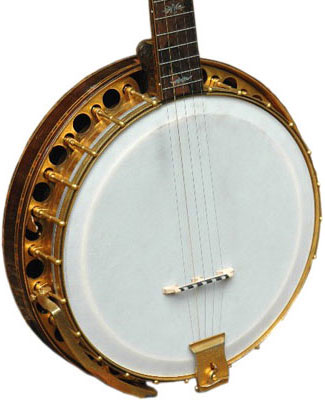
A 1933 Gibson Granada Mastertone banjo with its original flathead tone ring.
Today maple is considered a really high-quality wood, and it is. But the reason to use different woods is so you can have different price points and basically charge different amounts of money for the same banjo. There was also all kinds of inlay and wood carving, as well as metal engraving and even gold-plating. This gave players on different budgets a whole range of models to choose from.
Wood is actually not as important in a banjo as a guitar. A maple rim and a maple neck will sound a little bit different than a mahogany rim and a mahogany neck, let’s say, on a Gibson Mastertone banjo. That’s about all Gibson used for rim wood, mahogany or maple. They didn’t get into rosewood, and they only used walnut for a little bit. Mostly it was mahogany and maple—the mahogany tends to have a slightly warmer sound than the maple.
The banjo sound, if not the banjo itself, is not unique to American culture. The Celts and the Irish have similar instruments that sound like the banjo and are constructed exactly the same. You’ll hear Eastern European and Slavic music that sounds banjo-ish. Interestingly, in the southern latitudes you don’t hear many banjo-like sounds. Their sounds are woodier.
The same thing is true with Eastern music—you get banjo-y sounds from kotos and instruments like that. They aren’t really banjos, but they do have a similar, plunky sound. So banjo tones are used worldwide, but not so much in the southern hemispheres.
In America, banjo music evolved as a reflection of the culture. Throughout different periods, it reflected what Americans were doing to amuse themselves. In the late 1800s, with no TV or radio, people were going to music halls and watching Vaudeville shows which featured guys playing banjos. In the late 1920s and early ’30s, in the Southeast and even in the Midwest, there were radio stations starting to come on, powerful ones, with signals that reached quite a ways, and they broadcast a lot of live country-music shows.
“Banjos were sold by traveling salesmen and through catalogs such as Sears and Montgomery Ward.”
A lot of the bands that performed on these radio shows included a banjo player. The bands would travel around, maybe in a 350-mile radius from their home radio station, and play at fairs, churches, high schools, bazaars, little theaters, and Lions clubs, usually having to make it back to the radio station for some dumb 7:45 a.m. show every Tuesday, Thursday, and Saturday. That’s how the banjo was heard in those days.
During the 1960s, you could hear banjos in concerts at colleges and town halls. Same thing in Europe. There was a lot of rock ’n’ roll, too, but in the early ’60s, there was also a lot of folk and bluegrass music, which included banjos. People also heard banjos a little bit on TV, especially when “The Beverly Hillbillies” came along, with Earl Scruggs playing the theme song.
Today there’s a banjo community that extends all over the whole world. It’s pretty neat. People who are interested in banjos should know about Banjo Hangout. That is the main banjo community online, and from there you can find pretty much anything relating to banjos.
Collectors Weekly: How did World War II affect the production of banjos in the United States?
Levinger: I think it affected production in most countries. Any country that was involved in the war was using all its metal to make bullets, not banjos. That would be a great slogan—banjos, not bullets. Anyhow, during the war, musical-instrument manufacturers made just a trickle of instruments; a lot of parts on guitars that had been made out of metal were made out of wood during the war. Back then, many of the instrument factories were converted to wartime use. Gibson made toys for a while but when the war ended, they went back to making banjos and guitars.
Collectors Weekly: Who were the top banjo manufacturers?
A 1937 Gibson Charles McNeil five-string banjo.
Levinger: Gibson, Paramount, Epiphone, and Vega for sure. Bacon & Day would also be in there. B&D was their real name, but people called them Bacon & Day. The B&D Silver Bell was probably the most popular Dixieland banjo. Gibsons were the preferred bluegrass banjos because Earl Scruggs played a Gibson, so every bluegrass banjo player wanted that sound. It’s not easy to make that sound—you can do it on a Gibson but it’s almost impossible on a Bacon & Day. It’s a different method of construction using a completely different kind of tone ring. It’s fantastic for Dixieland but not good for bluegrass.
In the early days, banjos were sold by traveling salesmen, in stores, and through catalogs such as Sears and Montgomery Ward. Music teachers had classes and started orchestras in their hometowns, and the banjo companies would make the leaders of the orchestras dealers. They sold banjos to their students and their orchestra members, and that was a big, big part of the business.
Today, Gibson is still around, and I think Deering has taken over the Vega line. There are companies making copies of old banjos, too. Recording King makes copies of the old models of the Gibsons, so does Gold Star. I believe these are all made in China.
Collectors Weekly: What are some of the most sought after vintage or antique banjos?
Levinger: The most popular banjo from a collector’s or bluegrass player’s standpoint is an original mid-1930s Gibson Mastertone flathead five-string banjo. They only made about 90 of them, one of which Earl Scruggs played. Consequently, all the other concurrent, seminal, influential banjo players also wanted to play original five-string Gibson flathead Mastertone banjos. Most of those players managed to get themselves one in the late ’40s and early ’50s.
These banjos are the best sounding banjos for bluegrass in the world. I know a banjo player named Jim Mills who just wrote a book about Mastertone banjos. Of the known ones, he has pictures and the history of each one. When they trade hands, it’s in the neighborhood of a quarter of a million dollars. That’s nothing compared to a Stradivarius, but it’s still a lot of dough.
Collectors Weekly: What should a collector look for when purchasing a vintage or antique banjo?
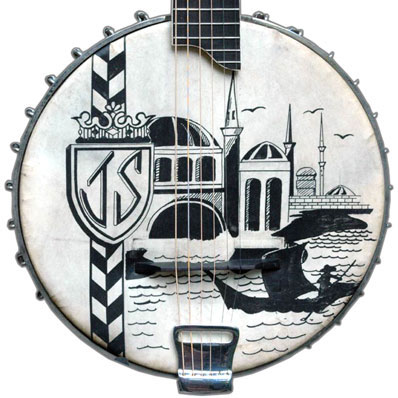
This circa-1912 Dayton six-string guitar banjo features a Venetian scene on its skin head.
Levinger: It has to be something that they will enjoy, assuming they’re a player. If they just want to hang it on the wall, it has to be beautiful, ornate, and really finely made, with no flaws in it. If they’re a player, it has to be comfortable for them to play and sound good. Each note must ring true, clear, and be in tune, without any buzzing, ‘fretting out’, or being sharp or flat. If they’re an ensemble player, like in a bluegrass band, it has to be able to really project and have a good dynamic range. If played softly, it has to have a good, sweet, full tone.
Condition is also a factor. Banjos that have been left in attics that go from humid to hot to freezing cold typically have cracks, or their finishes have come off, or their necks have warped. Banjos that have been stored in basements where the bottom of the case was resting in a puddle for seven months out of the year are likely to have water damage—when water seeps under the finish it expands the wood grain which cracks the wood, separates glue joints, and rusts metal. But banjos that have been kept in the bedroom right there with their owner, and maybe taken out for a few concerts, those are probably just fine.
Collectors Weekly: One last question: What’s with all the banjo jokes?
Levinger: There are a million of them. For instance, what’s the difference between a banjo and an onion? No one cries when you cut up a banjo. What’s the difference between a banjo and a Harley-Davidson motorcycle? You can tune a Harley. How about the difference between a banjo and a trampoline? You take off your shoes when you jump on a trampoline. Why are there no banjos in Star Trek? It’s the future. I have no idea where they all came from, but being a banjo player, you get exposed to them over the years.
Our good buddy Buck Thrailkill recently posted up his newsletter and after reading it, we realized just how much cool stuff he has going on and wanted to get it out to the masses. If you haven't heard much of Buck's banjo pickin', you are in for some amazing songs this year. With feature releases coming up with us and Farmageddon this year, Buck will be hitting stages across the country and showing how a banjo should be played.
"Hi Everyone, I hope you all had an AWESOME February...
The NEWS just keeps coming for you so
here we go...
There will be a lot of new recordings coming out this spring and fall with all of
the groups I am involved with. There is also bunches and bunches of new merch, t-shirts,
mugs, and more coming in. Almost have the song list finished for the SOLO Album.
I have one more piece to finish writing, which will also be on the new album with
Ronnie Hymes and Frank Ehlinger this summer from Rusty Knuckles Record Label.
I also had the honor be being asked to record a track for upcoming artist Larry Frick for his new album.
Check his band out. They are awesome.... And a true honor is going to be to record
with my dear friend Erik Smallwood this year. His latest album 'You Love' just came out in January
so please go check his incredible sound out with Neil Ray and many other guest artist.
Still want to make this year big on getting my ReverbNation page and Facebook Pages
out and I will need your help getting as many email addresses
as I can here, as well as the Venue's and other Band's ReverbNation pages. So help
get the word out for the News Letters, Seasonal Letters, Gig Updates for Special
shows, and so folks have an easy way to access me to send ideas for music, merch,
or whatever. You can also contact my good friend Sheila Barker at Ready to Roll Street Team on Reverb or Facebook for information as well.
Working in 'Ronnie Hymes and
Carolina Freight', with Ronnie Hymes and Frank Ehlinger, we finished
and released a brand new demo CD called '5 Tracks'
back in January. You can go to our ReverbNation page to have a listen or on
the Reverb Store and purchase the song and/or ringtone for any of the tracks you
like. We just finished up recording our New Album coming our summer via The Rusty Knuckles Record Label with almost all new original tunes written by us and a few friends.
We also have some great GIG dates coming in March and April around the Carolina's.
Be sure to check the show dates on my ReverbNation
page as well as RH&CF's ReverbNation Page. There is also new merch from the
Freight as well so check us out...
Working in 'JB Beverley and The Wayward Drifters',
with JB Beverley and Frank Ehlinger, we have a brand new CD in the recording works
right now of all originals that will be available from Farmageddon Records by the
spring/summer as well as some really awesome GIG dates coming up. Farmageddon Music Fest 2012
in Montana is coing up this year for the first annual. Already have an incredible
line up. Also the 3rd Annual Muddy Roots Music Fest
in Tennessee in September. BIG NEWS HERE. Dr. Ralph Stanley will be preforming at MRMF 2012. One
of my all-time banjo hero's!!!
Thank you very much for taking the time to read this mail and please fell free to
send to your friends and ask them to check out some or all the projects for 2012.