

James Hetfield, the man himself, sat down with us at Guitar Center in San Francisco. In the small room, he shared stories about becoming a musician, rising to fame, and even played a bit. All the while, customers continued to shop in the store, having no idea it was James playing, Hetfield's new ESP Iron Cross.
Showing posts with label Metallica. Show all posts
Showing posts with label Metallica. Show all posts
Thursday, December 10, 2015
James Hetfield of Metallica Jams at Guitar Center and Talks Music
James Hetfield, the man himself, sat down with us at Guitar Center in San Francisco. In the small room, he shared stories about becoming a musician, rising to fame, and even played a bit. All the while, customers continued to shop in the store, having no idea it was James playing, Hetfield's new ESP Iron Cross.


Wednesday, January 1, 2014
Can't Live Without My Radio, I Need A New Boom Box
 |
| Radio Raheem and his Promax J-1 Super Jumbo boombox as seen in a still from Spike Lee’s 1989 film, “Do The Right Thing.” |
Nostalgic bliss shows up in many forms and certain items will always be a litmus test within pop culture. If someone were to pull out a killer boombox there will always be a distinct vibe to immediately pop up. I know that my eyes will light up at the sight as I will instantly think of my childhood in the early 80's and recall seeing Beat Street in the theater and thinking how fast can I find a piece of linoleum to break dance on.
Later on, well as in a roughly maybe three years later that same boombox would switch to albums by the Circle Jerks and old Metallica and would be blasting while we skated our local slick curb.
Do yourself a favor, find a boombox and go make a skate session happen somewhere. If you are more on the hip hop side of things, find a killer wall to paint and blast some early 80's hip hop such as LL Cool J or Grand Master Flash and let the good times roll.
Huge shout out to my older brother for getting our first boom box, thanks for the memories Toby!
Find more great articles like this on Collectors Weekly
Later on, well as in a roughly maybe three years later that same boombox would switch to albums by the Circle Jerks and old Metallica and would be blasting while we skated our local slick curb.
Do yourself a favor, find a boombox and go make a skate session happen somewhere. If you are more on the hip hop side of things, find a killer wall to paint and blast some early 80's hip hop such as LL Cool J or Grand Master Flash and let the good times roll.
Huge shout out to my older brother for getting our first boom box, thanks for the memories Toby!
Find more great articles like this on Collectors Weekly
"Boomboxes are, by definition, excessive. With their deafening bass thud and dazzling chrome dials, these electric beasts are heavy enough to tone your biceps. Also known as “ghetto blasters” or “jamboxes,” they rose to fame in the 1980s along with hip-hop, flourishing as a tool for sharing and mixing the latest beats. Yet despite their widespread popularity, the innovators who conceived of these devices are still largely unknown, consigned to anonymity by the corporations that manufactured their creations.
Compared to today’s sleek micro-gadgets, boomboxes are like electronic dinosaurs, dated as much by their ludicrous size as their outmoded technology. Beginning in the late 1970s, companies recognized that buyers wanted their radios louder and more dynamic, so they made sure each model could project a solid mix of treble, midrange, and bass, while offering options for recording and editing, too. This was what made the analog boxes so big, requiring huge speakers, cassette decks, a radio receiver, and up to 10 D-sized batteries, all wrapped in heavy-duty casing.
“A boombox is a campfire, drawing in those nearby to enjoy a warm analog musical experience.”
Today, boombox connoisseurs typically swap information and compare their finds on forums like Boomboxery and Stereo2go, waxing nostalgic for the era of street parties and tape sampling that couldn’t have existed without these master blasters. With his 2010 book, “The Boombox Project,” boombox collector and photographer Lyle Owerko lamented the shift from this culture of public music-sharing to one that exists in private. “The world of sharing music in parks and on city streets now resides in cyberspace as we share in anonymity online. The boombox that marked this change from public music ‘broadcasting’ to private consumption was the JVC PC-100, a mini unit with a detachable headset. Now you could share your music in the public sphere, or keep it private by ejecting the cassette deck and plugging headphones into it.”
Lightwood is hopeful that shedding light on the origins of classic boomboxes might renew interest in the technology that facilitated this communal audio culture. We spoke to Lightwood about the world of vintage boomboxes, and why their creators are often shrouded in mystery.
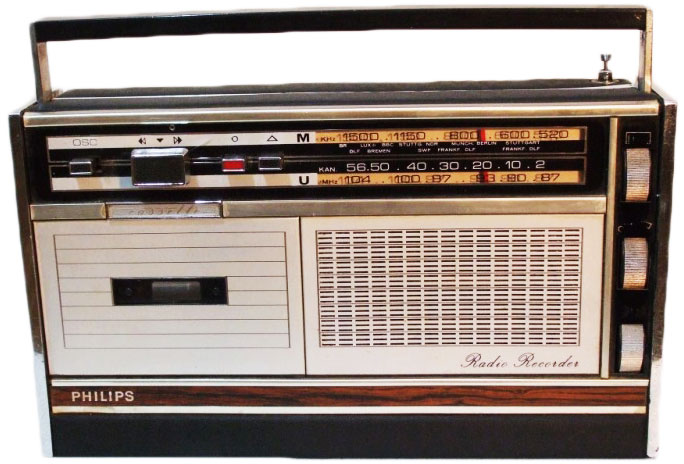 |
| The Philips “Radio Recorder” from 1969 is thought of as the world’s first boombox. |
Collectors Weekly: Where did the boombox originate?
Miles Lightwood: The boombox by its typical definition—a handled, portable, radio cassette deck with one or more speakers—was actually invented in the Netherlands by Philips in 1969. The one considered the first boombox was made so that you could record from the radio onto the cassette without having any external cables for a microphone. All of a sudden, you’ve got a very easy music-sharing culture, and the Japanese companies basically took that idea and ran with it.In my mind, the first device that’s like the urban boombox of popular culture is the JVC RC-550, which was a monster box. It’s got a 10-inch woofer, it looks mean, and it’s got lights and the whole package. That was made in ’75.
Collectors Weekly: How did your boombox obsession begin?
Lightwood: When I was younger, I had a couple of boomboxes, and they both got stolen out of my apartment. I was living in a bad part of downtown Los Angeles. One day, I came home, and someone had taken every electronic device I had.When I was skateboarding in empty pools back in the ’80s, just having a box gave you status. Regardless of whether it was the biggest or flashiest one, it was cool to be the one with the music. Some of those huge Japanese boxes cost around a thousand bucks. There was no Walkman; there was no iPod. Back then, the only way you could share music was with a boombox.
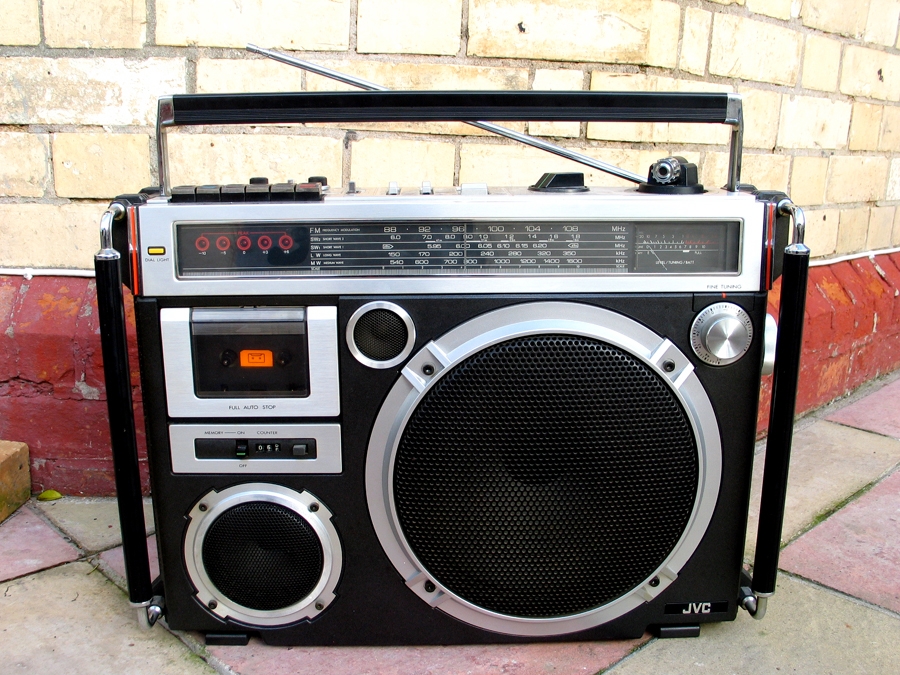 |
| Lightwood considers the JVC RC-550, also known as “El Diablo,” as the first radio to resemble a true boombox. Via radiohier.com. |
I’ve been collecting boomboxes for a few years now, and earlier this year, I began wondering who created these magnificent machines. We know the musicians, artists, and celebrities that appreciate boomboxes, but more than 30 years later we still don’t know who created these boomboxes: Who is the Jonathan Ive of Sharp? Who are the Charles and Ray Eames of Conion? Who is the Dieter Rams of Magnavox?
“A bigger, louder, flashier box got you more attention on the street—boosting your reputation.”
I really hope to make this a collaborative, crowd-sourced project, and our website will be the central point for that, possibly enlisting some design schools in Asia to help track down these people. It’s going to be a bit of a challenge, because even once we’ve identified certain people, they’re generally older, so they don’t really have any presence on the Internet.
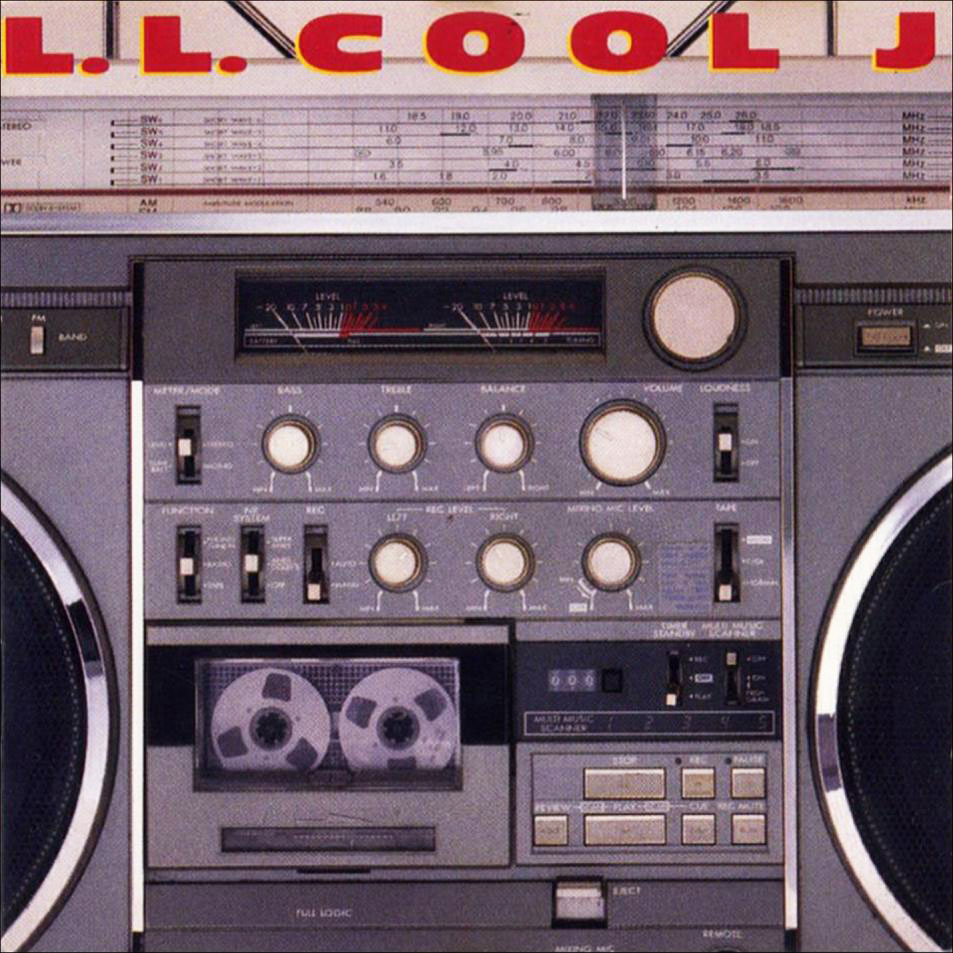 |
The cover of LL Cool J’s 1985 album “Radio” featured a JVC RC-M90.
|
Collectors Weekly: What makes a boombox a grail?
There are certain agreed-upon grails within the community, and then everyone has their own personal grail. Take for example, the JVC RC-M90, which is on the cover of LL Cool J’s first album “Radio.” It has an amazing sound but it’s also got an amazing look, and it’s one of the most sought-after boomboxes. If you can get one, it’s going to cost you at least $800 and a fierce bidding war on eBay or another auction website. I’ve got one of those, but personally, I focus on the Japanese boxes, which are fairly rare. I recently found one of those boomboxes that was stolen from me on eBay, not the exact same one, obviously, but a replacement in really good condition.
I know some collectors who have found grails like a Conion C-100F, another legendary box, on Craigslist. They went over to check it out, and they met this little old lady whose husband passed away, so she was downsizing. The couple originally bought this Conion so they could have some portable music at their cha-cha dance class or something. The box is like a time capsule: It never was a street warrior, never got beat up. I don’t have that type of story yet, but one day I will.
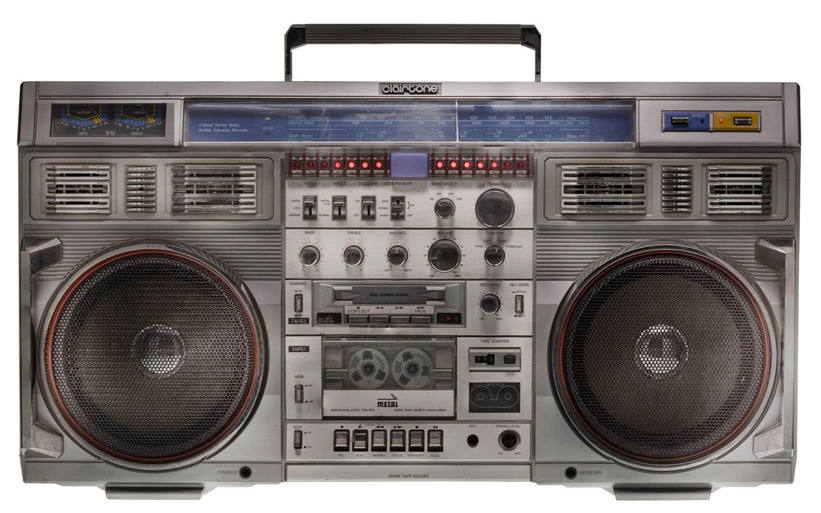 |
| A Conion C-100F, which included an ear-splitting motion detecting alarm (visible in the upper-right corner), from the collection of Lyle Owerko. Photo courtesy Lyle Owerko. |
Collectors Weekly: Why were they so big?
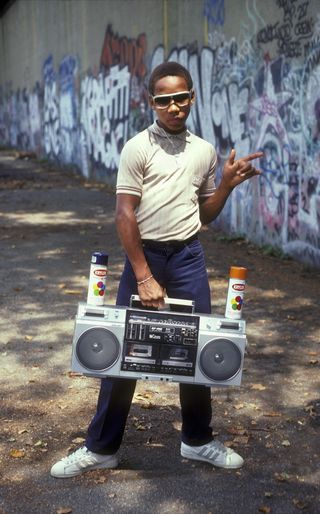 |
| A young B-boy struts his stuff in New York, circa 1980. Photo by Martha Cooper. |
Transporting all these components safely and with style required a sturdy enclosure that satisfied both aesthetic, sonic, and functional requirements; consequently, these boomboxes were large and heavy. Practical issues aside, a bigger, louder, flashier box got you more attention on the street—boosting your reputation—and manufacturers could charge more; so win-win. Bigger is better.
Collectors Weekly: What have we lost with the switch to MP3 players?
Lightwood: Sonic warmth and physical community. When shared in a public space, a boombox is a campfire, drawing in those nearby to enjoy a warm analog musical experience and connecting them in a spontaneous community. Anytime I share music from a boombox in public, I meet new people, learn new stories, and everyone has a great time. Listening to an MP3 player in public just isn’t the same.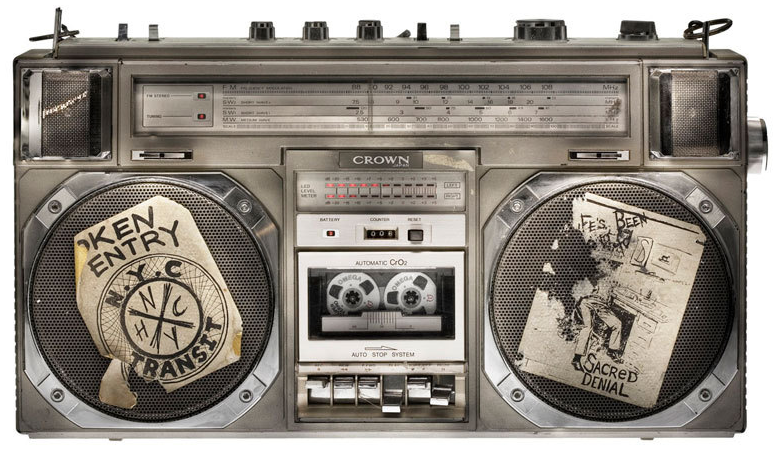 |
| Often boomboxes were customized with emblems of a favorite band or musical style, like this punked-up Crown CSC-950. Photo courtesy Lyle Owerko. |
Collectors Weekly: Why is it so hard to locate the original inventors of these devices?
Lightwood: A designer, engineer, or marketer working in a consumer electronics manufacturing company in the ’70s and ’80s was just a cog in the corporate wheel. Then as now, very few people were individually acknowledged for their contributions to a given product. Without assistance from a manufacturer, the only way to identify a creator is via a thorough examination of publicly available documents, and even then, not all these people can be identified.For several months at the start of the project, I reached out to the original manufacturers to help identify the creators of their boomboxes, but with no success. I continued researching, and once I realized how to search the public patent databases, many creators were revealed. I’ve identified 17 creators thus far, and I’m discovering more each month. Now identified, the real work begins: locating these people around the world and telling their stories before it’s too late, as many of them are elderly.
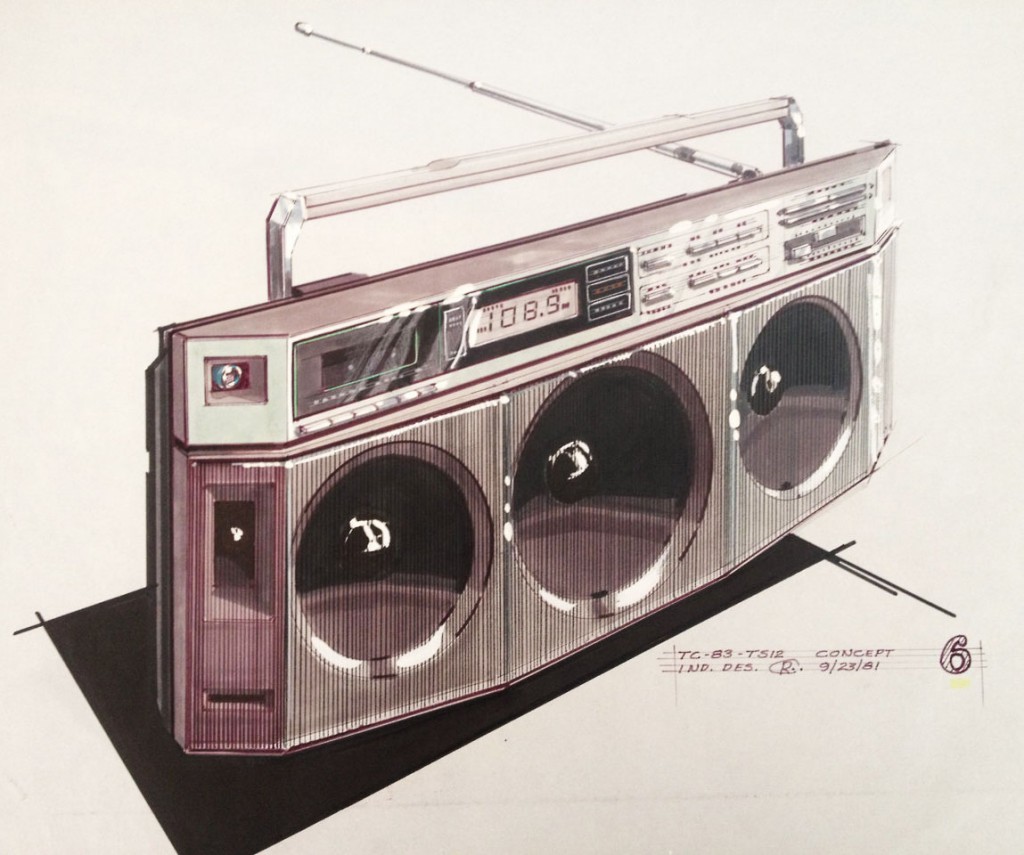 |
| Lightwood purchased several conceptual drawings from 1981 by Richard Culbertson through an estate liquidation on Etsy. |
Collectors Weekly: Are most of the companies who made these boomboxes still operating?
Lightwood: Yes, most of them are still operating. JVC, Panasonic, General Electronic, Pioneer, Sanyo, Hitachi, Toshiba, they’re all around. There’s a few oddball ones that aren’t, like Skitronic, which made the Discolite that has the light-up speakers and was featured in music videos by Madonna, Lady Gaga, and a bunch of others. That company is out of business, and those are grails as well. The sound quality isn’t that great on those, but they’re popular for their looks and their “wow” factor.Collectors Weekly: How do you find replacement parts for vintage boomboxes?
Lightwood: Replacement parts don’t really exist, but there are a few options, like asking other collectors for used parts, seeking out and buying a parts box, or utilizing new technologies to make your own. I’m involved in the 3-D printing community, and when I was trying to repair my most recent purchase, a Lasonic TRC-931, I needed new knobs. So I started printing up knobs. But I’ve realized that the resolution of most 3-D printers means that you don’t get an exact reproduction part. You get a functional part, but it doesn’t look quite right. There are plenty of internal parts that can fail, gears and whatnot, and those you can easily print because there’s no real cosmetic requirement—it’s all functional.Collectors Weekly: What’s been your favorite discovery related to boomboxes?
Lightwood: There are so many. Acquiring original drawings from the estate of a boombox creator, or meeting a creator who worked for one of the longest-standing boombox manufacturers.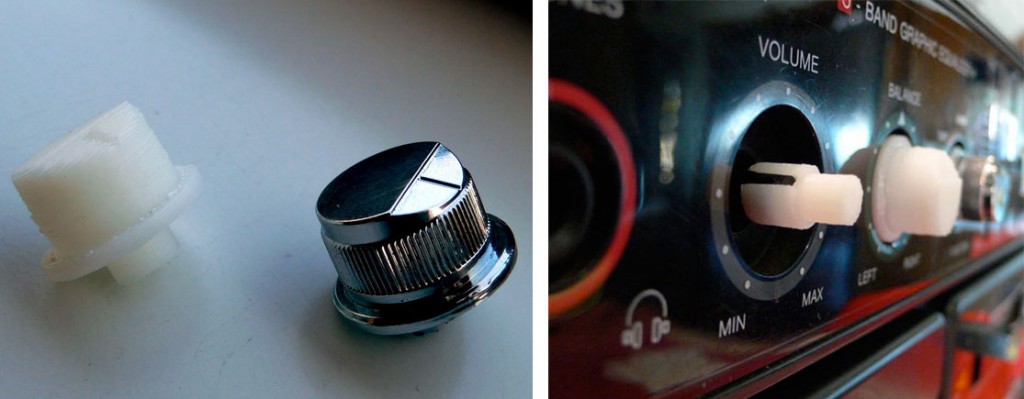 |
| Lightwood has used his 3-D printer to create replacements for knobs and other internal parts. |
Collectors Weekly: Why was that model so popular?
Lightwood: I don’t really know. Through my research, I realized that several of these Japanese manufacturers have museums devoted to the company founders and their popular products, which include all types of electronics and home appliances. Some guy went to the Matsushita museum and filmed a walkthrough that I found on YouTube, just panning over all the different products in there. And I thought, “Wow, there’s a boombox over there!” It was a gold boombox developed for the Middle Eastern market.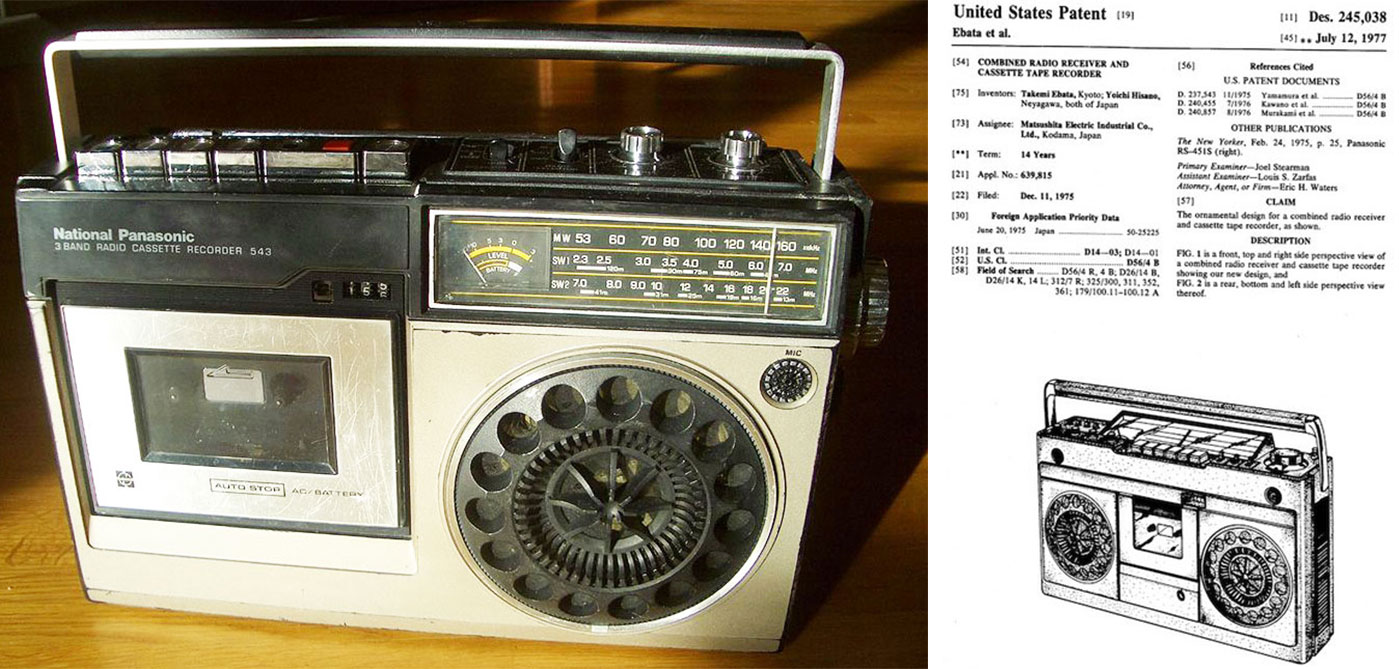 |
| The National Panasonic RQ-543 made by Matsushita sold over 4.2 million models, primarily in the Middle East. Photo via shizaudio.ru. |
This member in the U.A.E. said that most of those boomboxes aren’t even in the country anymore, because the people that would’ve bought them were mostly foreign laborers that were brought in to build or maintain the country’s infrastructure. Once their time was up, they would leave and take their equipment with them, so the boomboxes would end up wherever the laborers came from.
Collectors Weekly: Do you have a favorite boombox?
Lightwood: In no particular order: Victor RC-550, Tisonic PR-7000, Victor RC-M90, Amsen FK-887, Sanyo MR-X920, Sharp GF-999, Lasonic TRC-931, Victor RC-M70. I have them all, and that’s like a parent choosing a favorite child. Each has its own look and sonic personality. |
| The JVC PC-100 included a detachable cassette player, which began the shift to private audio devices like Walkmans. |
Sunday, May 5, 2013
Wednesday, January 16, 2013
Soldierhead, New Track From Jason Newsted, Formerly of Metallica
Have always been curious as to why Jason Newsted left Metallica. If you watch Some Kind Of Monster, many feelings and or egos seem to have been crushed throughout the years and seemed as if it was something they could work out. In essence, why in the hell would you quit the biggest band in the world? Who knows, but at the end of the day, what really matters is that Mr. Newsted is all about the music. Take a listen to his new project below, it is pretty damn good.
Link to original post on Blabbermouth
"Soldierhead", the first video from NEWSTED, the band fronted by former METALLICA, VOIVOD and FLOTSAM AND JETSAM bassist Jason Newsted, can be seen below. Directed by Leon Melas, the clip was filmed on December 15, 2012 in an abandoned factory in California.
In a recent interview with Sonic Excess, Newsted stated about the video shoot: "It's just a simple thing, and I just wanted to capture the band. There is no heavy concept, no literal thing about bullets chasing your head or any of those things. It's old-school metal and most likely will be black and white. It was shot in an old factory. It was a gnarly, dusty, old factory and it had energy. That is what I will describe it as. I haven't got to play to the camera like that for a long time, and I was really going for it. The soldier version is something everyone will have. An HD version will be available on iTunes, but I want everyone to have it for free across the world. I want it to be the tip of the spear for everybody to see and hear what exactly it's all about."
"Soldierhead" was premiered on the December 17, 2012 edition of the "Eddie Trunk Live" show on SiriusXM satellite radio. The song comes off NEWSTED's four-song EP, entitled "Metal", which was released on January 8 exclusively via iTunes. The EP will be made available as a physical CD on January 15.
"Metal" contains the following tracks:
* Soldierhead
* Godsnake
* King Of The Underdogs
* Skyscraper
By purchasing all four songs, you will receive a copy of Jason's handwritten lyrics.
NEWSTED is:
Jason Newsted - Bass, Lead Vocals
Jesus Mendez Jr. (THE NAPOLEON BLOWNAPARTS) - Drums
Jessie Farnsworth - Guitar, Backing Voice
Link to original post on Blabbermouth
"Soldierhead", the first video from NEWSTED, the band fronted by former METALLICA, VOIVOD and FLOTSAM AND JETSAM bassist Jason Newsted, can be seen below. Directed by Leon Melas, the clip was filmed on December 15, 2012 in an abandoned factory in California.
In a recent interview with Sonic Excess, Newsted stated about the video shoot: "It's just a simple thing, and I just wanted to capture the band. There is no heavy concept, no literal thing about bullets chasing your head or any of those things. It's old-school metal and most likely will be black and white. It was shot in an old factory. It was a gnarly, dusty, old factory and it had energy. That is what I will describe it as. I haven't got to play to the camera like that for a long time, and I was really going for it. The soldier version is something everyone will have. An HD version will be available on iTunes, but I want everyone to have it for free across the world. I want it to be the tip of the spear for everybody to see and hear what exactly it's all about."
"Soldierhead" was premiered on the December 17, 2012 edition of the "Eddie Trunk Live" show on SiriusXM satellite radio. The song comes off NEWSTED's four-song EP, entitled "Metal", which was released on January 8 exclusively via iTunes. The EP will be made available as a physical CD on January 15.
"Metal" contains the following tracks:
* Soldierhead
* Godsnake
* King Of The Underdogs
* Skyscraper
By purchasing all four songs, you will receive a copy of Jason's handwritten lyrics.
NEWSTED is:
Jason Newsted - Bass, Lead Vocals
Jesus Mendez Jr. (THE NAPOLEON BLOWNAPARTS) - Drums
Jessie Farnsworth - Guitar, Backing Voice
Thursday, December 6, 2012
Dave Grohl Can Do No Wrong, Now Add Film Director To His Resume
 |
| Dave Grohl is a man of many talents, now you can also add film director. |
While there have already been a handful of outtakes from the film with artists ranging from REO Speedwagon’s Kevin Cronin to Ratt’s Stephen Pearcy talking about their first musical memories, the full trailer of the film went up online today. It looks like a feel good movie, and not just one about the studio. The trailer looks like a testament to music made the way it used to be – in a shabby, run-down-looking analog studio with character instead of by machines.
Sound City will premiere at the Sundance Film Festival next month and will be released in February. Presumably, news will come out soon about the soundtrack, since people ranging from Corey Taylor to member of Ratt have been jamming with him earlier this year. Check out the trailer after the jump."
Link to original post on Metal Insider
Thursday, September 20, 2012
Still Thinking About Getting A Tattoo Of Your Favorite Band?
Still Thinking About Getting A Tattoo Of Your Favorite Band? Every now and then you see some tattoos that send you shaking your head and wonder who is more at fault. Is it the customer wanting to be the über fan or the tattoo artist that maybe isn't quite up to snuff. Needless to say, choose your imagery wisely along with the individual that is inking you up permanently.
Loudwire's display of horrible tattoos
Loudwire's display of horrible tattoos
 |
| Really? Earth Crisis on the face? Did that Firestorm of Ink Purify? |
 |
| Green Day never looked so rough. Poor ol' Billie Joe and his BJ pose, damn that's rough |
 |
| And Tattoo Justice For All |
 |
| Slayer fan that was tatted up by a six year old apprentice prodigy |
 |
| Dimebag Darrell is equally shocked by his depction in a style reminiscent of the Squidbillies |
 |
| Gotta love the drop shadow those letters have, Kid Rock looks like he is hiding a huge dome in the pimp hat |
Wednesday, August 15, 2012
Why Local Bands Don't Get Signed, From MetalHolic.com
How often do you go into a venue to see some act play and stand in amazement thinking on how great a particular band is. They could be on fire that particular show and melt faces and then poof, nothing. This happens more than you think as many fans tend to forget what they did five minutes ago, let alone go online or chase down a band to help support them.
The package, as we refer to the artist’s business plan or presentation, has to be ready to go and that is the artist’s responsibility to get there. It doesn’t fall on anyone’s shoulders to make this happen except for you. There is no excuse, what with all the free info out on the internet in books and magazines, that an artist can’t figure out the basics of the business, create a presentation and become attractive to the people who can help them get to the next level. Until that happens, it’s hard to get a manager, booking agent or anyone else to be excited about making 0% of 0% because the artist has created absolutely no demand for themselves. The money isn’t available in the industry for developmental deals as it was say 15-years ago. Thus the artist’s chances of getting signed on with professional representations are slimmer if they don’t present an attractive market value. Here are a few of the reasons that artists intentionally shoot themselves in the proverbial foot. This is by no means a comprehensive list, just some very obvious points.
One huge notion to remember is that if you just had a thirty minute set, there are 23:30:00 hours left for that 24 hour time period. Now is the time to go and really build your fan base. I don't think we will ever see the likes of a band such as the Beatles again. The world wide hysteria, the young kids screaming with excitement by the millions. Well, maybe a few boy bands can do this, but in our specific genres of dirty rock n' roll, real country and punk, it is just not the norm.
If you really want to make a difference and be heard it takes a lot more than just writing great songs. You have to cultivate who you are as an individual relating to your music and sell yourself. Yep, we said it, sell yourself. Fans don't want pussies, they want the dream. They want to live vicariously through the words, the music and most of all the artist. Is there any other reason why individuals are put on pedestals? Take a look at all the Waylon, Pantera, Metallica, Hank Williams, etc. tattoos. Fans want to emulate their hero's. So buckle down, man up and make your career happen. History is written by the winners.
Think on the topics below and see what you can do to further your career. The world is waiting...
Think on the topics below and see what you can do to further your career. The world is waiting...
11 Reasons Why Local Bands Don't Get Signed
"Dealing with the local music scene these days is very challenging for management, booking, promotion companies and record labels. To be able to get any artist to the next level requires being able to take the package and sell it to the public or other entertainment professionals or companies. Unfortunately, too often the product is rarely worth buying or even helping to promote further. Bands and artists tend to have this notion that, “Without the music you have nothing,” when dealing with industry professionals. While this is true to an extent, it’s not the whole story. In the industry, we can hire songwriters that have a proven track record, hire musicians to record it and make our own successful bands that we own completely and can control. We don’t need local artists with attitudes, little work ethic or strive not be productive in furthering their own careers. We all do what we love for a reason. It’s not always about being successful but for the satisfaction for seeing someone achieve their dreams so we keep diving into the murky waters of local musicians to find those that are worth partnering with.
The package, as we refer to the artist’s business plan or presentation, has to be ready to go and that is the artist’s responsibility to get there. It doesn’t fall on anyone’s shoulders to make this happen except for you. There is no excuse, what with all the free info out on the internet in books and magazines, that an artist can’t figure out the basics of the business, create a presentation and become attractive to the people who can help them get to the next level. Until that happens, it’s hard to get a manager, booking agent or anyone else to be excited about making 0% of 0% because the artist has created absolutely no demand for themselves. The money isn’t available in the industry for developmental deals as it was say 15-years ago. Thus the artist’s chances of getting signed on with professional representations are slimmer if they don’t present an attractive market value. Here are a few of the reasons that artists intentionally shoot themselves in the proverbial foot. This is by no means a comprehensive list, just some very obvious points.
- Not Booking Enough Shows: Most bands/artists want others to do this for them but in truth and reality, the artist should be booking their own shows until they are gigging at least 80-dates a year regionally and making money doing it. Why would anyone in the industry want to waste time booking a band that isn’t willing to do it themselves, does not understand the basics of promotion and end up making a small percentage of absolutely nothing for their work? There are no short cuts here. Pick up the phone and dial for dollars.
- Poor Promotion: Most artists spend very little time and effort promoting and usually post a gig once or twice on some form of social media expecting people to see it and show up on such short notice. This is absolutely pathetic. Especially in a band with several members, usually only one person promotes it. In no way shape or form is this acceptable, nor will anyone in the industry look kindly on an artist that does this. You don’t deserve to get paid at all if this is how you sell your band. Believe it or not, we all look at this and notice how well people promote themselves. Also, social media sites are not the only form or promotion needed. You still need flyers, advertisements and many other forms of creative promotion. It is not everyone else’s job to do all your promotion. When you are looking for opportunities with your gigs and no one shows up for your shows, you lose on many levels and miss out on opportunities.
- Misuse Of Social Media: If all you do is complain about the venues, management or any other form of the music business, you are signing your death warrant. Again, people in the industry and your peers see this and who would want to book you back at a venue or assist your band if this is your level of professionalism. You are a business, act like it. Grow up and quit using your bands page to complain. If you want to do that, do it in private where we can’t see it. This is common sense that seems to have escaped many artists.
- Wasting Time Goofing Off On Facebook: If you have time to post a million personal things on Facebook but don’t promote your show then you aren’t serious about this business. Stop spending time goofing off and start making things happen for your music. Facebook is a great networking tool when used right. The excuse, “I am so busy,” is quite weak when we can see your profile. This goes for both sides of the business, not just artists.
- Not Getting Back To People: When you approach someone and ask for their advice, services or whatever else and say, “I’ll get back to you,” then do it. The usual excuse again is, “Sorry, I was so sick” or “I have been so busy” but again we can see your social media so if you are well enough or have time to do that, you are well enough to practice a common courtesy and get back in touch with people, regardless of the outcome you decide on. This applies to getting back to people on booking a show, a meeting, or any other situation involving your band, music or related promotions. It is also basic good business manners.
- Not Doing Your Research: Approaching people about services they don’t even offer. This happens all of the time. You see a business name and just assume at what they do but don’t even research the company. You are wasting everyone’s time and showing how lazy and unprofessional you are.
- Not Accepting Gigs Because You Don’t Have The Money: “Sorry we don’t have the money to drive that far,” is a ridiculous excuse for a local or regional booking. You don’t have the money to drive to open a new market but you do have money to buy beer, party with your friends, buy drugs, go camping or visit someone three states away. Again, your Facebook page gives this all away. If you do not want to play a show for specific reasons, then politely decline, thus hopefully leaving the door open for future shows. If you aren’t able to be dedicated to your vision and dream by planning in advance and having a band fund for specific use: gear, travel, other expenses then don’t even bother approaching anyone. You can’t build a solid fan base if you aren’t playing out.
- Not Having An Appropriate Press Kit: Everyone has been doing this long enough to know you need one. No matter if you are a band, solo artist or musician looking for extra work. Everyone should have an electronic press kit (EPK) and/or hard copy press kit. Sending someone to Facebook, Myspace, Reverbnation, YouTube or other social music site, while a plus, is not a replacement for a professional media kit. If you don’t have one, you do not show serious business regard for your own career so why should anyone in the industry.
- Sending One Line Emails Saying You Need Representation: Again if you don’t have a press kit and you can’t take the time to compose a proper business letter and introduction about yourself or your band, don’t even bother. All you are doing is showing how lazy you really are. Be professional, always.
- Only Being Able To Play Weekends: We are all looking for bands than can tour, not just play every now and then. It’s hard to break a new market and build a fan base when you can only play one quarter of the year. Not only that, but you are competing with so many other bands for these bookings when weeknights are so much easier to get. This is why people with families often get passed by. It’s too hard to coordinate everything. We all make choices in life and once you decide to get married and have kids more often than not you aren’t able to be on the road enough. This does not apply to everyone, as many do have support systems in place to allow for travel. If you are serious about your career, have this support system in place. No one makes any money if you can’t play so they won’t sign you. It may not be fair but everyone involved has to pay their bills so why would anyone sign a band that can’t make them money? It’s not about the music when it comes to getting signed, it’s about people earning a living.
- Expecting To Work Without A Contract: First of all, one of the main rules of the music business is…always get a contract, so why you would you even consider asking someone to work with you without one? Why would a smart business owner work relentlessly to help you further your career just so you can walk away with the success they brought you? If another agency comes along and offers you a deal and you choose to go with them, without a contract featuring a ‘buy-out clause’ your former manager or agent is screwed and may be liable for future booking, promotions or business deals being worked for your project. The standard industry rap goes that the “industry and music business” people are the ones that screw over the artists but I know from experience that artists are fabulous about breaching contracts because they do not want to pay someone. Our courts are full of artists being sued by companies for breach of contract so it goes both ways. No one should EVER work without a contract, period. No one should risk his or her business on a promise or handshake agreement. You will get the short end of the stick every time.
After years of doing this and dealing with all types and genres of artists, the most common reason for artists not getting signed is that they are not focused on their end goal. They spend money on things they don’t need such as alcohol, drugs or video games instead of putting it into their careers and business package where it needs to go. To be successful means spending money on your career, missing friends because you are busting your butt working hard, and taking your act on the road into new markets. Don’t expect your team to do it for you, to be focused on you and your career when you can’t even do it for yourselves. This makes no sense what so ever. Again, no one in the industry will get involved with an artist that can’t and won’t work as hard as everyone else.
These are also many of the reasons most artists will be let go by a professional company. More often than not, these reasons make it very, very difficult to promote you and sell your package and product or in general, make anything happen for you. This is a business and the artist needs to treat it like one. Be professional at all times, work hard always and get focused. Quit blaming everyone else for what you are not doing for yourself.
Without having a great package to work with and sell, people just aren’t interested in not being able to make any money. It is the artist’s responsibility to build their business to an appropriate level before expecting or seeking help. Remember this is business and everyone needs to make money, not just the artist.
Good Luck!"
Thursday, February 9, 2012
Metallica Creaties Orion Music Fest In Atlantic City
This summer is going to be another one full of music festivals far and wide. Just heard about this new festival created by Metallica and maybe it could be damn cool. Great line up of bands that go across many spectrums it they say in the video they are playing Ride The Lightning in its entirety. Hearing that album in its exact sequence would be worth the trip.
Link to more news on the Orion Music Festival
"We are beyond excited to announce the introduction of the Orion Music + More Festival, a brand new festival that we, your friends in Metallica, will be the headliners, curators, and instigators of. After many years of playing at legendary festivals around the world including Reading, Roskilde, Werchter, Rock Im Ring, Rock In Rio, Lollapalooza and countless others, we're hoping to spread the good times and diverse musical feel here in the States and bring the amazing good vibes and spirit of our 30th anniversary celebration at the Fillmore Theatre in December to a larger, outdoor setting. We've got two nights of live 'Tallica mixed with all kinds of cool bands, activities and stuff to see wrapped into one incredible weekend planned for you. And for the only time in America this year, we're planning to continue the 'Black Album' anniversary celebration by playing it in its entirety on one night AND something we've never done before... drum roll please... all of 'Ride the Lightning' on the other!
If you had a chance to watch the live webcast, you know now that our location will be Bader Field in the heart of Atlantic City, New Jersey on the East Coast on June 23 and 24, 2012. We've joined forces with our friends at C3, who bring you Lollapalooza and Austin City Limits each year here in the U.S. as well as presenting Big Day Out to our Australian friends. Together we've invited a wide range of bands and musicians to play on multiple stages (at least three!) including Arctic Monkeys, Avenged Sevenfold, Modest Mouse, The Gaslight Anthem, Cage The Elephant, Fucked Up, Best Coast, Hot Snakes, Titus Andronicus, Gary Clark Jr., Lucero, Roky Erickson, The Black Angels, The Sword, Liturgy, and more to be announced in the coming weeks. We've also put together non-music activities for you to experience when you take a break between sets... hopefully a chance for you to interact with us and see some of the stuff we're into.
Weekend tickets go on sale SOON! Met Club members should log in for details on their pre-sale with discounted tickets and special packages that begins on Wednesday, February 8 at 7:00 AM PST and ends on Friday, February 10 at 7:00 PM PST. Tickets will be available for everyone starting Saturday, February 11 at 7:00 AM PST... all the details are here: www.orionmusicandmore.com. The entire weekend ticket is $150 with no service charges... what you see is what you get for ticket prices with no surprises.
Needless to say, the details will keep flowing... keep watching here and the Orion site for ongoing updates.
Ticket Info
Tickets will be available for the early bird price of $150 starting Saturday, February 11 at 7:00 AM PST at www.orionmusicandmore.com. Supplies are limited at this special price and ticket purchases are limited to no more than ten per person.
Travel packages including tickets, hotels, and shuttle busses will also be available. Please note that some hotels have age restrictions due to gambling laws, so be sure to read the fine print and book carefully.
A special VIP package is also available for $750 so you can experience the festival in style and comfort with special amenities in the Orion VIP lounge. Situated with a great view of the stage, the Orion VIP lounge has an elevated viewing platform perfect for music and people watching!
What You Get:
Your Orion VIP Pass gets you daily VIP wristbands (one each for Saturday and Sunday) to enter the festival. It also includes:
Link to more news on the Orion Music Festival
"We are beyond excited to announce the introduction of the Orion Music + More Festival, a brand new festival that we, your friends in Metallica, will be the headliners, curators, and instigators of. After many years of playing at legendary festivals around the world including Reading, Roskilde, Werchter, Rock Im Ring, Rock In Rio, Lollapalooza and countless others, we're hoping to spread the good times and diverse musical feel here in the States and bring the amazing good vibes and spirit of our 30th anniversary celebration at the Fillmore Theatre in December to a larger, outdoor setting. We've got two nights of live 'Tallica mixed with all kinds of cool bands, activities and stuff to see wrapped into one incredible weekend planned for you. And for the only time in America this year, we're planning to continue the 'Black Album' anniversary celebration by playing it in its entirety on one night AND something we've never done before... drum roll please... all of 'Ride the Lightning' on the other!
If you had a chance to watch the live webcast, you know now that our location will be Bader Field in the heart of Atlantic City, New Jersey on the East Coast on June 23 and 24, 2012. We've joined forces with our friends at C3, who bring you Lollapalooza and Austin City Limits each year here in the U.S. as well as presenting Big Day Out to our Australian friends. Together we've invited a wide range of bands and musicians to play on multiple stages (at least three!) including Arctic Monkeys, Avenged Sevenfold, Modest Mouse, The Gaslight Anthem, Cage The Elephant, Fucked Up, Best Coast, Hot Snakes, Titus Andronicus, Gary Clark Jr., Lucero, Roky Erickson, The Black Angels, The Sword, Liturgy, and more to be announced in the coming weeks. We've also put together non-music activities for you to experience when you take a break between sets... hopefully a chance for you to interact with us and see some of the stuff we're into.
Weekend tickets go on sale SOON! Met Club members should log in for details on their pre-sale with discounted tickets and special packages that begins on Wednesday, February 8 at 7:00 AM PST and ends on Friday, February 10 at 7:00 PM PST. Tickets will be available for everyone starting Saturday, February 11 at 7:00 AM PST... all the details are here: www.orionmusicandmore.com. The entire weekend ticket is $150 with no service charges... what you see is what you get for ticket prices with no surprises.
Needless to say, the details will keep flowing... keep watching here and the Orion site for ongoing updates.
Ticket Info
Tickets will be available for the early bird price of $150 starting Saturday, February 11 at 7:00 AM PST at www.orionmusicandmore.com. Supplies are limited at this special price and ticket purchases are limited to no more than ten per person.
Travel packages including tickets, hotels, and shuttle busses will also be available. Please note that some hotels have age restrictions due to gambling laws, so be sure to read the fine print and book carefully.
A special VIP package is also available for $750 so you can experience the festival in style and comfort with special amenities in the Orion VIP lounge. Situated with a great view of the stage, the Orion VIP lounge has an elevated viewing platform perfect for music and people watching!
What You Get:
Your Orion VIP Pass gets you daily VIP wristbands (one each for Saturday and Sunday) to enter the festival. It also includes:
- Unlimited access to the Orion VIP Lounge
- Viewing platform of the stage with premium sightlines
- Complimentary beer, wine and specialty libations all day
- Complimentary catered food servings daily
- Reserved air conditioned restrooms
- Shaded and relaxed lounge seating"
Tuesday, December 20, 2011
Metal Evolution - VH1 Documentary Series
Finally, a great show about Heavy Metal called Metal Evolution and the storied history about where it really came from. VH1, you are alright in our books now and we cannot wait for the Thrash Metal show on December 31st. Our only gripe is that with the series listing, nothing is covered when it comes to Death or Black Metal? C'mon folks, this is a huge area to mine or maybe the suits over at Viacom were a bit nervous about talking to church burners and legions of the damned.
Nov 11: Pre Metal
Nov 19: Early Metal US
Dec 3: Early Metal UK
Dec 10: New Wave Of British Heavy Metal
Dec 17: Glam
Dec 31: Thrash
Jan 7: Grunge
Jan 14: Nu Metal
Jan 21: Shock Rock
Jan 28: Power Metal
Feb 4: Progressive Metal
About Metal Evolution:
Metal Evolution presents 11 episodes based on the much-debated Metal
History "family tree" originally shown in Headbanger's Journey. This 24
sub-genre genealogical chart reveals the vast complex progeny of heavy
metal--from Early Metal and Shock Rock to Thrash, from Progressive Metal
to Grunge and Nu Metal. Using the chart as his road map, our host,
metalhead turned anthropologist Sam Dunn, will crisscross the globe in
search of the very essence of Metal, from bars and back alleys to the
biggest open air festivals.
Saturday, October 29, 2011
Devils Night Playlist - Metal Party Starter Kit
We have always been huge fans of metal and in particular thrash, speed and death metal genre's. It could be old Suffocation, Slayer, Overkill, Testament, Obituary, Morbid Angel or countless more, but those frothing vocals and fret board shearing screams just call upon us like that sacred bottle of Bourbon in the liquor cabinet. Dig into some of these blackened classics for the warpaint party you might be attending tonite.
Sunday, October 16, 2011
So Ya Wanna Be A Roadie Part 4
It’s Episode 4 of Marshall Headphones: On The Road. After the bad behavior witnessed onstage at Steel Panther, Jesse investigates the women in rock ’n’ roll, first with one of his heroes and mentors, Ian Astbury of The Cult, and then in a discussion with three women who know more about the business than most: Megan Tobin, ex-lighting tech for the likes of Metallica, Michael Jackson and Guns’n’Roses; Patty Schemel, ex-drummer for Hole; and Laura-Jean Hyde, who has worked on tours with acts like Alice Cooper and Rob Zombie.
Link to original post on Vice.com
Link to original post on Vice.com
Tuesday, September 27, 2011
Remembering Cliff Burton, Passed On 25 Years Ago
Found this amazing write up over at Revolver Magazine with Lars Ulrich of Metallica speaking on Cliff Burton. What an amazing talent that left this world way too soon. For all of us that grew up listening to Metallica in the 80's and being one of our first metal bands, Cliff we forever will remember your memory...
Today marks the 25th anniversary of Metallica bassist Cliff Burton’s death. In remembrance of him, the band’s drummer Lars Ulrich (pictured left) gave a personal and emotional account of him in Revolver’s January/February “Fallen Heroes” issue (available here). He had so many great stories about Burton, we couldn’t fit them in the magazine. So, in reverence, here is everything Ulrich had to say about Burton.

REVOLVER What do you remember about the first time you saw him?
LARS ULRICH I had just never really seen anything quite like it. It was just unique and so original. And there was just this incredible stage presence and this uniqueness to the whole vibe. I had just never seen anything like it. It was new, it was different. And obviously you could tell there was an incredible ability, and there was a stage presence, and all this type of stuff wrapped up in this incredible type of personality. And I think we were a little intimidated by him in the beginning because he was just so unique.
But then as we got to know him a little bit, and I sort of started courting him to try and jump ship [from his band Trauma], then I started realizing he was a pretty chill dude. But he was also pretty firm on the fact that L.A. was not for him. ’Cause me and James were trying to get him to come down to L.A., and he just wasn’t into that. He was really rooted up here [near San Francisco], he really was a kind of a Northern California…almost a hillbilly like. I mean, there’s a lot of different vibes up here, and there’s definitely a kind of unique vibe in Castro Valley and Hayward and stuff. And he was a real, really rooted where it came from. And he was probably, certainly speaking for myself, I was much more of a gypsy. When we traveled and stuff like that, he was the first guy to want to go home. And he was the one who was probably at the strongest of roots of all of us. He had family and kind of a history. Me and James were more loners.
He seems like he was laidback.
He didn’t hurt people. He didn’t cross the line, but he was certainly always up for being part of stirring some shit up. But more like a rascal point of view then someone who was out to hurt people. So it was more fun and games. He would fake fight or whatever, throw some kind of fake punches, but he would never throw any real punches. I don’t think I ever saw Cliff in a fight. I don’t think I ever saw Cliff get into heated exchanges or anything. I mean, he was a pretty chill guy. And it never got nasty or unpleasant.
What are your fondest memories of him?
My fondest memories of Cliff are his total disregard for convention and his total disregard for playing things out the way you expected them. He was up to challenge the normalcy, to challenge the status quo, to just fuck with things musically, attitude-wise—the way he dressed, the way he carried himself, his sense of humor, his relationship with the music that inspired him, the music that he played. It was always very unconventional, and it was very unusual. You could certainly argue that me and James [Hetfield] at that time were more kind of the squarer guys, ’cause we were more like, “Motörhead, Iron Maiden!” Heavy metal T-shirts, and long hair and bang our heads into the wall. Cliff was just so fast in his palette of things that he was into and things that were inspiring him and the things that he was doing. So it was definitely his music, and his attitude, and his approach towards life that really inspired me and James to broaden our horizons, broaden Metallica’s horizons musically. So when I think of Cliff, that’s what I think…that’s just kind of variety and unpredictability, you know
What are some of the bands he turned you on to?
First of all, he was classically trained and really knew his way around classical music. He actually studied classical music at college. So he’s sitting there talking about Johann Sebastian Bach, talking about some of these kind of cool classical things. And I had heard some of these words thrown around when Richie Blackmore was talking about his influences, but it was not something I had ever been exposed to.
Then he was also really…you know, this whole Southern thing. I mean, obviously I was aware of Skynyrd and had an appreciation for some of their heavier moments. But he was so immersed in Skynyrd and .38 Special and ZZ Top and the Allman Brothers and all of these things that kind of came in the wake of that Black Oak Arkansas. And the Outlaws and all that stuff, there was a whole kind of thing there.
He was also really into a lot of kind of progressive stuff like Yes, and Peter Gabriel, and a lot of f prog rock. And he was a hardcore Rush fanatic. Certainly I had an appreciation of Rush, but not to the level that he did. So there was a whole kind of array of things.
When I met Cliff in ’81, I had been through a lot of different musical experiences myself. But at that time, the things that were inspiring me to play music and so on were…I can’t say that Lynyrd Skynyrd was a particularly big inspiration for me to start playing drums. It was much more narrow. Iron Maiden and Deep Purple and Judas Priest and Diamond Head and Angel Witch, and the stories been told a thousand times. And the New Wave of British Heavy Metal stuff, and Cliff was just so wide in his scope. I played him Diamond Head. He liked some of their stuff, he liked some of Iron Maiden’s energy. He liked Witchfinder General, some of that stuff. But he also, he was a little more selective in what he liked, where me and James were more sort of like, Dude, the New Wave of British Heavy Metal, it rocks! Where some of it you can argue 20, 30 years later was not as good some of the other stuff. There were hit and misses in there.
But Cliff was sort of into Peter Gabriel, the Police. Some of the stuff, I mean, it wasn’t the enemy because I was aware of the fact that there was musical integrity there. But I can’t tell you I knew much about what the Police were doing other then five songs I’d heard on the radio. But all of the sudden, in between the Diamond Head tapes and the Iron Maiden tapes being played on the tour buses and in the shitty vans, the fuckin’ Police album Zenyattà Mondatta would come on. Or what was that Yes album? 90125 or whatever. Some of that stuff would come on. It would just be nice. He loved to play some early ZZ Top. I just didn’t really know my way around Tres Hombres or the rest of those albums until Cliff started pounding them in our direction.
What do you think of him when you look back at it all now?
He was really cool. It was, obviously other than losing a brother, it would’ve been the more… I would’ve been interested to see what else he could’ve contributed, because it felt like we were just getting started. We just started playing “Orion” again on the last run, in the last two weeks [when Metallica were preparing for the Big Four concert in April]. So playing “Orion,” I think we played it like three times in the last two weeks. You sit there and all of a sudden go, Fuck! What a, just, incredible piece of music. And just so unique. And it would’ve been interesting to see what else would’ve been in that vast well of stuff that he could’ve shared with the rest of us. That will forever be the curiosity element. But I’m so glad that I got a chance to play with him for a couple, three years. And got a chance to know him, and got a chance to drink with him, and all the shenanigans that probably shouldn’t be printed in a nice, family publication like Revolver. But it definitely was a pretty nutty time, and at the time we certainly embraced what life was offering us. And accelerated it to a “mach 10,” as James used to say on stage.
Today marks the 25th anniversary of Metallica bassist Cliff Burton’s death. In remembrance of him, the band’s drummer Lars Ulrich (pictured left) gave a personal and emotional account of him in Revolver’s January/February “Fallen Heroes” issue (available here). He had so many great stories about Burton, we couldn’t fit them in the magazine. So, in reverence, here is everything Ulrich had to say about Burton.
REVOLVER What do you remember about the first time you saw him?
LARS ULRICH I had just never really seen anything quite like it. It was just unique and so original. And there was just this incredible stage presence and this uniqueness to the whole vibe. I had just never seen anything like it. It was new, it was different. And obviously you could tell there was an incredible ability, and there was a stage presence, and all this type of stuff wrapped up in this incredible type of personality. And I think we were a little intimidated by him in the beginning because he was just so unique.
But then as we got to know him a little bit, and I sort of started courting him to try and jump ship [from his band Trauma], then I started realizing he was a pretty chill dude. But he was also pretty firm on the fact that L.A. was not for him. ’Cause me and James were trying to get him to come down to L.A., and he just wasn’t into that. He was really rooted up here [near San Francisco], he really was a kind of a Northern California…almost a hillbilly like. I mean, there’s a lot of different vibes up here, and there’s definitely a kind of unique vibe in Castro Valley and Hayward and stuff. And he was a real, really rooted where it came from. And he was probably, certainly speaking for myself, I was much more of a gypsy. When we traveled and stuff like that, he was the first guy to want to go home. And he was the one who was probably at the strongest of roots of all of us. He had family and kind of a history. Me and James were more loners.
He seems like he was laidback.
He didn’t hurt people. He didn’t cross the line, but he was certainly always up for being part of stirring some shit up. But more like a rascal point of view then someone who was out to hurt people. So it was more fun and games. He would fake fight or whatever, throw some kind of fake punches, but he would never throw any real punches. I don’t think I ever saw Cliff in a fight. I don’t think I ever saw Cliff get into heated exchanges or anything. I mean, he was a pretty chill guy. And it never got nasty or unpleasant.
What are your fondest memories of him?
My fondest memories of Cliff are his total disregard for convention and his total disregard for playing things out the way you expected them. He was up to challenge the normalcy, to challenge the status quo, to just fuck with things musically, attitude-wise—the way he dressed, the way he carried himself, his sense of humor, his relationship with the music that inspired him, the music that he played. It was always very unconventional, and it was very unusual. You could certainly argue that me and James [Hetfield] at that time were more kind of the squarer guys, ’cause we were more like, “Motörhead, Iron Maiden!” Heavy metal T-shirts, and long hair and bang our heads into the wall. Cliff was just so fast in his palette of things that he was into and things that were inspiring him and the things that he was doing. So it was definitely his music, and his attitude, and his approach towards life that really inspired me and James to broaden our horizons, broaden Metallica’s horizons musically. So when I think of Cliff, that’s what I think…that’s just kind of variety and unpredictability, you know
What are some of the bands he turned you on to?
First of all, he was classically trained and really knew his way around classical music. He actually studied classical music at college. So he’s sitting there talking about Johann Sebastian Bach, talking about some of these kind of cool classical things. And I had heard some of these words thrown around when Richie Blackmore was talking about his influences, but it was not something I had ever been exposed to.
Then he was also really…you know, this whole Southern thing. I mean, obviously I was aware of Skynyrd and had an appreciation for some of their heavier moments. But he was so immersed in Skynyrd and .38 Special and ZZ Top and the Allman Brothers and all of these things that kind of came in the wake of that Black Oak Arkansas. And the Outlaws and all that stuff, there was a whole kind of thing there.
He was also really into a lot of kind of progressive stuff like Yes, and Peter Gabriel, and a lot of f prog rock. And he was a hardcore Rush fanatic. Certainly I had an appreciation of Rush, but not to the level that he did. So there was a whole kind of array of things.
When I met Cliff in ’81, I had been through a lot of different musical experiences myself. But at that time, the things that were inspiring me to play music and so on were…I can’t say that Lynyrd Skynyrd was a particularly big inspiration for me to start playing drums. It was much more narrow. Iron Maiden and Deep Purple and Judas Priest and Diamond Head and Angel Witch, and the stories been told a thousand times. And the New Wave of British Heavy Metal stuff, and Cliff was just so wide in his scope. I played him Diamond Head. He liked some of their stuff, he liked some of Iron Maiden’s energy. He liked Witchfinder General, some of that stuff. But he also, he was a little more selective in what he liked, where me and James were more sort of like, Dude, the New Wave of British Heavy Metal, it rocks! Where some of it you can argue 20, 30 years later was not as good some of the other stuff. There were hit and misses in there.
But Cliff was sort of into Peter Gabriel, the Police. Some of the stuff, I mean, it wasn’t the enemy because I was aware of the fact that there was musical integrity there. But I can’t tell you I knew much about what the Police were doing other then five songs I’d heard on the radio. But all of the sudden, in between the Diamond Head tapes and the Iron Maiden tapes being played on the tour buses and in the shitty vans, the fuckin’ Police album Zenyattà Mondatta would come on. Or what was that Yes album? 90125 or whatever. Some of that stuff would come on. It would just be nice. He loved to play some early ZZ Top. I just didn’t really know my way around Tres Hombres or the rest of those albums until Cliff started pounding them in our direction.
What do you think of him when you look back at it all now?
He was really cool. It was, obviously other than losing a brother, it would’ve been the more… I would’ve been interested to see what else he could’ve contributed, because it felt like we were just getting started. We just started playing “Orion” again on the last run, in the last two weeks [when Metallica were preparing for the Big Four concert in April]. So playing “Orion,” I think we played it like three times in the last two weeks. You sit there and all of a sudden go, Fuck! What a, just, incredible piece of music. And just so unique. And it would’ve been interesting to see what else would’ve been in that vast well of stuff that he could’ve shared with the rest of us. That will forever be the curiosity element. But I’m so glad that I got a chance to play with him for a couple, three years. And got a chance to know him, and got a chance to drink with him, and all the shenanigans that probably shouldn’t be printed in a nice, family publication like Revolver. But it definitely was a pretty nutty time, and at the time we certainly embraced what life was offering us. And accelerated it to a “mach 10,” as James used to say on stage.
Wednesday, June 8, 2011
Nobody Likes A Thief - Elvis Proctor Got Busted
Thanks to the quick eye of Owen Mays and the folks over at Farmageddon Records, an indie record label was caught red handed bootleggin' music. Yes, you heard right, an indie label called Pint of Happiness, owned by Elvis Proctor. We understand the controversy, from being right there at the beginning when Lars from Metallica was lambasted by many fans over his fight with Napster to present day when its hard as hell to get folks to even pay a dollar for a full album. Its one thing to share music with your friends and maybe burn a mix cd of music you want folks to listen to. But to be caught grabbin' so much music from indie bands and labels that are struggling to survive, yet own a small indie label, absolute horseshit in our book. Eye for an eye is our belief and now you have the masses gunnin' for ya as you have been caught and spread through to the facebook masses. No mercy and no sympathy for Pint of Happiness Records.