Showing posts with label Collectors Weekly. Show all posts

Sunday, September 16, 2018

Cool Maker Embossed Antique Drill Bit Indexer From Ebay

Cool Maker Embossed Antique Drill Bit Indexer From Ebay

Finding vintage and cool unique tools is something for which I am forever on the hunt for. One of my favorite hunting sites is called Collectors Weekly. What they post within articles, ebay feeds and as a general search is mind boggingly great. Forget the notion of wasting time, instead think about time well spent on an amazing site. Get over there daily and find your particular rabbit hole to slide down into.

Original ebay post

Maker embossed to the 'New Process Twist Drill C-Taunton, Mass'. Substantial size at 6 x 1 inch. Some smallish casting voids around the bottom outside - cosmetic - see photos. The smallest hole does have the remains of a bit, so would have to be drilled out if bits are to be added. If no bits, then fine for display. Overall excellent plus collector condition. Buyer will be very pleased with this rare old drill index...

The best damn drill bit holder we have ever seen

Bottom side of cast metal drill bit holder

Find your drill bit sizing instantly and also have a great tool to do it with
 

Wednesday, March 18, 2015

Hand Painted Billboards Used To Dominate The Sunset Strip In Hollywood. What Happened To Real Art?


Tommy, The Movie, Billboard
The Who created one of the most iconic billboard advertisements towering above the Sunset Strip

Hand painted billboards used to dominate the sunset strip in Hollywood throughout the 70's and then a moment in history changed everything. MTV was born and ushered in a new era on the way we consume music and pop culture.

After checking out these great hand painted billboards it only serves as a reminder as to how much an iconic album meant back in the day. Artwork was crucial to relaying a message rather then just a few key photos or illustrated lines to post to Instagram to make followers stay attentive. 

We are huge fans of albums as a package and as a way to help an album be accepted by the mass populace, but these billboards are an art form all to themselves.

Wednesday, January 1, 2014

Can't Live Without My Radio, I Need A New Boom Box

do-the-right-thing-radio-raheem-puerto-rican-music-duel
Radio Raheem and his Promax J-1 Super Jumbo boombox as seen in a still from Spike Lee’s 1989 film, “Do The Right Thing.”
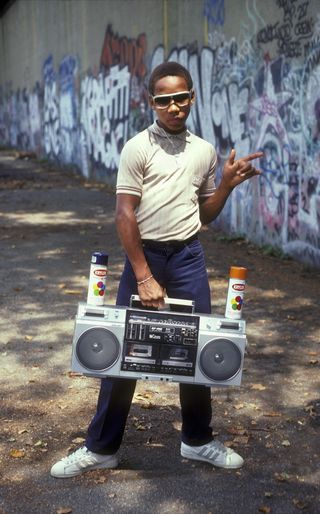
Nostalgic bliss shows up in many forms and certain items will always be a litmus test within pop culture. If someone were to pull out a killer boombox there will always be a distinct vibe to immediately pop up. I know that my eyes will light up at the sight as I will instantly think of my childhood in the early 80's and recall seeing Beat Street in the theater and thinking how fast can I find a piece of linoleum to break dance on.

Later on, well as in a roughly maybe three years later that same boombox would switch to albums by the Circle Jerks and old Metallica and would be blasting while we skated our local slick curb. 

Do yourself a favor, find a boombox and go make a skate session happen somewhere. If you are more on the hip hop side of things, find a killer wall to paint and blast some early 80's hip hop such as LL Cool J or Grand Master Flash and let the good times roll. 

Huge shout out to my older brother for getting our first boom box, thanks for the memories Toby!


Find more great articles like this on Collectors Weekly

"Boomboxes are, by definition, excessive. With their deafening bass thud and dazzling chrome dials, these electric beasts are heavy enough to tone your biceps. Also known as “ghetto blasters” or “jamboxes,” they rose to fame in the 1980s along with hip-hop, flourishing as a tool for sharing and mixing the latest beats. Yet despite their widespread popularity, the innovators who conceived of these devices are still largely unknown, consigned to anonymity by the corporations that manufactured their creations.

Miles Lightwood hopes to change that. He’s the founder of Boomboxラジカセ Creators, an online archive and forthcoming documentary film devoted to identifying the individuals behind the most successful boomboxes of all time. So far, Lightwood has only located a handful original designers and engineers, a few of whom are already deceased, but he hopes that with the help of the Internet’s global community, more will be found before they pass away.

Compared to today’s sleek micro-gadgets, boomboxes are like electronic dinosaurs, dated as much by their ludicrous size as their outmoded technology. Beginning in the late 1970s, companies recognized that buyers wanted their radios louder and more dynamic, so they made sure each model could project a solid mix of treble, midrange, and bass, while offering options for recording and editing, too. This was what made the analog boxes so big, requiring huge speakers, cassette decks, a radio receiver, and up to 10 D-sized batteries, all wrapped in heavy-duty casing.
“A boombox is a campfire, drawing in those nearby to enjoy a warm analog musical experience.”
The oversized radio-and-cassette-player combos quickly became a sign of status among urban youth, who knew their models by name: The JVC RC-550; the Panasonic RX-7200; the Sharp VZ-2000. Eventually they included features like detachable speakers and keyboard synthesizers, allowing for even greater mixing capability. These monster boxes grew so large and expensive that one model, the Conion C-100F, actually included a motion detector that sounded an alarm if the box was moved.

Today, boombox connoisseurs typically swap information and compare their finds on forums like Boomboxery and Stereo2go, waxing nostalgic for the era of street parties and tape sampling that couldn’t have existed without these master blasters. With his 2010 book, “The Boombox Project,” boombox collector and photographer Lyle Owerko lamented the shift from this culture of public music-sharing to one that exists in private. “The world of sharing music in parks and on city streets now resides in cyberspace as we share in anonymity online. The boombox that marked this change from public music ‘broadcasting’ to private consumption was the JVC PC-100, a mini unit with a detachable headset. Now you could share your music in the public sphere, or keep it private by ejecting the cassette deck and plugging headphones into it.”

Lightwood is hopeful that shedding light on the origins of classic boomboxes might renew interest in the technology that facilitated this communal audio culture. We spoke to Lightwood about the world of vintage boomboxes, and why their creators are often shrouded in mystery.

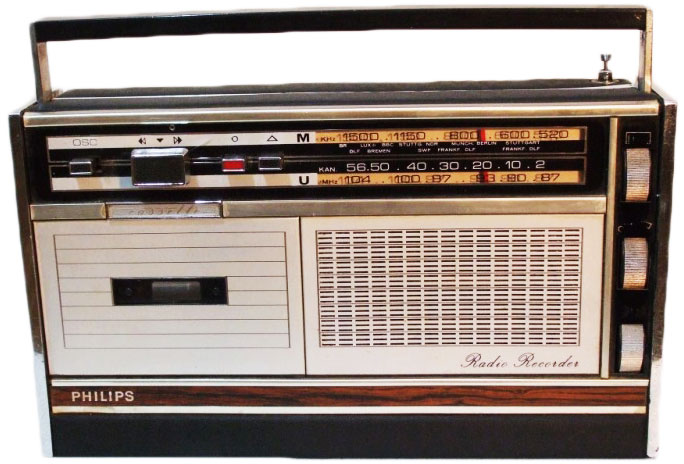
The Philips "Radio Recorder" from 1969 is thought of as the world's first boombox.
The Philips “Radio Recorder” from 1969 is thought of as the world’s first boombox.

Collectors Weekly: Where did the boombox originate?

Miles Lightwood: The boombox by its typical definition—a handled, portable, radio cassette deck with one or more speakers—was actually invented in the Netherlands by Philips in 1969. The one considered the first boombox was made so that you could record from the radio onto the cassette without having any external cables for a microphone. All of a sudden, you’ve got a very easy music-sharing culture, and the Japanese companies basically took that idea and ran with it.

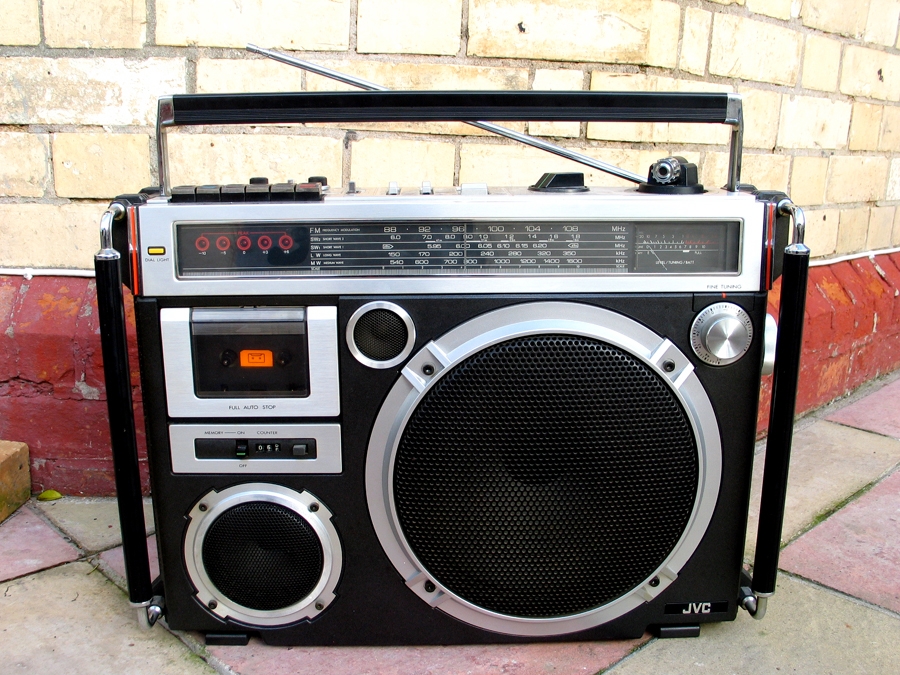
In my mind, the first device that’s like the urban boombox of popular culture is the JVC RC-550, which was a monster box. It’s got a 10-inch woofer, it looks mean, and it’s got lights and the whole package. That was made in ’75.

Collectors Weekly: How did your boombox obsession begin?

Lightwood: When I was younger, I had a couple of boomboxes, and they both got stolen out of my apartment. I was living in a bad part of downtown Los Angeles. One day, I came home, and someone had taken every electronic device I had.

When I was skateboarding in empty pools back in the ’80s, just having a box gave you status. Regardless of whether it was the biggest or flashiest one, it was cool to be the one with the music. Some of those huge Japanese boxes cost around a thousand bucks. There was no Walkman; there was no iPod. Back then, the only way you could share music was with a boombox.

Lightwood considers the JVC RC-550, also known as "El Diablo," as the first radio to resemble a true boombox.
Lightwood considers the JVC RC-550, also known as “El Diablo,” as the first radio to resemble a true boombox. Via radiohier.com.
Then about two and a half years ago, the radio in my car went out, and when I looked into getting it replaced, I realized it was going to cost me about the same as a boombox. So I decided I was just going to get a boombox and keep it in the car. I got what’s called an “AKA,” or a re-badged and re-styled version of an earlier box, and it’s actually still in my car. I listen to it all the time. But like any other type of collecting, one is never enough.

I’ve been collecting boomboxes for a few years now, and earlier this year, I began wondering who created these magnificent machines. We know the musicians, artists, and celebrities that appreciate boomboxes, but more than 30 years later we still don’t know who created these boomboxes: Who is the Jonathan Ive of Sharp? Who are the Charles and Ray Eames of Conion? Who is the Dieter Rams of Magnavox?
“A bigger, louder, flashier box got you more attention on the street—boosting your reputation.”
While functionally developed in the Netherlands, the most iconic boomboxes were created in Japan during the 1970s and ’80s. This was a time when Japanese design and manufacturing was evolving from a copying culture to an innovating culture, and the boombox is a great example of this. I want to find the inventors of these important “grail” boxes and tell the stories of how they designed the machines we love, before it’s too late. Aside from satisfying my own curiosity, boombox creators need to be recognized and celebrated for the contributions they have made, not only to the fields of design and engineering, but also to music-sharing and popular culture worldwide.

I really hope to make this a collaborative, crowd-sourced project, and our website will be the central point for that, possibly enlisting some design schools in Asia to help track down these people. It’s going to be a bit of a challenge, because even once we’ve identified certain people, they’re generally older, so they don’t really have any presence on the Internet.

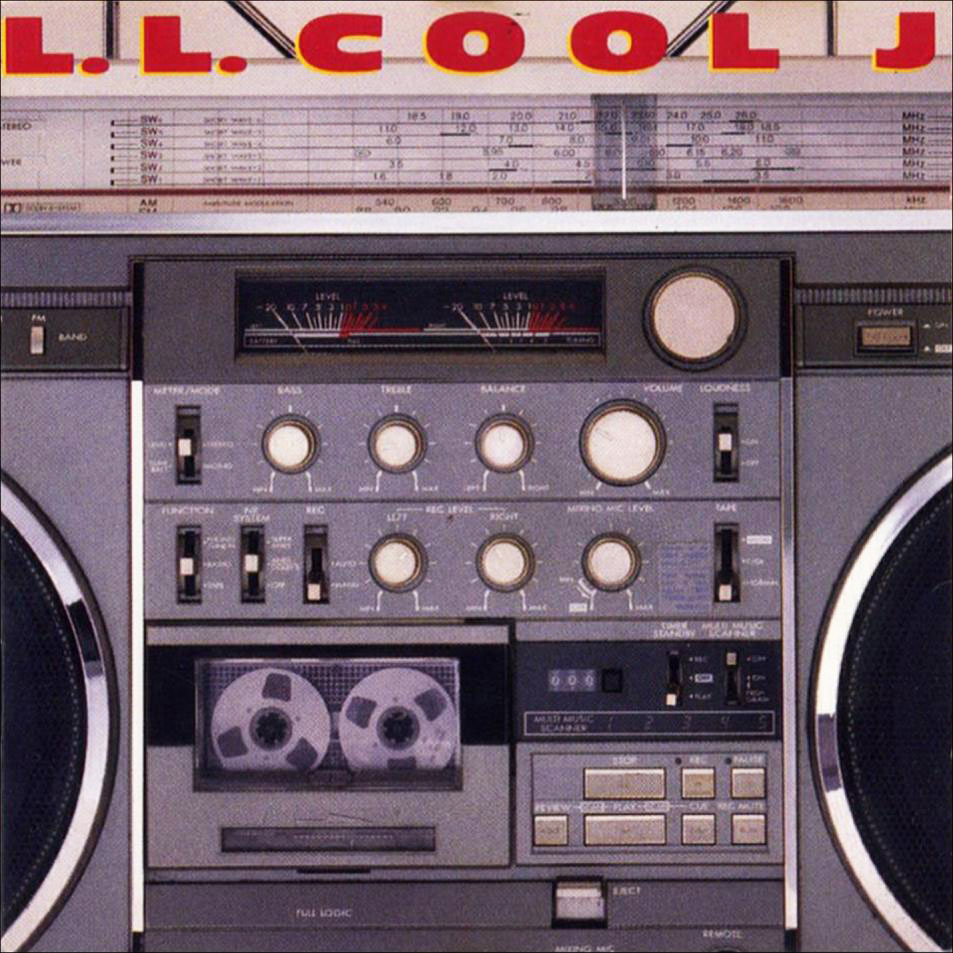
The cover of LL Cool J's 1985 album "Radio" featured a JVC RC-M90.
The cover of LL Cool J’s 1985 album “Radio” featured a JVC RC-M90.
Collectors Weekly: What makes a boombox a grail?
Lightwood: That’s shorthand for “holy grail,” meaning the most collectible or the most recognizable, the ones that have all the features that you associate with a boombox. They’re big; they’re loud; they’ve got all the bells and whistles.

There are certain agreed-upon grails within the community, and then everyone has their own personal grail. Take for example, the JVC RC-M90, which is on the cover of LL Cool J’s first album “Radio.” It has an amazing sound but it’s also got an amazing look, and it’s one of the most sought-after boomboxes. If you can get one, it’s going to cost you at least $800 and a fierce bidding war on eBay or another auction website. I’ve got one of those, but personally, I focus on the Japanese boxes, which are fairly rare. I recently found one of those boomboxes that was stolen from me on eBay, not the exact same one, obviously, but a replacement in really good condition.

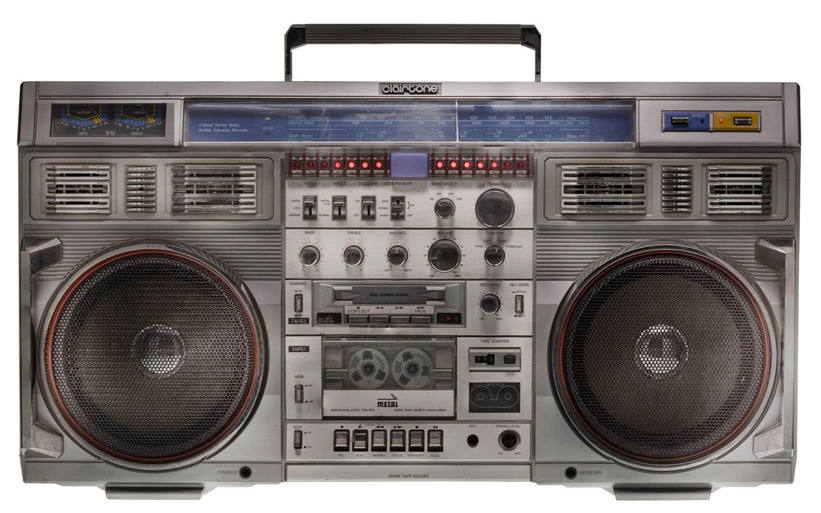
I know some collectors who have found grails like a Conion C-100F, another legendary box, on Craigslist. They went over to check it out, and they met this little old lady whose husband passed away, so she was downsizing. The couple originally bought this Conion so they could have some portable music at their cha-cha dance class or something. The box is like a time capsule: It never was a street warrior, never got beat up. I don’t have that type of story yet, but one day I will.

A Conion C-100F, which included an ear-splitting motion detecting alarm (visible in the upper right corner) from the collection of Lyle Owerko. Photo courtesy Lyle Owerko.
A Conion C-100F, which included an ear-splitting motion detecting alarm (visible in the upper-right corner), from the collection of Lyle Owerko. Photo courtesy Lyle Owerko.

Collectors Weekly: Why were they so big?

A young B-boy struts his stuff in New York, circa 1980. Photo by Martha Cooper.
Lightwood: The classic grail boomboxes of the ’70s and ’80s were designed to provide a home stereo experience on the go. That meant several large speakers (typically 2 to 3 speakers ranging from 2″ to 10″ in diameter), one or more cassette decks (side-by-side or stacked), a multi-band radio receiver (typically 2 to 5 bands, but some had more), the power supply to blast it in the street (8-10 batteries), and the transformer that allowed you to plug-in at home. In the analog era, to get the loudest sound out of big speakers required a large amplifier and other crossover electronics that occupied quite a bit of physical space within a box.

Transporting all these components safely and with style required a sturdy enclosure that satisfied both aesthetic, sonic, and functional requirements; consequently, these boomboxes were large and heavy. Practical issues aside, a bigger, louder, flashier box got you more attention on the street—boosting your reputation—and manufacturers could charge more; so win-win. Bigger is better.

Collectors Weekly: What have we lost with the switch to MP3 players?

Lightwood: Sonic warmth and physical community. When shared in a public space, a boombox is a campfire, drawing in those nearby to enjoy a warm analog musical experience and connecting them in a spontaneous community. Anytime I share music from a boombox in public, I meet new people, learn new stories, and everyone has a great time. Listening to an MP3 player in public just isn’t the same.

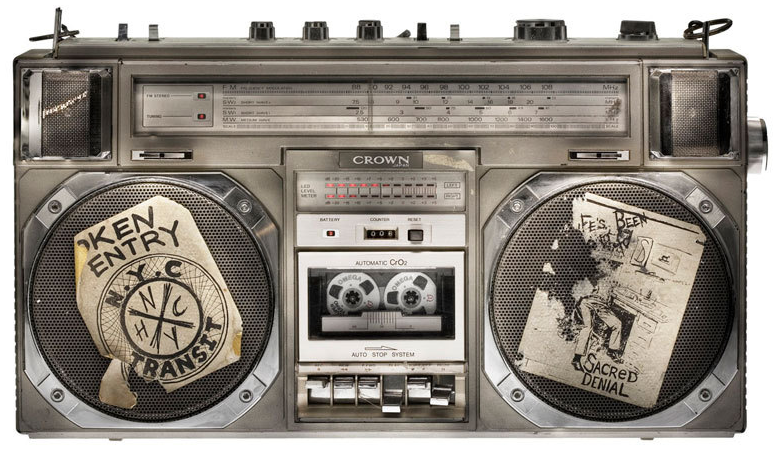
Often boomboxes were customized with emblems of a favorite band or musical style, like this punked-up Crown CSC-950. Photo courtesy Lyle Owerko.

Collectors Weekly: Why is it so hard to locate the original inventors of these devices?

Lightwood: A designer, engineer, or marketer working in a consumer electronics manufacturing company in the ’70s and ’80s was just a cog in the corporate wheel. Then as now, very few people were individually acknowledged for their contributions to a given product. Without assistance from a manufacturer, the only way to identify a creator is via a thorough examination of publicly available documents, and even then, not all these people can be identified.

For several months at the start of the project, I reached out to the original manufacturers to help identify the creators of their boomboxes, but with no success. I continued researching, and once I realized how to search the public patent databases, many creators were revealed. I’ve identified 17 creators thus far, and I’m discovering more each month. Now identified, the real work begins: locating these people around the world and telling their stories before it’s too late, as many of them are elderly.

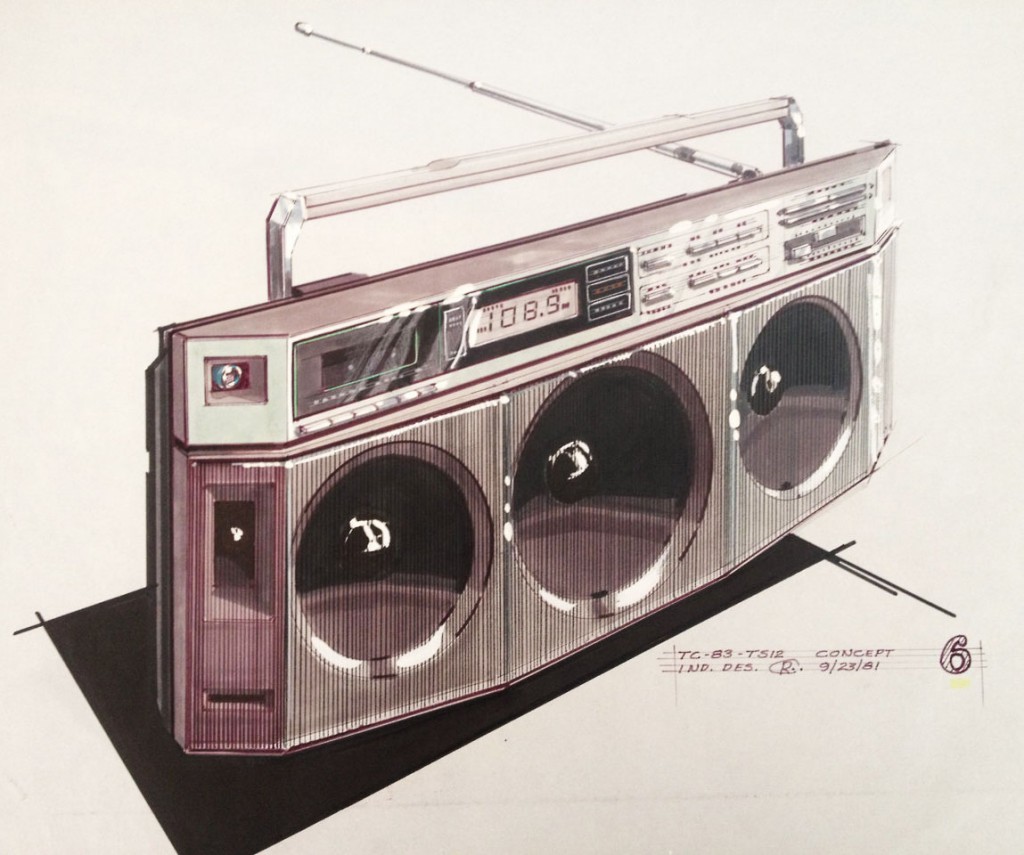
Lightwood purchased this 1981 conceptual drawing by Richard Culbertson from an estate liquidation on Etsy.
Lightwood purchased several conceptual drawings from 1981 by Richard Culbertson through an estate liquidation on Etsy.
So, the first breakthrough was realizing that people’s names are in the patent databases if you know how to look for them. The second was actually getting 50-some odd drawings from the estate of an actual boombox creator. There’s a guy who has a Mid-Century Modern furniture store on Etsy, but he also has drawings and paintings and whatnot. And he came across these Richard Culbertson drawings from an estate liquidator. When I found them, I was like “Holy moly!” They’re all meticulously hand-drawn, just gorgeous.

Collectors Weekly: Are most of the companies who made these boomboxes still operating?

Lightwood: Yes, most of them are still operating. JVC, Panasonic, General Electronic, Pioneer, Sanyo, Hitachi, Toshiba, they’re all around. There’s a few oddball ones that aren’t, like Skitronic, which made the Discolite that has the light-up speakers and was featured in music videos by Madonna, Lady Gaga, and a bunch of others. That company is out of business, and those are grails as well. The sound quality isn’t that great on those, but they’re popular for their looks and their “wow” factor.


Collectors Weekly: How do you find replacement parts for vintage boomboxes?

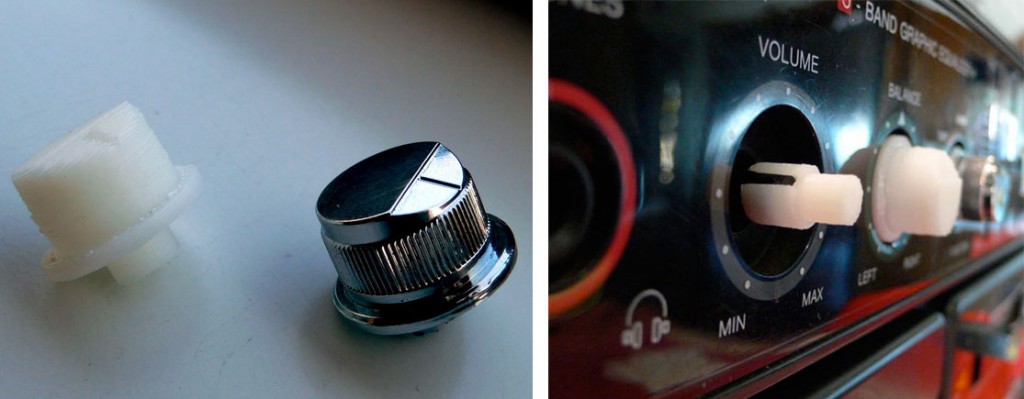
Lightwood: Replacement parts don’t really exist, but there are a few options, like asking other collectors for used parts, seeking out and buying a parts box, or utilizing new technologies to make your own. I’m involved in the 3-D printing community, and when I was trying to repair my most recent purchase, a Lasonic TRC-931, I needed new knobs. So I started printing up knobs. But I’ve realized that the resolution of most 3-D printers means that you don’t get an exact reproduction part. You get a functional part, but it doesn’t look quite right. There are plenty of internal parts that can fail, gears and whatnot, and those you can easily print because there’s no real cosmetic requirement—it’s all functional.

Collectors Weekly: What’s been your favorite discovery related to boomboxes?

Lightwood: There are so many. Acquiring original drawings from the estate of a boombox creator, or meeting a creator who worked for one of the longest-standing boombox manufacturers.

Lightwood has used his 3-D printer to create replacements for knobs and other internal parts.


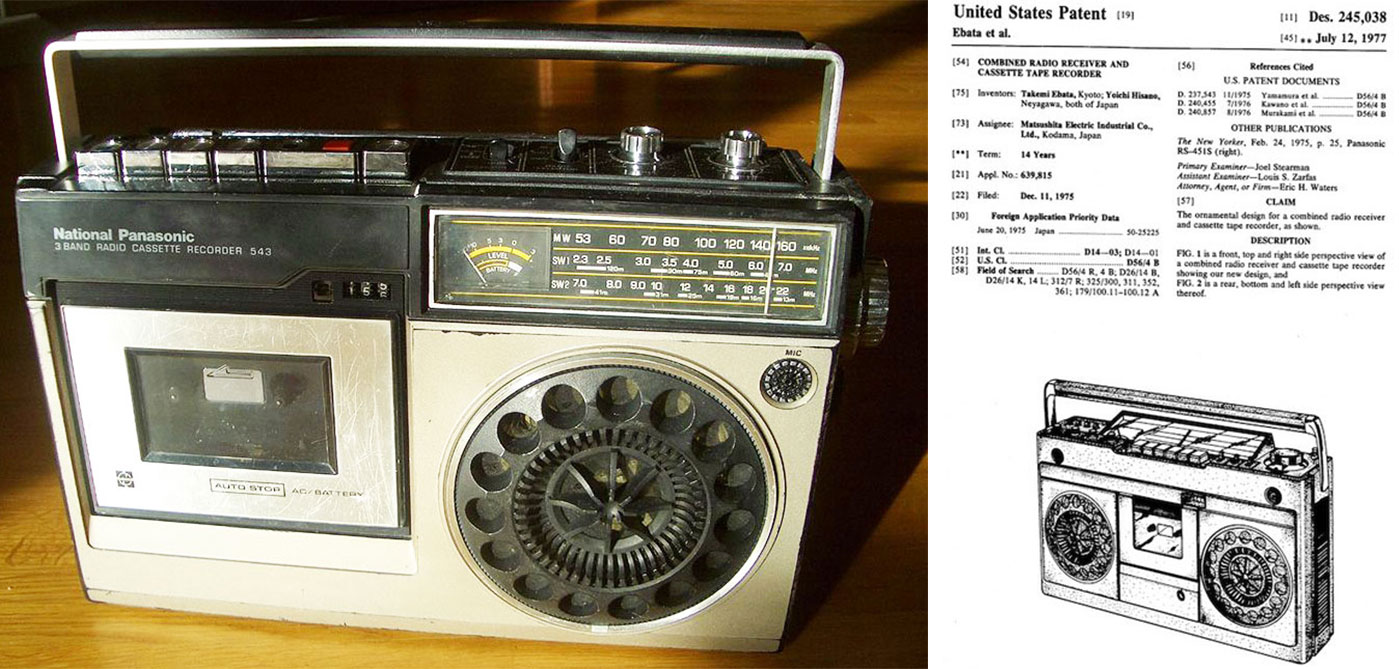
Matsushita was this Japanese company that owned a bunch of different brands, like Technics, JVC, Quasar, Panasonic, and Sanyo. Over a 16-year period, Matsushita sold 4.2 million of one model boombox, the National Panasonic RQ-543. That’s a little over 700 boomboxes a day for 16 years. And that blew my mind; I had no idea they were made in such numbers.

Collectors Weekly: Why was that model so popular?

Lightwood: I don’t really know. Through my research, I realized that several of these Japanese manufacturers have museums devoted to the company founders and their popular products, which include all types of electronics and home appliances. Some guy went to the Matsushita museum and filmed a walkthrough that I found on YouTube, just panning over all the different products in there. And I thought, “Wow, there’s a boombox over there!” It was a gold boombox developed for the Middle Eastern market.

The National Panasonic RQ-543 made by Matsushita sold over 4.2 million models, primarily in the Middle East. Photo via shizaudio.ru.

If I spoke Japanese, I could write to the museum and get a little more background on it. I contacted one individual in the boombox collecting community who lives in the Middle East, in the U.A.E., and asked him if he’s ever seen this gold box. I don’t know if they were all gold, or if this is a commemorative one for the 4.2 million they sold.

This member in the U.A.E. said that most of those boomboxes aren’t even in the country anymore, because the people that would’ve bought them were mostly foreign laborers that were brought in to build or maintain the country’s infrastructure. Once their time was up, they would leave and take their equipment with them, so the boomboxes would end up wherever the laborers came from.

Collectors Weekly: Do you have a favorite boombox?

Lightwood: In no particular order: Victor RC-550, Tisonic PR-7000, Victor RC-M90, Amsen FK-887, Sanyo MR-X920, Sharp GF-999, Lasonic TRC-931, Victor RC-M70. I have them all, and that’s like a parent choosing a favorite child. Each has its own look and sonic personality.

The JVC PC-100 included a detachable cassette player, which began the shift to private audio devices like Walkmans.


Monday, February 18, 2013

Your Turntable Is Not Dead, It Just Craves New Vinyl

In 2013 we will have quite a few new albums coming out on vinyl records. There will be 7" records, 12" records and damn if there won't be some amazing tracks as part of those releases. One important person in the vinyl record resurgence is the one and only Jack White. Third Man Records is now one of the biggest vinyl sellers in the world and below is a really cool write up from Ben Blackwell who heads up the vinyl production within Third Man Records.


Jack White, musican, business man and vinyl record champion for the music fans
"When the White Stripes got signed, Jack White created Third Man Records as an insurance policy. With the White Stripes and, later on, Whirlwind Heat and the Raconteurs, the bands only licensed their music to record companies—the labels didn’t really own it. So in case things went sour, Third Man was a way for Jack and the bands to be able to maintain ownership of their masters and their records.

You hear so many stories about that damning phrase, “in perpetuity,” on contracts. Jack was savvy: he didn’t just jump at the first offer he got. He dictated his own terms and got exactly what he wanted.

Come 2008, the White Stripes’ original deal with V2 Records in North America had expired. They signed for “Icky Thump” with Warner Bros., and Warner Bros. also took on the manufacturing of the White Stripes’ CD back catalog. But the band retained the vinyl rights.

The main impetus for starting Third Man Records in 2009 was getting these White Stripes records—their back catalog—back into print on vinyl. In between the germination of that idea and the actual opening of Third Man, The Dead Weather formed and recorded an album, which redirected us for the first year or so. But now we’re back on point, working on these White Stripes reissues.

Collectors Weekly: What kind of facilities does Third Man Records have?

Blackwell: The store itself is fairly small, maybe about 15 feet by 15 feet, maybe a little bigger. We’ve got a little hallway that leads back to our offices. The offices aren’t open to the public, but the hallway is lined with a display of gold and platinum record awards. Mainly two to three people oversee the store, with a fair amount of help from everyone else.

On June 10, 2010, late-night host Conan O'Brien and the Legally Prohibited Band played a set at Third Man Records. The live vinyl LP features Jack White joining in on Eddie Cochran’s "20 Flight Rock."
The store is in Nashville because that’s where Jack White lives. He’s very hands-on, overseeing everything from artwork to listening to test pressings. When he’s not on tour, he’s here every day, partaking in the running of the label.

Almost all of our releases have been recorded at Jack’s recording studio, which is at a different location than the store and offices. We’ve also done a couple reissues, which obviously weren’t recorded there.

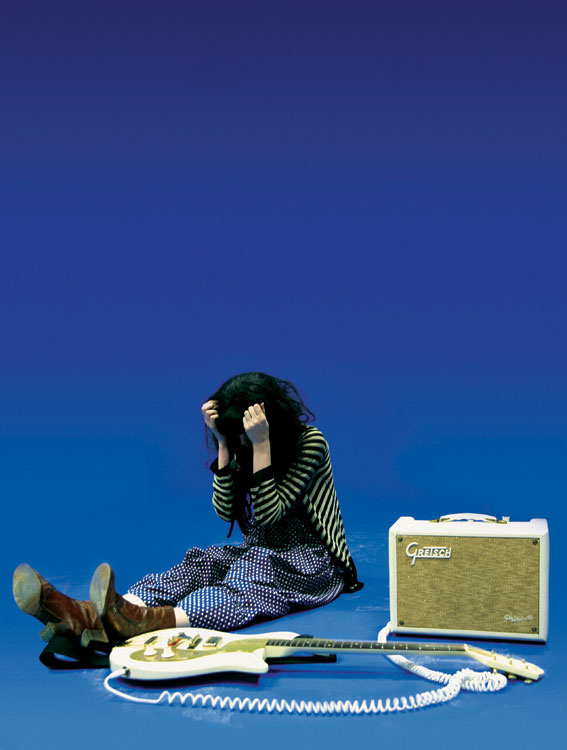
In terms of what we have here at our offices, I think our biggest asset is our performance room, which is called the Blue Room. The covers of the 45s we’ve done from our so-called “Blue Series” were all shot in that room—each has a vivid blue background behind the artist’s portrait.

That’s really the foundation of the building. It’s in the back and holds approximately 300 people. It’s where The Dead Weather played their first show and where they played the live streaming version of “Sea of Cowards” a couple months back.

Dex Romweber Duo has played a show there, as did Conan O’Brien when his band was coming through in June. We also had Karen Elson play, plus a punk band from California called Nobunny.

We also have a fully operational darkroom. We don’t have on-site record pressing, but it’s something we hope to accomplish further down the line.

Collectors Weekly: Where are the records pressed?

Blackwell: United Record Pressing is approximately a mile and a half from our offices, so they’re literally down the street. They’ve been pressing records since 1949, first as Southern Plastics and then under the United name starting in 1971. It’s a really amazing place.
Jack White is the unifying aspect of all our releases. This label is fueled by his energy.
From what I can tell, United seems to be the largest pressing plant in the world, both by capacity and square footage. They can crank out a lot in a day. They’ve got 7-inch, 10-inch, and 12-inch presses. They do 180-gram records, as well as all different kinds of colored vinyl.

For our Texas pop-up store, we had this idea of doing oversized records because everything’s bigger in Texas. So United pressed 8- and 13-inch records for us. I don’t know if anyone had actually done 13-inch records before.

It’s a not-so-secret secret weapon, being in the same town as your pressing plant. I can go over there and see my records being pressed, and I can deal with my customer service rep face-to-face to get answers in real time. You don’t really get that connection with someone when you’re just emailing or placing a phone call, which all ties back to our analog approach in some respects—it’s a more old-fashioned way of doing things.

United works with all kinds of major labels, including Motown back in the day. They do a lot of record pressing for Sundazed Records, the Universal family, and small labels like HoZac. Until the mid-’90s or so, they only pressed 7-inch records. Going in there kind of feels a little bit like stepping back in time.

Collectors Weekly: How are vinyl records made?

Blackwell: First off, vinyl as it is right now has a lead component to it, which is obviously not terribly safe for consumption. You don’t want to eat it. There are moves toward working with a lead-free vinyl, which would be better for everyone.

Mildred of Mildred and the Mice met Jack White in a Kentucky hardware store. She sang a song for him and he signed her on the spot, making her the first non-Jack White artist for Third Man.
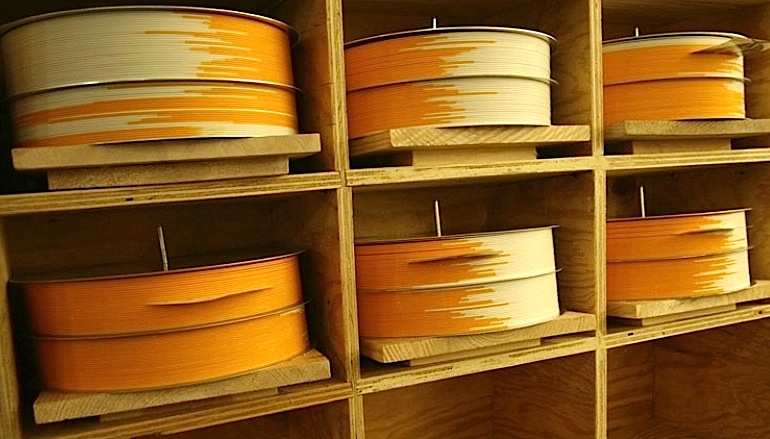
That being said, vinyl in its raw form comes in small, gravel-sized pellets. The pellets are packed in boxes, each of which literally weighs a ton.

That raw vinyl is fed into a machine called a hopper, which melts the pellets down and moves them into the extruder. The extruder pushes the vinyl out in strings, which are then formed into what we call a puck or a cake because it looks like a hockey puck or a small, flat cupcake. That cake is very hot, so it’s malleable. Labels are affixed to the cake’s corresponding A and B sides.

A lot of people don’t realize that the labels lend structural integrity to the record itself. Those labels are baked on there. They’re in the press. A lot of people think they’re affixed afterwards or that they’re stickers. That’s not the case.

After the labels are in place, the record is slid into a machine that exerts between 10,000 and 20,000 pounds of steam pressure, depending on whether you’re pressing a 45 or an LP. The puck is pressed against a plate with ridges that correspond to the actual playable audio, which makes grooves on the puck.

The record then slides out of the press and moves toward a turntable that trims off the excess, what I guess you could call the crust of the vinyl. The trimmed crust falls into a bin underneath. The record slides off into a spindle and is then inserted by hand into a paper sleeve.
The Cadillac of record pressing is 180-gram vinyl.
The excess vinyl, the crust or the trim, plus any defective records that are scratched or off-center, are all ground down and used in subsequent pressings. For a petroleum product, an oil-based product, there’s actually very little waste involved—there’s a lot of recycling that goes on with vinyl record pressing.

For a regular pressing, I think the percentage is 90 percent virgin vinyl and 10 percent regrind. United also runs specials—what we call the hippie special or the green record pressing—in which they can press on 100 percent reground vinyl so that you’re reducing your carbon footprint. Top-of-the-line 180-gram records, on the other hand, are pressed with 100 percent virgin vinyl.

Collectors Weekly: What is significant about 180-gram vinyl?

Blackwell: The main indicator of a vinyl record’s quality is its weight. The standard weight of an LP is between 140 and 150 grams. Most records you grab are going to be that. The Cadillac of record pressing is 180-gram vinyl, which is heavier and a little bit thicker. There’s a lot of misinformation about it, though. Some people think 180-gram records have deeper grooves, which is supposed to improve the sound. Not true. Records have a standard groove depth, and your turntable wouldn’t really be able to play anything deeper.

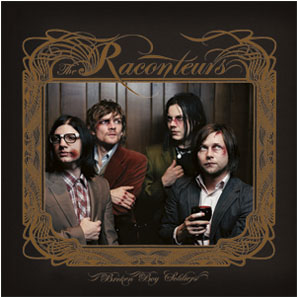
Part of the mission of Third Man Records is to keep LPs such as "Broken Boy Soldiers," the debut album of the Raconteurs, in print on vinyl.
The advantage of 180-gram vinyl is that it’s much less susceptible to warping—you basically have a sturdier record. The old 1970s major-label pressings on Dynaflex were so thin they’d flap in the wind. These 180-gram records just won’t do that.

The second thing is that 180-gram records are less susceptible to feedback between your turntable and your receiver, depending, of course, on what kind of stereo record player setup you have. I believe it cuts down on drag or interference between the actual turntable and the stylus, your needle.

There’s not really an equivalent for 45s, definitely not at United. There’s also GZ Vinyl, which is in the Czech Republic and is probably the second biggest plant in the world. They do a 45 that kind of feels like if you threw it at someone’s neck, it would cut their head off. I don’t know the exact weight of that, but it might be something like 100 grams.

Lots of artists ask me for advice on pressing records. There are approximately a dozen record pressing plants in the U.S. today. I always recommend the record-pressing plant in their town. You’re going to get a little bit better service than if you’re calling someone or emailing someone. You can go there and walk right in. That’s just a fact.

There are plants in places like Detroit, Cleveland, Nashville, and Columbus. Southern California has a bunch. There’s a handful on the East Coast, and I believe there’s still one in Texas. They’re around. So if there’s a plant nearby, use it. Support your local businesses. It’s going to help you in the end.

Collectors Weekly: What is electroplating?

Blackwell: Here’s the short version of how a record comes to be. Let’s say I’ve got a finished recording. I take that to a vinyl-mastering engineer. United doesn’t do that in-house, but the company that does it for them is literally across the parking lot, an independent company called National Record Productions.

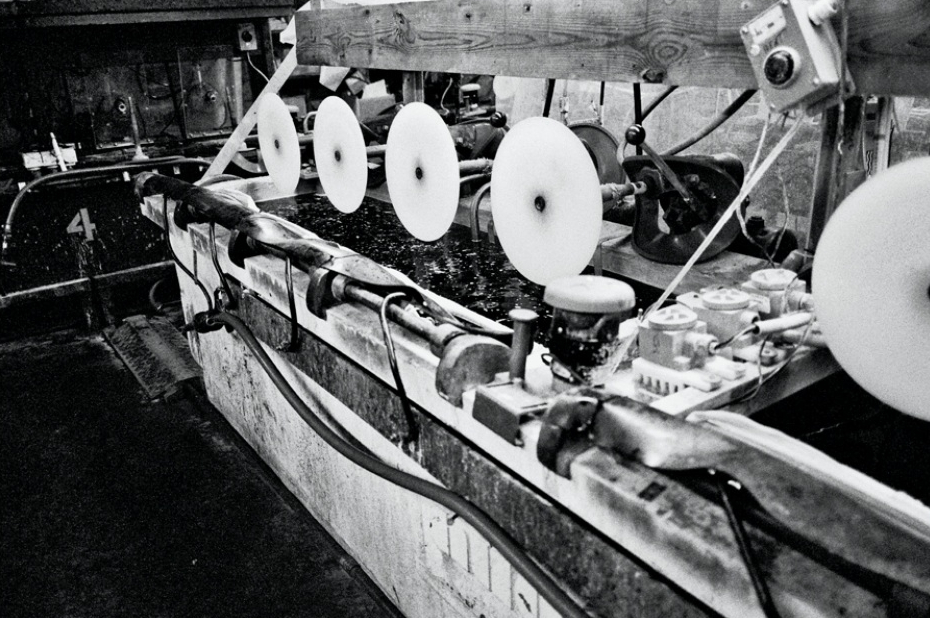
Before a record can be pressed, the masters need to be electroplated, as shown here.
The engineer has a really important tool called a lathe. Starting with a blank, empty acetate—or lacquer, as they’re sometimes called—he uses the lathe to cut the physical grooves that will be pretty much the same grooves that are on your playable record.

Once the vinyl-mastering engineer has cut the grooves, the finished lacquer, or acetate, is sent over to United to be electroplated, which involves coating the lacquer with a thin layer of silver that’s then delicately peeled off. Next in the process is nickel-bath electroplating, which makes the stampers from the peeled and electroplated silver. The stamper is what you actually affix to your record press to be stamped into the molten vinyl with the 20,000 pounds of steam pressure I was talking about earlier. In other words, electroplating creates the plates you use in the press.

United also has a really big finishing department, where they insert records into jackets, do shrink-wrapping, run the stickering machine, and so on, in addition to a distribution department and lots of warehouse storage. It’s a big operation.

Collectors Weekly: How is multicolored vinyl made?

Blackwell: We’ve done a few color combinations, including the split-color black and blue LPs. Basically, you have two extruders, each one filled with a different-colored vinyl. Those two extruders feed the molten vinyl into something that looks like a cupcake mold, more or less.

"Horehound," the debut album by Jack White's latest band, The Dead Weather, featured two LPs, one in traditional black and a second in white and yellow.
In that cupcake mold, there’s a thin piece of metal dividing it in half so that, for example, all the black fills one side and all the blue fills the other side without becoming mixed. When that cup lifts up, those two different vinyl portions are right next to each other, which is how you get that really well-defined line between colors. You don’t get any marbling because the different-colored vinyls are kept separate until the actual puck is set into the press.

It’s a little bit different for the tricolor 45s that we do in black, yellow, and white because that is not an automated process. All of our tricolor 45s are done by hand—they’re cut by hand, reassembled with the different-colored portions, and then inserted into a manual press. During the whole process, there’s something like a hot plate around it to keep it at a high enough temperature so it doesn’t solidify. Someone has to press a button for every record pressed. It’s way more labor-intensive, but I think the tricolor vinyl has become our calling card.

Collectors Weekly: Has Third Man done any other special, unique vinyl pressings?

"A Glorious Dawn" was found on YouTube and pressed with the permission of the Carl Sagan Estate.
Blackwell: We released a song called “A Glorious Dawn.” We credited it to Carl Sagan, but it’s basically audio taken from his “Cosmos” television series, remixed, rejiggered, and accompanied by a backbeat. We were introduced to it via a YouTube clip, and as soon as Jack saw it, he said, “We have to put this out.” So we contacted the guy who put it together who was really accommodating, and then we called the estate of Carl Sagan. They were very interested and could not have been more helpful.

We did a limited release for that record and called it Cosmos-colored vinyl. It was basically black vinyl with little glow-in-the-dark specks—if you held it up to the ceiling, it didn’t take much imagination for the record to look like the universe or the night sky. I don’t think I’ve ever seen that before. To make that, United used raw, glow-in-the-dark vinyl—they just threw a handful in for each record.

When we did a pop-up store in London one Halloween, we took all the 7-inchers that we had pressed up to that point, repressed them on glow-in-the-dark vinyl, and coupled each release with new Halloween-themed picture sleeve artwork. We did 100 each of those titles—the demand far exceeded the supply. People are paying a couple hundred bucks each for them now if you look on eBay.

Collectors Weekly: Where is Third Man’s album art printed?

Blackwell: For our 7-inchers, we use a local printing company called TFS Graphics. They’ve been absolutely wonderful for us. For our LP jackets, we use a company in California called Stoughton Printing. They are the go-to place to get record jackets done right. That’s not the kind of thing that you can do locally. There are only a handful of printing presses that can do all the folding and gluing properly.

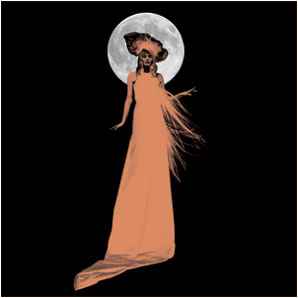
Karen Elson's "The Ghost Who Walks" LP was produced in an edition of 300. The vinyl was peach colored and scented.
There are a couple of things that make it, and keep it, a difficult process. The artwork is printed out as a sheet of thin paper, also sometimes known as a flick, and is then cut and glued around a board jacket. I think Stoughton is the only company that still does that old style or “tip-on jacket.” It’s a look that’s become synonymous with a lot of private-press records.

We’ve used that on The Dead Weather’s “Horehound.” Most of our jackets are done with that old-style tip-on sleeve. It’s printed on a solid, sturdy stock that really looks and feels good. Actually, that’s what we’re all about—looking good and feeling good.

I think people can tell the difference when they hold our records—they look at it and they say, “This wasn’t just dashed off in 20 minutes. They worked hard at this.” At least, I hope that’s what people are taking away from it because we do work extremely hard on every release.

Collectors Weekly: Is Third Man geared specifically toward collectors?

Blackwell: I think we do get accurately pegged as catering to a collector market and to people who are record collectors, but at the same time, the idea behind Third Man Records is that all of this stuff will be in print for eternity. If you want to buy a copy of the first Dead Weather 7-inch—and if you’re not a super-collector who has to have it on tricolor vinyl—you will be able to buy that from us for something like $5 from here until this place falls apart or the world ends.

Jack White plays drums for The Dead Weather, seen here in their first public performance at Third Man Records.
The idea is to make music accessible. We do a limited run of these tricolor or split-color records to cater to the collectors, the people who crave that stuff. But if you’re a music fan, we’re also the place for you. It will always be available.

I’m a music fan first and a record collector second. I think that’s something that we try to keep in mind here. People sometimes complain, saying, “I couldn’t get your 8-inch records in Texas or your 13-inch records,” or “I couldn’t get the glow-in-the-dark records in London.” Those records were made to celebrate an event. The point is that you had to actually be there.
Just because no one’s going to sell one million copies of an LP ever again doesn’t mean that vinyl is dead.
We also get a little bit of a flack for not making this stuff available online to the worldwide market. To those critics, we just have to respond by saying that they are totally missing the point. One of the ideas behind Third Man is that not everything is just available with the click of a mouse. A lot of what we try to do is meant to be a part of a tangible, real experience.

When we started out pressing the tricolor vinyl, we were pressing 100 copies of tricolor 7-inchers, and they were only available at our storefront. People were pissed—some of them are still pissed about it. Seeing how well it went over, but trying to respond to the complaints, we’ve tweaked it a bit. We still make 100 available in our storefront. People line up and wait overnight outside of our store to get them; some will get proxies in there, and people will flip them on eBay, all that stuff. But we also press 50 copies that we insert randomly into mail orders for that title. So you never know.

Collectors Weekly: Does Third Man sell anything besides vinyl?

Blackwell: Yes. The idea was that if you’re a Jack White fan, if you’re just a fan of the stuff that he’s done, it’s kind of a one-stop shop. If you need a Raconteurs T-shirt or a White Stripes CD, you can get it at our store. We understand that our proclivity toward vinyl isn’t for everyone, so we definitely have CDs available if someone wants to buy those.

Collectors Weekly: Third Man Records works with a pretty diverse group of artists. What unifies them?

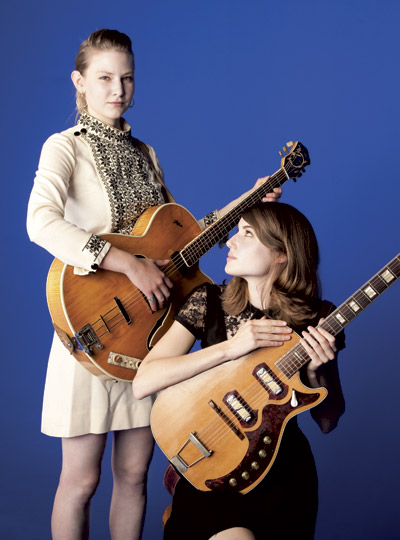
The Smoke Fairies are an example of a band that has cut a record with Third Man but is not represented by the label in the traditional sense.
Blackwell: Well, I do tend to notice a common misconception about artists and the label. People think that because we put out a Smoke Fairies 7-inch, the Smoke Fairies are on Third Man. That’s not really the case. Most of the records that we put out are one-off deals. They’re lone 7-inch records. We’re not really in the traditional mold of a record label that will sign an artist and help break them or develop them. We do stuff that interests us.

For a band like Dex Romweber Duo, they were coming through Nashville on tour. We thought, “Well, let’s get them in the studio. We’ll record two songs. We’ll take their photo in front of the blue wall and we’ll whip it out as soon as we can.” It’s not like Dex Romweber is calling us and we’re providing tour support.

We’re a label, but not in the way people are used to thinking about. We’re more of an old-style label, just focusing mainly on going from single to single.

The one unifying thing behind pretty much all of our releases is the involvement of Jack White, whether he’s in the band or producing it. In short, it’s his label, and I think his vision is the unifying aspect of all these releases. It is wholly fueled on his energy and what he wants to accomplish.

Collectors Weekly: Are there any other labels out there now with a similar strategy?

Blackwell: There are a lot of labels that do what we do, but they aren’t labels that many people have heard of. The staff here is really into labels like Trouble in Mind or Rob’s House. A label that I really love is In the Red Records. HoZac is another great one. But these all tend to be more independent and underground. For lack of a better term, you could call them hobby labels.
Vinyl still has some lead in it. You don’t want to eat it.
We’re in a special spot. Because we’re Jack White’s record label, we’re afforded a little bit of a higher profile, and we’re able to sell more records because of it. But we think of ourselves as just a larger version of those so-called hobby labels, labels that put out music they love, focus mainly on singles, and think in terms of working from one project to the next. We’ve been open about a year and a half, and I’ve already assigned 55 catalog numbers. That’s a lot of records to put out.

Collectors Weekly: Why are small labels important?

Blackwell: Smaller record labels will always be important because they are the record labels that discover talent. There are certain obvious exceptions to this rule—John Hammond from Columbia Records discovering Bob Dylan, for example. But Bob Dylan was an undeniable talent. Anyone who saw him would’ve known that.

Even though the facilities at Third Man Records in Nashville include a 300-person performance space, the retail space itself is barely 15 by 15 feet.
Independent record labels aren’t really there to nurture careers. Independent record labels are labels that are good for a first release, for putting out a record by someone you’ve never heard of and spreading the word with the hopes of helping that artist reach a larger audience and, if necessary, moving them toward a more traditional record label that can help them in the long-term.

Look at Elvis Presley starting with Sun Records before moving on to RCA. Look at Nirvana starting with Sub Pop and moving on to DGC. Look at the White Stripes starting with a single on a small Detroit record label called Italy Records and then moving up to V2 after three albums. All of these are artists that started out on small, independent labels. That seems to be a proven path to success time and time again.

Not to slight any artist that debuted on a major record label, of course. Three of my favorite bands—the Stooges, the Ramones, and the Sex Pistols—were major-label bands that never did anything on small, independent labels to begin with. It’s just that in the world where I grew up and still operate in, independent labels are where the wealth of my music interest and information comes from.

Collectors Weekly: You don’t seem old enough to have come from vinyl roots.

Blackwell: I’m only 28 years old, but I got into Nirvana really early on. One day, I was at a record store called Desirable Discs in Dearborn, Michigan, and I saw a copy of the “Sliver” 7-inch by Nirvana on the wall.

Of course, if you are looking for a vinyl copy of the latest White Stripes album, Third Man Records has that, too.
Sub Pop has never let that single fall out of print—it’s been pressed since 1990, so it wasn’t an especially desirable or rare record. I think it cost 10 bucks. When I saw it on the wall for the first time in person, I was instantly captivated. “Because I’m a Nirvana fan, I need to get that,” I thought.

At the time, I didn’t even have a record player. I was probably 14. I had a job, and I had money, so I found a record player for 15 bucks or so.

From there, I set off buying what I could of Nirvana vinyl. I got the easily obtained stuff, the LPs and the handful of bootlegs, and I expanded from there, thinking, “The Melvins are kind of like Nirvana; I’m going to look for Melvins records.” Then I got into Mudhoney records. Sub Pop’s 1996 mail-order catalog blew it open for me.

Sub Pop did a poster of its first 370 or so releases. I thought it was so cool that I bought the poster and basically used it as my guidebook. That was my no-turning-back point. I started getting records just because they were on Sub Pop; in time I went from, “Wow, I bought this just because it has this logo on it,” to actually liking the bands—the Fastbacks, Eric’s Trip, and bands I hadn’t heard anything about before.

Collectors Weekly: Where did Third Man’s slogan, “Your turntable is not dead,” come from?

Ben Blackwell takes a call on his analog banana phone.
Blackwell: Jack originally operated an upholstery business in Detroit called Third Man Upholstery. The motto of Third Man Upholstery printed on Jack’s business card was “Your furniture is not dead.” So Third Man and its slogan were an extension of that, both the motto and the company name, obviously.

The overall mindset around here is that just because vinyl records aren’t the medium of choice for the masses doesn’t mean that they’re not viable. Just because no one’s ever going to sell one million copies of an LP ever again—I feel like I can say that as a certain fact—doesn’t mean that vinyl is dead. It’s the format that we believe in.

For example, even though the first music I ever purchased was on vinyl, most of my time growing up was spent listening to music on cassettes and CDs. But vinyl was always in the picture. It’s the format I like most. The 7-inch 45 RPM vinyl single with a picture sleeve is my favorite way to listen to music. It’s quick, easy, and digestible. That’s personally how I like records to be, and how I like listening to music. I like putting down a 7-inch."
(All images courtesy Third Man Records)

Thursday, December 20, 2012

Hello Sailor! The Nautical Roots of Popular Tattoos, From Collectors Weekly

"Man, this would look bitchin' as a tattoo!" Ever heard those words before? Yep, that notion along with many others are sort of a departure point for some folks thinking on a tattoo design. If you ever sit in a chair in a busy tattoo shop, just soak in that burning needle and have a good laugh to yourself seeing the folks come through the door, looking to get a tattoo for the sake of having themselves adorned with skin art. Not to deride their interest or the tattoo artist who can line his pocket with some quick cash, but more thought should be applied to each tattoo.

Through our continual perusing of the web seeking out interesting content to read and enjoy, we came across this article relating to the history of nautical tattoos. If you hang out at any punk show or see enough "alternative" individuals a tattooed nautical star will surely beam out at some point. Does that person necessarily know where the symbol comes from or its true roots? Most likely not, so educate them on the true history. The same goes for those who continue to get traditional style tattoos with other nautical themes. Maybe ask them if they can tie a bowline knot or half hitch, what a cleat is or maybe which side of the boat is starboard. If they cannot, grill them on some sailor talk and what their tattoos really mean. 

Knowledge is power and if you want to adorn yourself with permanent art, know the damn meaning. Give respect to the elder explorers and those who went on adventures maybe to never return home. 

"If you live a life of make-believe, your life isn't worth anything until you do something that does challenge your reality. And to me, sailing the open ocean is a real challenge, because it's life or death." - Morgan Freeman

View original article on Collectors Weekly


Traditional tattoo designs, like anchors, swallows, and nautical stars, are popping up on the arms and ankles of kids in every hip neighborhood from Brooklyn to Berlin, Sao Paulo to San Francisco. Yet these young land lubbers probably don’t even know the difference between a schooner and a ship, much less where the term “groggy” comes from. (Hint: Grog once referred to a watered-down rum issued by the British Royal Navy to every sailor over age 20.)
“There’s no way to take a tattoo home, except in your skin.”
In fact, contemporary tattooing in the West can be traced to the 15th century, when European pilgrims would mark themselves with reminders of locations they visited, as well as the names of their hometowns and spouses to help identify their bodies should they die during their travels. “The attractions of tattoos for itinerant populations are quite obvious,” says tattoo-art historian Matt Lodder. “They can’t be lost or stolen and they don’t encumber an already heavily burdened traveler, so it’s not a surprise that they became inextricably linked with sailors.”

Though tattooing was already present in much of Europe, during the 1700s, the visibility of exotic voyages taken by the likes of Captain James Cook helped cement the connection between tattoos and seafaring men in the popular media. The English word “tattoo” is actually a descendant of the Tahitian word “tatau,” which Cook recorded after a stop on the island while travelling in the South Pacific. European explorers frequently returned with tattooed foreigners to exhibit as oddities in the West, like Omai, the native Raiatean man Cook presented to King George and members of British royal society. Such publicity soon ignited a more widespread fascination with body art.


Top: A scene from Tattoo Jack’s shop in Denmark, circa 1942, from the book “Danish Tattooing” by Jon Norstrøm. Above: An etching of “Prince Giolo,” a tattooed slave captured from the Island of Miangas by William Dampier’s expedition in 1691.


“Explorers like Cook took sailors to the South Pacific, where tattooing was a highly developed art form going back centuries,” says C.W. Eldridge, the founder of the Tattoo Archive in Winston Salem, North Carolina. “These sailors wanted to bring back a record of this style of tattooing, and there’s no way to take a tattoo home except in your skin.” In places like Tahiti and New Zealand, tattoos were created using bone and soot, as their native populations weren’t familiar with metals until Europeans arrived. Many of the ordinary sailors on these crews returned with new tattoos, a tradition linked to their nautical lifestyle.

Body art was particularly well-suited to the transient and dangerous nature of life at sea. “These sailors were traveling the world, and wanted to bring back souvenirs from places they had visited,” explains Eldridge. “Aboard a ship, you don’t have much room to carry fancy souvenirs, so you end up getting tattoos as travel marks.” By the late 18th century, navy records show that around a third of British and a fifth of American sailors had at least one tattoo, while other accounts reveal that French, German, and Scandinavian navies were also fond of getting inked.


Two vibrant nautical designs by tattoo pioneer Samuel O'Reilly.
Two vibrant nautical designs by tattoo pioneer Samuel O’Reilly.

But beyond mere records of their travels, tattoos also served a superstitious purpose among those living an unpredictable, and often risky, lifestyle. “Many sailors are extremely superstitious,” says Eldridge, “so they would get specific tattoos to relieve this anxiety over their beliefs. There are stories of guys in the old, wooden-ship days who would get Christ’s head tattooed on their backs so if they got into trouble and had to take lashes, the person wielding the lash would be more sympathetic.”

The variety of designs matched each and every danger aboard a ship. “Sailors would get things like a pig and rooster on their feet to keep them from drowning,” Eldridge says. “They would have ‘Hold Fast’ tattooed on their knuckles so that when they were in the riggings, their hands would stay strong. They would get hinges on their elbows to keep them from having rheumatism and arthritis, and sometimes they would even get a little oil can tattooed above the hinge so that the hinges would stay lubricated.”

Though the meanings of such tattoos have often shifted according to context, for some sailors, crosses on the feet were an attempt to ward off sharks, swallows were associated with a safe voyage home, and nautical stars were linked to accurate navigation. “The stereotypical images we think of as classic tattoo designs today—pierced hearts, swallows, anchors, suns and moons, mermaids, naked women, memorial images such as graves, and religious imagery such as crosses—were all common motifs by the time militaries started recording the tattoos of enlisted men,” says Lodder. “All these designs can be found in naval handicrafts and folk art of the same period, too, etched into tobacco tins, carved into whalebone as scrimshaw, or included in love-tokens made from beads and shells.”


Captain Elvy, who worked as a sideshow attraction, displays his beautiful back piece designed by "Sailor" George Fosdick.
Captain Elvy, who worked as a sideshow attraction, displays his beautiful back piece designed by “Sailor” George Fosdick.


By the turn of the 18th and 19th centuries, the most common naval tattoos were those we still see today: initials and names; things connected to the sea; religious symbols; marks, spots, or rings; love symbols; and patriotic emblems. “Tattooing was largely a naval affair during the first half of the 19th century,” says Lodder. “So the simple, iconographic designs of naval origin quickly became archetypal in the public imagination, and by the time the first professional tattoo shops opened in the late 1800s, they were already old-fashioned.”

Tattooing really took off after 1870, when the first professional tattoo shops opened in the United States and Great Britain. In America, the earliest tattoo parlor is attributed to a German immigrant named Martin Hildebrandt, who opened his business in lower Manhattan. Hildebrant practiced the slow art of giving tattoos by hand, using a row of needles attached to a wooden-handle which was rapidly tapped upon the skin. At the time, tattooing was an artisan trade typically learned by working with a well-established tattooer. “It was a craft,” says Eldridge, “usually learned through an apprenticeship. It’s exactly the way a seamstress would hem your pant cuff with a needle and thread rather than a sewing machine. They learned to manipulate the needle into the skin and to create designs by hand.”


Percy Water's innovative tattoo machine and a 1928 ad that mimics the artistry of hand-drawn flash.
A photograph of Percy Water’s tattoo machine and an advertisement from 1928, which mimics the artistry of hand-drawn flash.

In 1891, New York tattooist Samuel O’Reilly transformed Thomas Edison’s reciprocating pen used for engravings into an electric tattoo machine, and tattooing became a bona-fide industry. Though the tattoo machine has been improved, notably in the late ’20s by Percy Waters’ devices, which used alternating electromagnetic currents to propel the needle bar, the basic technology used to insert ink into skin remains virtually unchanged. As Eldridge says, “It’s like the wheel: They invented it and the damn thing’s still round. Of course, there have been refinements and the machine is more sophisticated, but the basic design principle is the same.”

This system of shared knowledge also helps explain why nautical designs were commonly copied and spread from artist to artist. “A lot of classic symbols were passed down from one war to the next, even going back to the Civil War,” explains Eldridge. “The tattooer might take an illustration, an etching, or a block print, do a drawing from that design, and put that on his sheets of flash,” the name for the paper ads tattooists created to show off their wares. Another tattooist would see a design and, in some cases, do a tracing directly off the person’s arm. “The designs were copyright-free and in the public stream,” Eldridge adds.
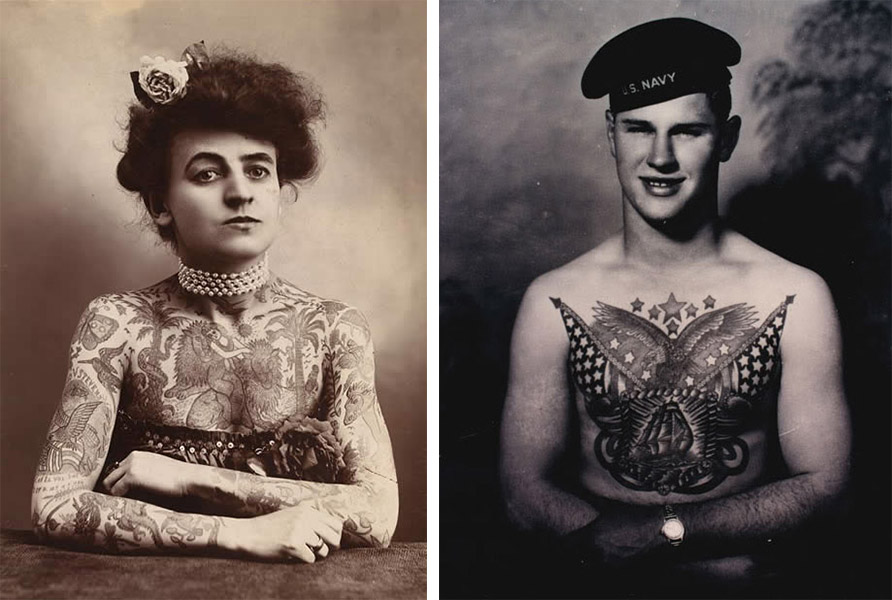

Left, a 1907 portrait of Mrs. Maud Stevens Wagner, the wife of tattooist Charlie Wagner. Right, a sailor with a patriotic chest piece by West Coast tattooist Bert Grimm.
Left, a 1907 portrait of Mrs. Maud Stevens Wagner, the wife of tattooist Gus Wagner. Right, a sailor with a patriotic chest piece by West Coast tattooist Bert Grimm.
In the 1920s, a wallpaper salesman and tattooer named Lew Alberts reportedly collected the designs of many popular tattoos and began selling paper prints to other tattooists. According to Lodder, “by the 1920s, there were several companies in the U.S. from whom you could buy mail-order design sheets, as well as tattoo machines, how-to-tattoo guides, and supplies.”

As military enlistment escalated prior to World War II, the American Navy caused another inadvertent boom in tattooing. Decades before, the U.S. government had issued a pamphlet with a passage requiring incoming recruits to fix any obscene tattoos, which primarily meant drawings of nude women. During the ’40s, this passage was a godsend for tattoo artists, as young men scrambled to censor their bodily markings so they could enlist. “It’s been just like old-home week around here since Pearl Harbor,” said Charlie Wagner, the famous New York tattooist. “Could you imagine how a store clerk would feel in a town where everybody’s clothes wore out at the same time? That’s how I’ve been feeling. For going on 50 years, I’ve been turning out tattooed ladies, most of them naked, and now all I do is cover them up.”
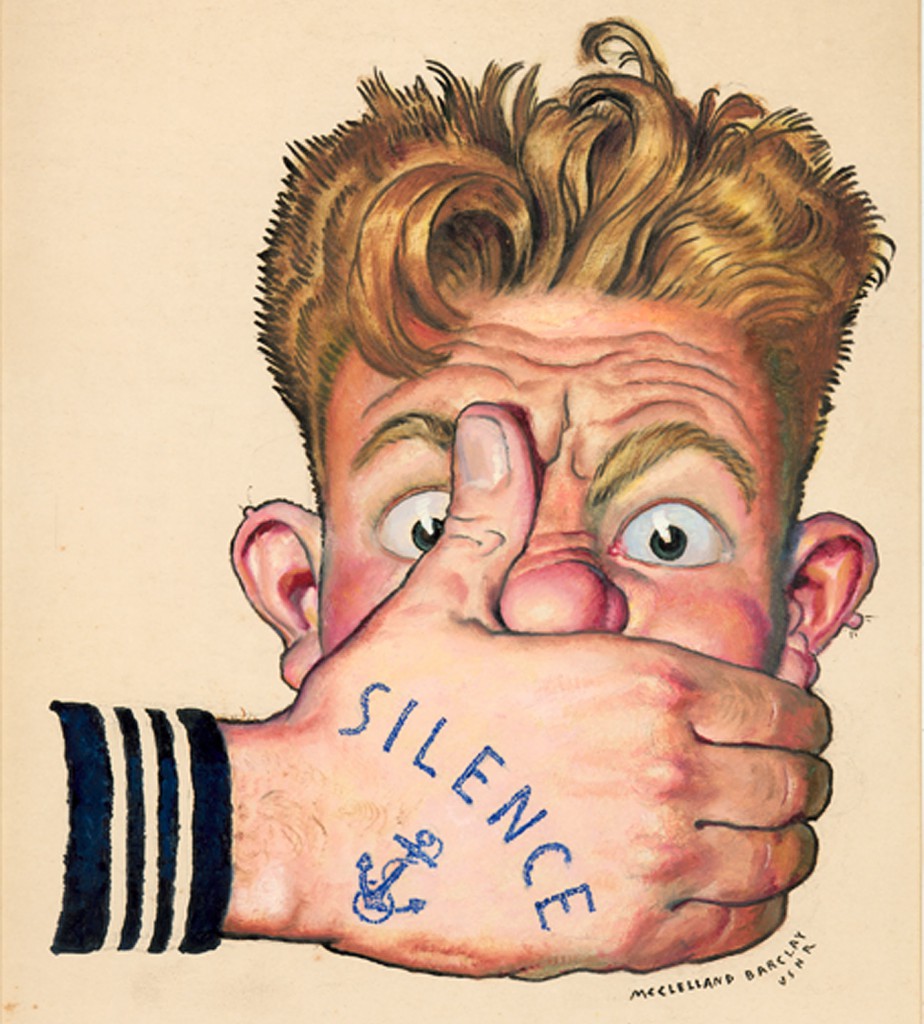

Even official U.S. Navy posters incorporated the ubiquitous nautical tattoos, like this image from the "Loose Lips Sink Ships" campaign of the '40s.
Even official U.S. Navy posters incorporated the ubiquitous nautical tattoos, like this image from the “Loose Lips Sink Ships” campaign of the ’40s.

Despite the industry’s saturation of generic nautical designs, a few artists like Charlie Wagner and Percy Waters helped propel traditional tattooing through their distinctive artwork. One of the most lauded innovators was Norman “Sailor Jerry” Collins, a Honolulu-based navy veteran who combined stylistic elements from Japanese, American, and European techniques to create his own unique look.

Lodder believes that Sailor Jerry’s influence on contemporary tattooing can’t be overstated. “He was an incredible draughtsman and artist who made use of the technical limitations of the medium to produce incredible designs. His pieces are complex enough to have life and energy, but simple and stripped-down enough that they look great in the skin, are readable from a distance, and age superbly.” Eldridge agrees that Sailor Jerry had a profound influence, possibly most distinguished by his ability to execute designs that looked even better on skin than they did on paper.

“There’s so much discipline in his line drawings,” Lodder adds, “but that tight style does nothing to reduce the sexiness of his pin-ups, the energy of his cartoons, the anger of his political designs, or the romance of his renditions of Hawaii. His style, a re-imagining of American tattooing of the 1920s and ’30s into a cleaner, bolder version for the 1950s and ’60s, established the ‘traditional’ tattoo in the late 20th century imagination.”


A sheet of Sailor Jerry's flash shows his expressive, clean-lined style.
A sheet of Sailor Jerry’s flash shows his expressive, clean-lined style.

Despite wide-scale recognition of Sailor Jerry’s artistic merits, there remains a misconception that until recently, only outcasts got tattoos. In fact, the practice has been favored by upper-class taste-makers for over a hundred years. As Lodder explains, “by the 1880s, most port cities and the large metropolitan areas boasted tattoo artists, often catering to very diverse and well-heeled clientele.”
“When the first tattoo shops opened in the late 1800s, they were already old-fashioned.”
One of the most visible of these affluent clients was King Frederik IX of Denmark, who took the throne in 1947. “He was from a Scandinavian country that treasured its seafaring tradition, so he went to sea at the age of 12,” says Eldridge, “It was almost a requirement for the king to understand how the Navy operated, because back then, whoever ruled the oceans ruled the world.”

In Britain, the expansion of professional tattooing was partly due to the trendiness of tattoos among the aristocracy following the Prince of Wales’ acquisition of a “Jerusalem Cross” during a trip he took to the Holy Land in 1862. “All the major London tattoo artists around the turn of the century made much of their celebrity clients—kings, princes, barons, music hall stars and entertainers—and their adverts were placed among those for champagne and high-end cigars in the tabloid press,” Lodder says.


Left, traditional American flash designs on 1960s flash. Right, King Frederik IX of Denmark shows off his tattooed torso.
Left, traditional American designs featured on Col. Todd’s flash in 1963. Right, King Frederik IX of Denmark shows off his tattooed torso.

Meanwhile, the popularity of tattooed characters in circus freak-shows spread the opposite message, that tattoos were only for those living in the darkest underworld of human existence. Beginning with the natives brought back by European explorers, people whose bodies were covered in tattoos realized they could make a living by exhibiting themselves to a paying public. “Eventually, sailors who had spent their lives at sea and had gotten heavily tattooed came back and went into show business, working with circuses or carnivals,” Eldridge says.

In the 2oth century, popular media outlets repeatedly hyped this dual view of tattooing as both a chic fashion for the wealthy and an expression of vile barbarity. A Vanity Fair article from 1926 claimed that tattoos had “percolated through the entire social stratum; tattooing has received its credentials, and may now be found beneath many a tailored shirt.” Ten years later, Life Magazine published an article that claimed 1 in 10 Americans had a tattoo.

After extensive research, Lodder has come to realize that “even when the press praised tattooing as newly respectable, newly fashionable, and a spectacular and ancient art form, as has happened every decade since the 1880s, other corners of the commentariat would decry tattooing as primitive, barbarous, and uncouth. Rather than waxing and waning in social acceptability over the 20th century, it’s more accurate to see these two strands as running in parallel.” Though sensationalist articles were meant to sow the seeds of controversy among readers, the majority of whom certainly did not have tattoos, they often reveal this repeated fallacy in the media coverage of tattoos.
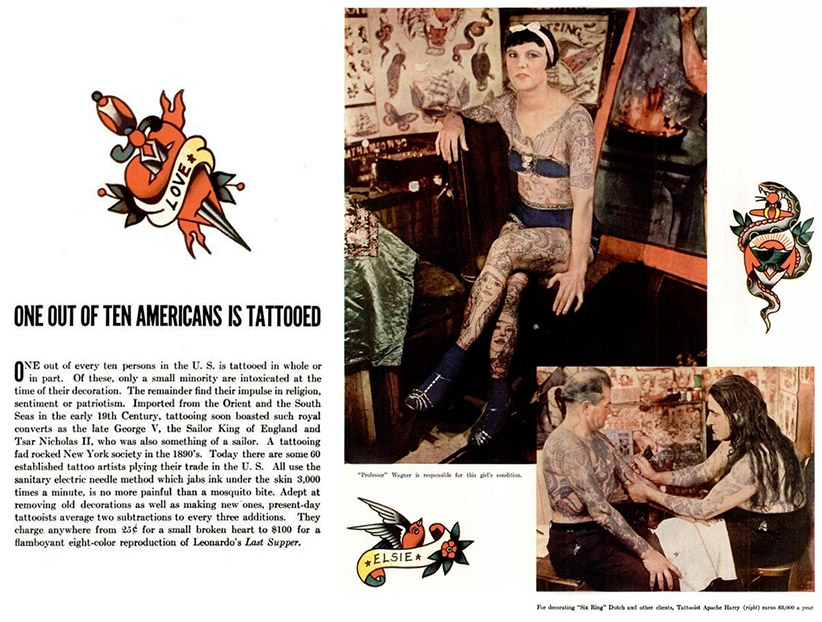

A spread from the 1936 "Life Magazine" expose on tattoos in America.
A spread from the 1936 “Life Magazine” expose on tattoos in America.

From Eldridge’s perspective, our ambivalent views about tattoos in Western culture stem from engrained religious beliefs. “I really believe that prejudice is rooted in religion, and it’s going to take a long time for that to disappear,” says Eldridge. “Our country is a very religious, Christian country. Leviticus and all those Bible verses about ‘marking the body’ continue to hold a lot of sway.”

Lodder also emphasizes the importance of eugenics and racial hygiene theories at the end of the 19th century, which allowed scientists to equate tattooing with an uncivilized past. “The idea that you can judge a person’s moral character and worth by their appearance really took hold in intellectual circles, and tattooing was swept into that rhetoric. Even as articles appeared in the press about the future King George V getting tattooed in Japan, or praising Japanese tattooers for their highly developed skills, the scientific literature asserted that tattooing was barbaric and only for those of lower means—a strange ahistorical, counter-factual set of arguments which persist to this day.”

Despite continued stigma, in the United States the number of individuals with tattoos is definitely growing. A recent Harris poll found that nearly a third of the population between the ages of 18 and 39 has a tattoo. Eldridge traces the rise of contemporary tattooing to the debut of MTV in the early ’80s. “You know how television is in America: If it’s on television, then it is somehow validated. We’ve always emulated celebrities and musicians, inheriting their styles, clothing, cars, and everything else. So I think once MTV appeared and all these musicians were visible with their tattoos, it was only natural that their fans would start getting tattooed.”


Temporary tattoo products have long banked on the trendiness of sailor tattoos, as seen in this 1940s booklet. Image courtesy Ballyhoo Vintage.


But why are nautical tattoos so trendy today? “I think that pop culture goes in cycles, and tattooing has to be considered part of pop culture,” says Eldridge. Lodder also sees it as part of a generational cycle, in which the designs of our immediate past go out of style and those from earlier periods seem fresh again. The youth of the 1920s preferred the nautical imagery from the 1860s, rather than the Asian-influenced designs of the 1890s, while World War II linked tattooing so closely with the military that the postwar generation had little interest in tattoos.

“The rise of consumer culture along with the embrace of unadorned, streamlined modernist aesthetics in the 1950s also undoubtedly contributed to tattooing’s fall from grace,” Lodder says, “until its subsequent revival in the 1970s. Once again taking the lead from their grandparent’s generation, tattooing began to rise in popularity through the mid-’70s and ’80s, though in a visual-culture context propelled by postmodernism, conceptual art, and the impact of the avant garde, the design choices were increasingly eclectic, making the ‘traditional’ designs seem somewhat old hat.”

Which brings us to the present, and the hordes of young urbanites whose flesh is marked with symbols of mariners from centuries past. Eldridge finds that brands like Christian Audiger’s line of Ed Hardy clothing or Sailor Jerry Rum have had “a tremendous effect on the current popularity of traditional tattooing.” In 1995, Hardy also published “Flash from the Past,” which Lodder believes prefigured the revival of classic American tattooing.

But perhaps the most straightforward reason for the resurgence in traditional tattoos is the nostalgic allure of a fantasy life at sea, especially at a time when the present seems rather bleak. “Traditional American designs are steeped in romance,” says Lodder, “and come with a combative rhetoric of tradition, lineage, craftsmanship, and cultural memory, as well as a loudly defended sense of what tattooing is, and what it should be.”"
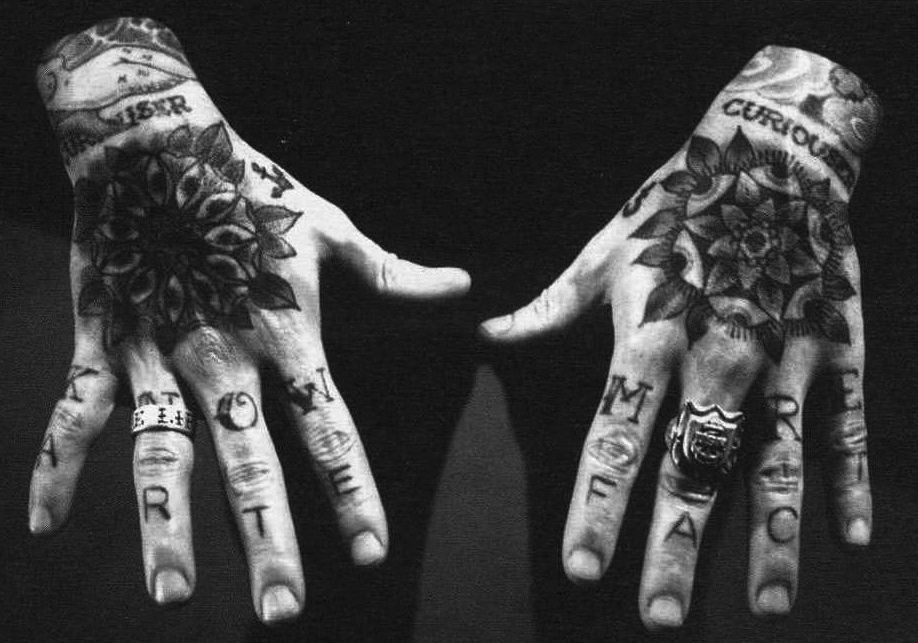

Matt Lodder's "Know More" hand tattoos blend naval superstition with academic sensibility.
Matt Lodder’s “Know More” hand tattoos blend naval superstition with academic sensibility.
To learn more about historic tattoos, follow Dr. Matt Lodder on Twitter, visit C.W. Eldridge at the Tattoo Archive in Winston Salem, North Carolina, and check out the Ballyhoo Vintage blog.