

Showing posts with label Tattoo. Show all posts
Showing posts with label Tattoo. Show all posts
Saturday, June 18, 2016
The World's First Tattooing Prosthetic Arm!
Twenty two years after losing his lower right arm as a child, French
tattoo artist JC Sheitan Tenet has become the first person in the world
to be fitted with a modified prosthetic arm that can double as his
tattoo gun.


Wednesday, August 5, 2015
Seeking True Character Depth? Look No Further Than Mark Mahnoey of Shamrock Tattoo
 |
| Deep thinker, tattoo artist and an overall man of action ready to play the next gangster kingpin in a film |
Understanding depth of character and meeting a truly unique individual can be a relatively daunting task. The more real, honest and genuine that character may be, the more they almost recede into the background as our media is full of those seeking any miniscule amount of quick fame or fortune. Then there are those individuals that live in a fantasy land and never quite achieve what they set out to do.
I am a huge fan of dark and troubled characters as they seem to take on the flaws of humanity as a whole. These individuals tread through troubled waters as if they don't know of any other area or locale to call home, yet live resolutely within that space. After listening to Mark Mahoney of Shamrock Tattoo in Los Angeles talk briefly about his shop and thoughts on life, it immediately turns into a quick study about a true character that has survived through the tattoo underbelly of a society that yearns for characters with real depth.
Monday, July 29, 2013
Death Is Not The Worst Of Evils...
Death
is not the worst of evils... The phrase is the rest of New Hampshire's
state motto, "Live Free or Die". Amazing illustration work by tattoo
wizard Scott Bramble. Damn stoked to have finally met him up in PA and
talked shop.
Check out more of Scott Bramble's work
Check out more of Scott Bramble's work
 |
| Scott Bramble illustration "Death Is Not The Worst of Evils" |
Tuesday, July 23, 2013
Make Your Own Tattoo Gun For Cheap
Roger Alan Wade sings a great line in one of his songs in which he says that "If your gonna be dumb, ya gotta be tough." This mantra can also be related to any of us that to choose to live on the fringes and on our own terms. I always saw this in any tattoo artist that I have met. They live from one drawing to the next and tend to be quite the free spirits. Their marks are permanent and each design is reflective of their skill set as the wearer of the ink will most likely have it forever, unless they go through the even more painful process of tattoo removal. Watching a quick video by Casey Neistat shows just how easy it can be to create your own tattoo gun and get busy leaving your mark.
scott campbell prison tattoo from Casey Neistat on Vimeo.
scott campbell prison tattoo from Casey Neistat on Vimeo.
Thursday, April 4, 2013
Be Sure To Choose Your Tattoo "Artist" Wisely
Without a doubt, tattoos are an art form. Here is the dilemma though, if you don't choose your tattoo "artist" wisely, you might end up regretting that decision for a long time to come. Have a look at a few notable and indelible marks of expression, courtesy of Loudwire.
 |
| Dave Grohl if ya didn't know was originally a Sunday paper comic strip character |
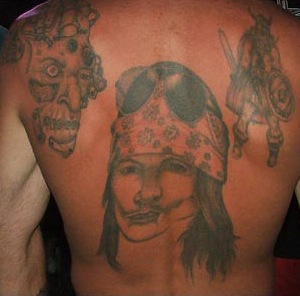 |
| Axl Rose doesn't need an angel and demon over his shoulder, he has a techno zombie and vikings to help make bad decisions |
 |
| Is this your weird uncle that still lives out the 80's? Or maybe its actually Carl from Aquateen Hunger Force. |
 |
| Original art by L.A. graffiti icon Mear One, but damn, Its still Limp Bizkit you have to live down. |
 |
| Jesus is top of the food chain and should have counseled your "artist" about how to spell GWEN STEFANI |
 |
| Did you know that Dime from Pantera was supposed to be a Squidbilly? |
 |
| Can only guess that this was done high on PCP or Crack. Please don't let muppets tattoo you anymore. |
 |
| News just in, Ozzy Osbourne has a flesh eating virus |
 |
| Jonathan Davis of Korn after eating 34 pizzas straight along with a case of Red Bull |
Sunday, February 17, 2013
Become A Real Zombie, Learn From Rick Genest
 |
| Rico The Zombie aka Rick Genest |
Maybe it is not how most folks would go about representing themselves, but damn we find it interesting from a lot of different angles. The commitment to the ink and pain, the realization that there is no going back to a normal life and to be constantly stared at, could you go all in?
Learn more about Rico the Zombie
"We are in a huge fabric hall. An exposed and
obviously uncommon character sits there on a couch. German photographer
Nadine Elfenbein will soon continue taking pictures of him. He smokes his cigarette while making little tricks with it. Short
inflammations illuminate his face releasing skull fragments. It’s a Day
of the Dead scenery. We are here with Rick Genest aka Rico the Zombie."
Production A&O, Artists and Organisation / Camera and Editing Jens Schwengel / Interview Jan Joswig / Special Effect Make-Up Twilight Creations / Tamar Aviv, Anke Schiffl / Styling Linda Ehrl / Photography Nadine Elfenbein / Assistent Photography Daniel Wilkniss / Rico Zombie Boy A.K.A. Rick Genest @ IZAIO models / Styling Linda Ehrl / Music Walera Goodman, Photography Nadine Elfenbein nadineelfenbein.com/
Rick Genest aka Rico the Zombie - Embrace Everything That Is Different from The Avant/Garde Diaries on Vimeo.
Tuesday, February 12, 2013
The Tattoos That Will Keep You Out Of Heaven?
Reality television is all around us. Whether it be the website you are reading now, or walking into a Walmart, just praying that you witness an episode of PeopleOfWalmart.com. Every now and then we find such a gem of an article that we have to really digest what we are seeing before we can even attempt to repost our findings.
Music can be a great divider amongst folks talking on their favorite playlists. Who cares what you enjoy listening to, as our listening pleasure goes out to music across the board from Bach, to Bathory, to Buck Owens and to Buddy Guy. We make no judgements on the tunes, but where the line in the sand is drawn, comes down to fan devoted tattoos. Poor taste can lead to quite the downfall, but even Tosh.O cannot offer these folks any sort of web redemption. Please God, have mercy on their souls.
Check out the post on Noisey.com

Music can be a great divider amongst folks talking on their favorite playlists. Who cares what you enjoy listening to, as our listening pleasure goes out to music across the board from Bach, to Bathory, to Buck Owens and to Buddy Guy. We make no judgements on the tunes, but where the line in the sand is drawn, comes down to fan devoted tattoos. Poor taste can lead to quite the downfall, but even Tosh.O cannot offer these folks any sort of web redemption. Please God, have mercy on their souls.
Check out the post on Noisey.com
"In the past ten years, our culture has reversed its attitude about tattoos, and dermis ink has shifted from offensive scribblings on the disease-ridden arms of convicts and sailors to literally everyone you know in real life and see on TV. As this shift has occurred, the level of dumb tattoos has risen with their acceptance.
Now don't misunderstand: Dumb tattoos are the best kind. Getting liquored up with your friends and getting matching Meat Shits stick-n-pokes is arguably the best way to whittle Friday night into Saturday morning. But now that every dingus with eighty bucks to spare is lining up at their local tat shop to snag the tree from that Modest Mouse record, we're all starting to wish we'd just stayed clean. Too late.
Anyway, today I went on the Internet and it showed me a bunch of awful band tattoos and then I put them back on the Internet.

15 Miley Cyrus Tattoos
This Yorkshire, UK local has (count 'em) 15 Miley Cyrus tattoos all over his body. He has her name on both hands and his chest, but the kicker is the portrait of her on his shoulder depicting a post-Hannah Montana Miley with an almost zombie-like appearance. I’d be terribly afraid to send my middle school child to soccer practice with this guy.

Wu Tang Mouth Mask
I’m a little confused on this one. On one hand, this guy is clearly down with the Wu. In theory, I should buy him a beer for being such a committed killer bee. On the other hand, he could be some next level Juggalo, which I can’t really resonate with. I’m just going to go with Wu Tang simply so I can like him. Good luck getting that job!

Tour Life Back Tat
Tattoos should be memorable. Something with a lot of personal meaning and thought put into it, not your reminder list. This is a sad list of musicians to have on your back. It’s even sadder that you put Nickelback on there not once, but twice. I can feel humanity doing a face palm for you. Didn’t you learn your lesson the first time? Guess not. Extra points for the rainbow Jesus fish!

Nickelback Cleavage Tattoo
Tattoo aside, this is an very unflattering image of this lady. But to top it off, there’s a tattoo of Nickelback on her cleavage. It does look a little like permanent marker though. Regardless of the medium, she has probably one of the worst contemporary bands known to the human earth on her chest. I do give her mad kudos for reppin’ it so hard in the photo. That takes some serious balls I know neither of us have.

The Bono Portrait
What makes this really bad is that this person didn’t pick young, awesome Bono. He picked midlife crisis Bono. Whoever you go to bed with at night must wake up screaming from thinking Bono is in their bed. Major props to the tattoo artist for not killing this customer during the process.

Rush
Honestly, this isn’t that embarrassing of a tattoo. It seems like it’s in a vague, easily concealed spot giving you the ability to get a job. However, Rush is definitely a band that isn't worth putting on your body. I don't think anyone is going to be impressed when they see this. I take that back; If you live the life of Hank from King of the Hill you'll impress a bunch of people.

Bieber Fever
I just threw up in my mouth.
Wednesday, January 30, 2013
Forget Lions, Tigers and Bears, Tools Are Our Kind Of Tattoo Flash
Forget lions, tigers and bears, tools are our kind of tattoo flash. We have a cool project in the works and decided to post a teaser of what is in the works.
 |
| Rusty Knuckles © 2013 tool illustrations |
Thursday, December 20, 2012
Hello Sailor! The Nautical Roots of Popular Tattoos, From Collectors Weekly
"Man, this would look bitchin' as a tattoo!" Ever heard those words before? Yep, that notion along with many others are sort of a departure point for some folks thinking on a tattoo design. If you ever sit in a chair in a busy tattoo shop, just soak in that burning needle and have a good laugh to yourself seeing the folks come through the door, looking to get a tattoo for the sake of having themselves adorned with skin art. Not to deride their interest or the tattoo artist who can line his pocket with some quick cash, but more thought should be applied to each tattoo.
Through our continual perusing of the web seeking out interesting content to read and enjoy, we came across this article relating to the history of nautical tattoos. If you hang out at any punk show or see enough "alternative" individuals a tattooed nautical star will surely beam out at some point. Does that person necessarily know where the symbol comes from or its true roots? Most likely not, so educate them on the true history. The same goes for those who continue to get traditional style tattoos with other nautical themes. Maybe ask them if they can tie a bowline knot or half hitch, what a cleat is or maybe which side of the boat is starboard. If they cannot, grill them on some sailor talk and what their tattoos really mean.
Knowledge is power and if you want to adorn yourself with permanent art, know the damn meaning. Give respect to the elder explorers and those who went on adventures maybe to never return home.
"If you live a life of make-believe, your life isn't worth anything until you do something that does challenge your reality. And to me, sailing the open ocean is a real challenge, because it's life or death." - Morgan Freeman
Through our continual perusing of the web seeking out interesting content to read and enjoy, we came across this article relating to the history of nautical tattoos. If you hang out at any punk show or see enough "alternative" individuals a tattooed nautical star will surely beam out at some point. Does that person necessarily know where the symbol comes from or its true roots? Most likely not, so educate them on the true history. The same goes for those who continue to get traditional style tattoos with other nautical themes. Maybe ask them if they can tie a bowline knot or half hitch, what a cleat is or maybe which side of the boat is starboard. If they cannot, grill them on some sailor talk and what their tattoos really mean.
Knowledge is power and if you want to adorn yourself with permanent art, know the damn meaning. Give respect to the elder explorers and those who went on adventures maybe to never return home.
"If you live a life of make-believe, your life isn't worth anything until you do something that does challenge your reality. And to me, sailing the open ocean is a real challenge, because it's life or death." - Morgan Freeman
View original article on Collectors Weekly
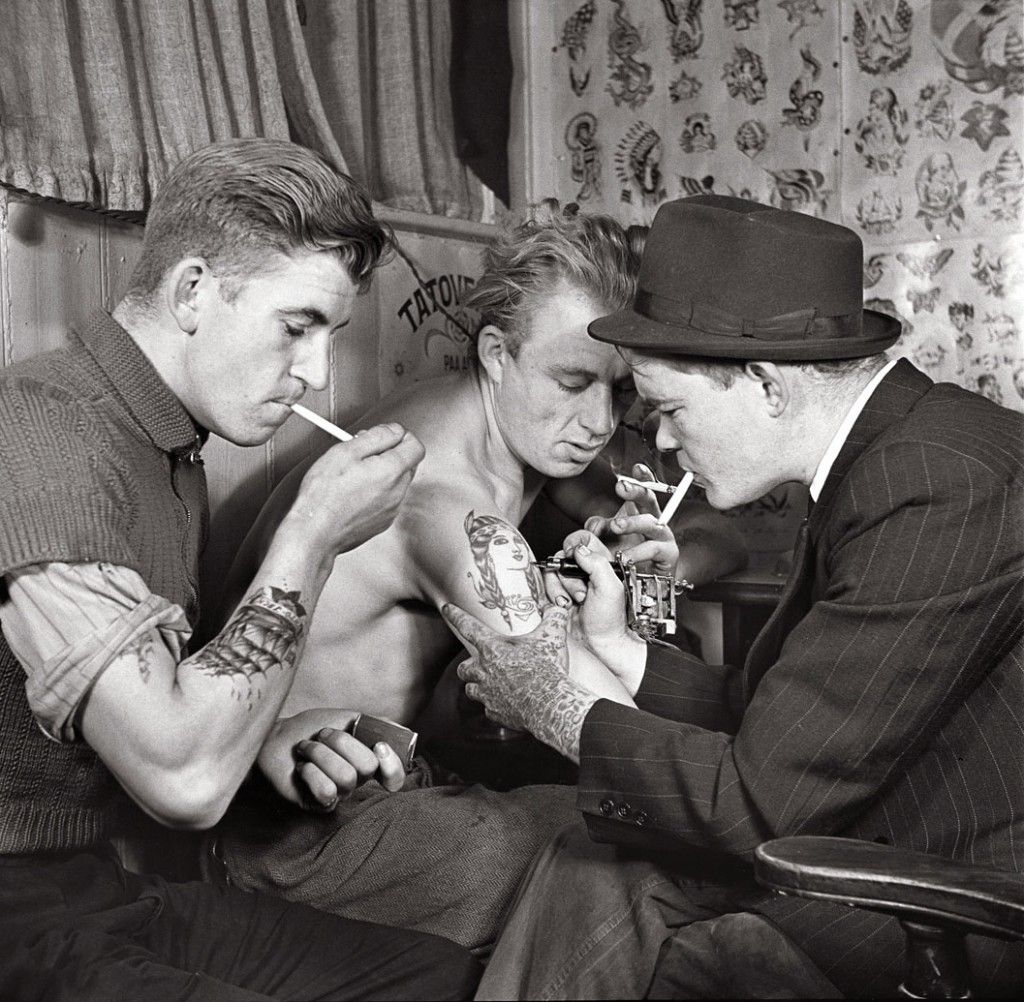
Traditional tattoo designs, like anchors, swallows, and nautical stars, are popping up on the arms and ankles of kids in every hip neighborhood from Brooklyn to Berlin, Sao Paulo to San Francisco. Yet these young land lubbers probably don’t even know the difference between a schooner and a ship, much less where the term “groggy” comes from. (Hint: Grog once referred to a watered-down rum issued by the British Royal Navy to every sailor over age 20.)
“There’s no way to take a tattoo home, except in your skin.”
Though tattooing was already present in much of Europe, during the 1700s, the visibility of exotic voyages taken by the likes of Captain James Cook helped cement the connection between tattoos and seafaring men in the popular media. The English word “tattoo” is actually a descendant of the Tahitian word “tatau,” which Cook recorded after a stop on the island while travelling in the South Pacific. European explorers frequently returned with tattooed foreigners to exhibit as oddities in the West, like Omai, the native Raiatean man Cook presented to King George and members of British royal society. Such publicity soon ignited a more widespread fascination with body art.
 |
| Top: A scene from Tattoo Jack’s shop in Denmark, circa 1942, from the book “Danish Tattooing” by Jon Norstrøm. Above: An etching of “Prince Giolo,” a tattooed slave captured from the Island of Miangas by William Dampier’s expedition in 1691. |
Body art was particularly well-suited to the transient and dangerous nature of life at sea. “These sailors were traveling the world, and wanted to bring back souvenirs from places they had visited,” explains Eldridge. “Aboard a ship, you don’t have much room to carry fancy souvenirs, so you end up getting tattoos as travel marks.” By the late 18th century, navy records show that around a third of British and a fifth of American sailors had at least one tattoo, while other accounts reveal that French, German, and Scandinavian navies were also fond of getting inked.
 |
| Two vibrant nautical designs by tattoo pioneer Samuel O’Reilly. |
The variety of designs matched each and every danger aboard a ship. “Sailors would get things like a pig and rooster on their feet to keep them from drowning,” Eldridge says. “They would have ‘Hold Fast’ tattooed on their knuckles so that when they were in the riggings, their hands would stay strong. They would get hinges on their elbows to keep them from having rheumatism and arthritis, and sometimes they would even get a little oil can tattooed above the hinge so that the hinges would stay lubricated.”
Though the meanings of such tattoos have often shifted according to context, for some sailors, crosses on the feet were an attempt to ward off sharks, swallows were associated with a safe voyage home, and nautical stars were linked to accurate navigation. “The stereotypical images we think of as classic tattoo designs today—pierced hearts, swallows, anchors, suns and moons, mermaids, naked women, memorial images such as graves, and religious imagery such as crosses—were all common motifs by the time militaries started recording the tattoos of enlisted men,” says Lodder. “All these designs can be found in naval handicrafts and folk art of the same period, too, etched into tobacco tins, carved into whalebone as scrimshaw, or included in love-tokens made from beads and shells.”
 |
| Captain Elvy, who worked as a sideshow attraction, displays his beautiful back piece designed by “Sailor” George Fosdick. |
Tattooing really took off after 1870, when the first professional tattoo shops opened in the United States and Great Britain. In America, the earliest tattoo parlor is attributed to a German immigrant named Martin Hildebrandt, who opened his business in lower Manhattan. Hildebrant practiced the slow art of giving tattoos by hand, using a row of needles attached to a wooden-handle which was rapidly tapped upon the skin. At the time, tattooing was an artisan trade typically learned by working with a well-established tattooer. “It was a craft,” says Eldridge, “usually learned through an apprenticeship. It’s exactly the way a seamstress would hem your pant cuff with a needle and thread rather than a sewing machine. They learned to manipulate the needle into the skin and to create designs by hand.”
 |
| A photograph of Percy Water’s tattoo machine and an advertisement from 1928, which mimics the artistry of hand-drawn flash. |
This system of shared knowledge also helps explain why nautical designs were commonly copied and spread from artist to artist. “A lot of classic symbols were passed down from one war to the next, even going back to the Civil War,” explains Eldridge. “The tattooer might take an illustration, an etching, or a block print, do a drawing from that design, and put that on his sheets of flash,” the name for the paper ads tattooists created to show off their wares. Another tattooist would see a design and, in some cases, do a tracing directly off the person’s arm. “The designs were copyright-free and in the public stream,” Eldridge adds.
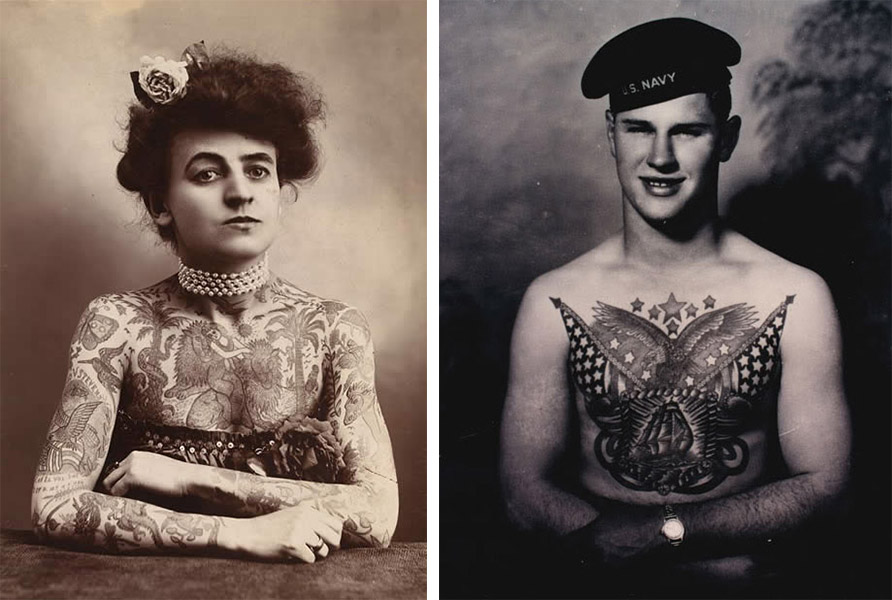 |
| Left, a 1907 portrait of Mrs. Maud Stevens Wagner, the wife of tattooist Gus Wagner. Right, a sailor with a patriotic chest piece by West Coast tattooist Bert Grimm. |
As military enlistment escalated prior to World War II, the American Navy caused another inadvertent boom in tattooing. Decades before, the U.S. government had issued a pamphlet with a passage requiring incoming recruits to fix any obscene tattoos, which primarily meant drawings of nude women. During the ’40s, this passage was a godsend for tattoo artists, as young men scrambled to censor their bodily markings so they could enlist. “It’s been just like old-home week around here since Pearl Harbor,” said Charlie Wagner, the famous New York tattooist. “Could you imagine how a store clerk would feel in a town where everybody’s clothes wore out at the same time? That’s how I’ve been feeling. For going on 50 years, I’ve been turning out tattooed ladies, most of them naked, and now all I do is cover them up.”
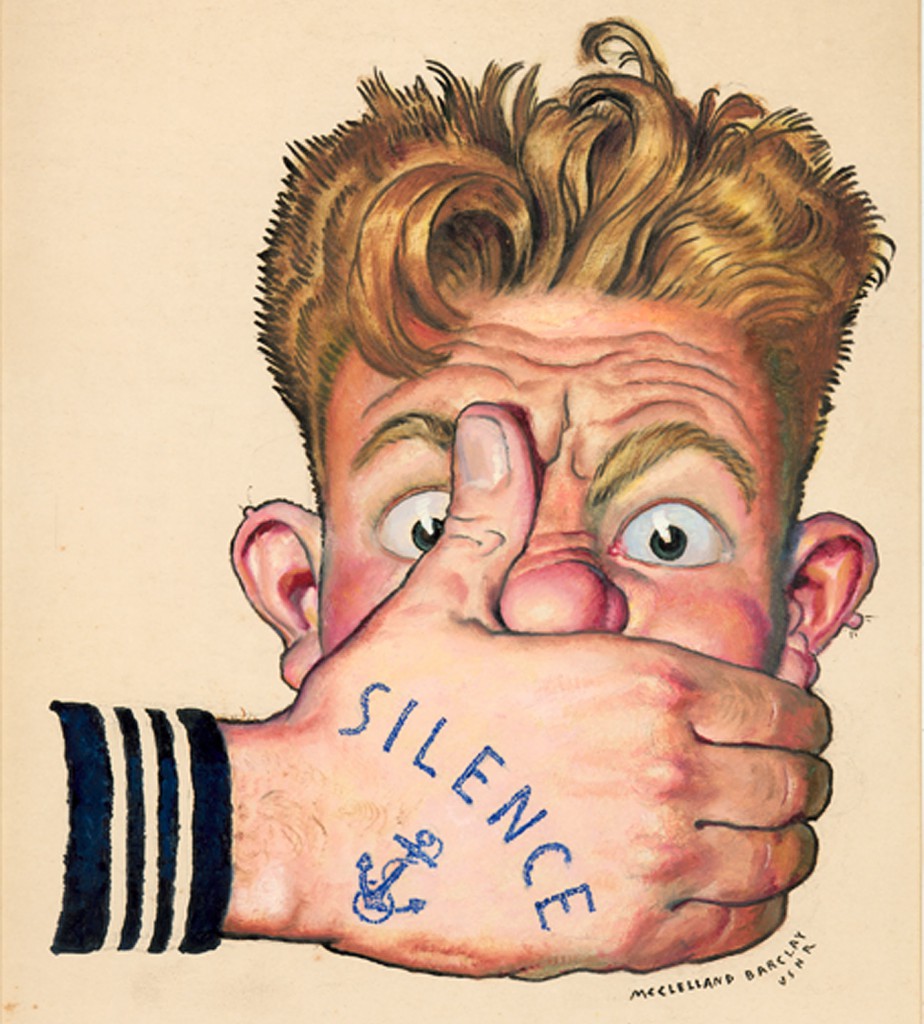 |
| Even official U.S. Navy posters incorporated the ubiquitous nautical tattoos, like this image from the “Loose Lips Sink Ships” campaign of the ’40s. |
Lodder believes that Sailor Jerry’s influence on contemporary tattooing can’t be overstated. “He was an incredible draughtsman and artist who made use of the technical limitations of the medium to produce incredible designs. His pieces are complex enough to have life and energy, but simple and stripped-down enough that they look great in the skin, are readable from a distance, and age superbly.” Eldridge agrees that Sailor Jerry had a profound influence, possibly most distinguished by his ability to execute designs that looked even better on skin than they did on paper.
“There’s so much discipline in his line drawings,” Lodder adds, “but that tight style does nothing to reduce the sexiness of his pin-ups, the energy of his cartoons, the anger of his political designs, or the romance of his renditions of Hawaii. His style, a re-imagining of American tattooing of the 1920s and ’30s into a cleaner, bolder version for the 1950s and ’60s, established the ‘traditional’ tattoo in the late 20th century imagination.”

A sheet of Sailor Jerry’s flash shows his expressive, clean-lined style.
Despite wide-scale recognition of Sailor Jerry’s artistic merits, there remains a misconception that until recently, only outcasts got tattoos. In fact, the practice has been favored by upper-class taste-makers for over a hundred years. As Lodder explains, “by the 1880s, most port cities and the large metropolitan areas boasted tattoo artists, often catering to very diverse and well-heeled clientele.”
“When the first tattoo shops opened in the late 1800s, they were already old-fashioned.”One of the most visible of these affluent clients was King Frederik IX of Denmark, who took the throne in 1947. “He was from a Scandinavian country that treasured its seafaring tradition, so he went to sea at the age of 12,” says Eldridge, “It was almost a requirement for the king to understand how the Navy operated, because back then, whoever ruled the oceans ruled the world.”
In Britain, the expansion of professional tattooing was partly due to the trendiness of tattoos among the aristocracy following the Prince of Wales’ acquisition of a “Jerusalem Cross” during a trip he took to the Holy Land in 1862. “All the major London tattoo artists around the turn of the century made much of their celebrity clients—kings, princes, barons, music hall stars and entertainers—and their adverts were placed among those for champagne and high-end cigars in the tabloid press,” Lodder says.
 |
| Left, traditional American designs featured on Col. Todd’s flash in 1963. Right, King Frederik IX of Denmark shows off his tattooed torso. |
In the 2oth century, popular media outlets repeatedly hyped this dual view of tattooing as both a chic fashion for the wealthy and an expression of vile barbarity. A Vanity Fair article from 1926 claimed that tattoos had “percolated through the entire social stratum; tattooing has received its credentials, and may now be found beneath many a tailored shirt.” Ten years later, Life Magazine published an article that claimed 1 in 10 Americans had a tattoo.
After extensive research, Lodder has come to realize that “even when the press praised tattooing as newly respectable, newly fashionable, and a spectacular and ancient art form, as has happened every decade since the 1880s, other corners of the commentariat would decry tattooing as primitive, barbarous, and uncouth. Rather than waxing and waning in social acceptability over the 20th century, it’s more accurate to see these two strands as running in parallel.” Though sensationalist articles were meant to sow the seeds of controversy among readers, the majority of whom certainly did not have tattoos, they often reveal this repeated fallacy in the media coverage of tattoos.
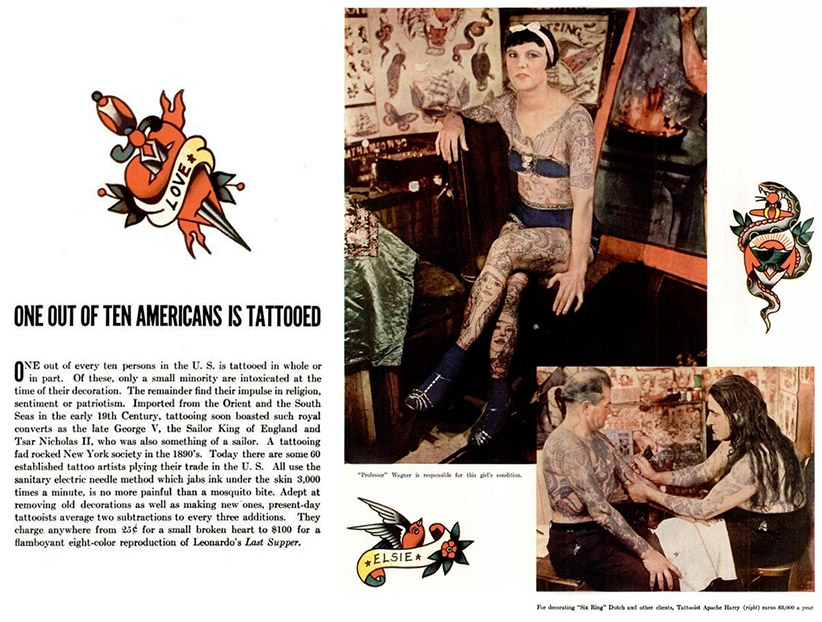 |
| A spread from the 1936 “Life Magazine” expose on tattoos in America. |
Lodder also emphasizes the importance of eugenics and racial hygiene theories at the end of the 19th century, which allowed scientists to equate tattooing with an uncivilized past. “The idea that you can judge a person’s moral character and worth by their appearance really took hold in intellectual circles, and tattooing was swept into that rhetoric. Even as articles appeared in the press about the future King George V getting tattooed in Japan, or praising Japanese tattooers for their highly developed skills, the scientific literature asserted that tattooing was barbaric and only for those of lower means—a strange ahistorical, counter-factual set of arguments which persist to this day.”
Despite continued stigma, in the United States the number of individuals with tattoos is definitely growing. A recent Harris poll found that nearly a third of the population between the ages of 18 and 39 has a tattoo. Eldridge traces the rise of contemporary tattooing to the debut of MTV in the early ’80s. “You know how television is in America: If it’s on television, then it is somehow validated. We’ve always emulated celebrities and musicians, inheriting their styles, clothing, cars, and everything else. So I think once MTV appeared and all these musicians were visible with their tattoos, it was only natural that their fans would start getting tattooed.”
 |
| Temporary tattoo products have long banked on the trendiness of sailor tattoos, as seen in this 1940s booklet. Image courtesy Ballyhoo Vintage. |
“The rise of consumer culture along with the embrace of unadorned, streamlined modernist aesthetics in the 1950s also undoubtedly contributed to tattooing’s fall from grace,” Lodder says, “until its subsequent revival in the 1970s. Once again taking the lead from their grandparent’s generation, tattooing began to rise in popularity through the mid-’70s and ’80s, though in a visual-culture context propelled by postmodernism, conceptual art, and the impact of the avant garde, the design choices were increasingly eclectic, making the ‘traditional’ designs seem somewhat old hat.”
Which brings us to the present, and the hordes of young urbanites whose flesh is marked with symbols of mariners from centuries past. Eldridge finds that brands like Christian Audiger’s line of Ed Hardy clothing or Sailor Jerry Rum have had “a tremendous effect on the current popularity of traditional tattooing.” In 1995, Hardy also published “Flash from the Past,” which Lodder believes prefigured the revival of classic American tattooing.
But perhaps the most straightforward reason for the resurgence in traditional tattoos is the nostalgic allure of a fantasy life at sea, especially at a time when the present seems rather bleak. “Traditional American designs are steeped in romance,” says Lodder, “and come with a combative rhetoric of tradition, lineage, craftsmanship, and cultural memory, as well as a loudly defended sense of what tattooing is, and what it should be.”"
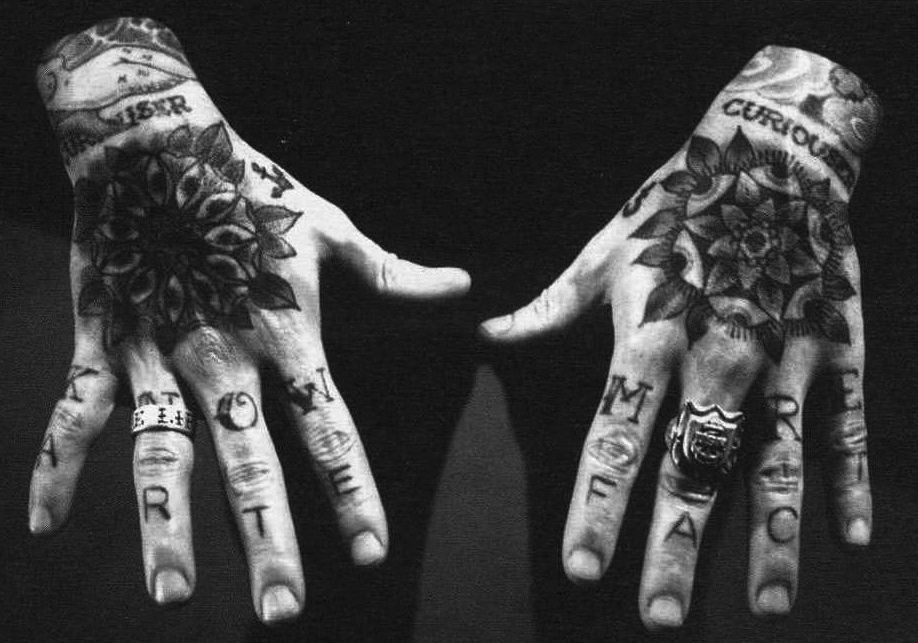 |
| Matt Lodder’s “Know More” hand tattoos blend naval superstition with academic sensibility. |
To learn more about historic tattoos, follow Dr. Matt Lodder on Twitter, visit C.W. Eldridge at the Tattoo Archive in Winston Salem, North Carolina, and check out the Ballyhoo Vintage blog.
Wednesday, October 31, 2012
Large Tattoo Skulls For Those Who Need To Make A Statement
The illustrated skull as a tattoo motif will never go out of style. Could it be due to the fact that we all have a skull or that it represents life, death and all of that encompasses us as humans? Our morbid fascination with death as a society is one of the only constants we throughout recorded history, besides taxes and compounding interest.
For those who use their skin as a canvas and allow for the macabre to come to life, this is dedicated to you. All of the tattoos below are well thought out and take up a large portion of each recipient's body. To achieve such a goal is to put great faith into your chosen tattoo artist and a belief in your mission of pain, to let a personal story unfold. Hades is proud and smiling outwardly from the depths.
Check out the skull appreciation society
For those who use their skin as a canvas and allow for the macabre to come to life, this is dedicated to you. All of the tattoos below are well thought out and take up a large portion of each recipient's body. To achieve such a goal is to put great faith into your chosen tattoo artist and a belief in your mission of pain, to let a personal story unfold. Hades is proud and smiling outwardly from the depths.
Check out the skull appreciation society
 |
| Skull full back piece with third eye |
 |
| Crystal skull of the cosmos full back piece |
 |
| Asian style style dragon and skull |
 |
| Bigfoot skull in scale size on back piece |
 |
| Skull or two folks having a drink? |
 |
| A skull is never just one skull, but made up of those for which it has conquered |
 |
| Skull chest piece |
 |
| Skull full chest piece |
Thursday, September 20, 2012
Still Thinking About Getting A Tattoo Of Your Favorite Band?
Still Thinking About Getting A Tattoo Of Your Favorite Band? Every now and then you see some tattoos that send you shaking your head and wonder who is more at fault. Is it the customer wanting to be the über fan or the tattoo artist that maybe isn't quite up to snuff. Needless to say, choose your imagery wisely along with the individual that is inking you up permanently.
Loudwire's display of horrible tattoos
Loudwire's display of horrible tattoos
 |
| Really? Earth Crisis on the face? Did that Firestorm of Ink Purify? |
 |
| Green Day never looked so rough. Poor ol' Billie Joe and his BJ pose, damn that's rough |
 |
| And Tattoo Justice For All |
 |
| Slayer fan that was tatted up by a six year old apprentice prodigy |
 |
| Dimebag Darrell is equally shocked by his depction in a style reminiscent of the Squidbillies |
 |
| Gotta love the drop shadow those letters have, Kid Rock looks like he is hiding a huge dome in the pimp hat |
Wednesday, July 13, 2011
Grab A Tiger By The Tail
As often as you can see a tiger tattoo do you really think you know the symbolism on the animal in Asian lore? Strength and pride are generally indicative of a lion but a tiger has a distinct prowess that is all about sensuality and lingers heavily around the libido. For example, one quote online states that "Tigers make ardent and virile lovers who dominate their partners. Because of their sensuality, their impetuousness and love of adventure, there is an excitement that not only follows Tigers wherever they go, but also guarantees them a certain irresistible sexy allure. These creatures whose emotions are out-front have strong libidos and are lusty in their passions. Generally flirtatious, they are especially prone to wild flings in their early years but do settle down as they get older. When committed to a happy and fulfilling relationship, Tigers make loving and caring partners, warm-hearted and generous. They don't, however, lose that romantic streak nor that exciting ability to surprise."
With this notion in mind does a tiger tattoo make sense on a man, woman or do we just need to bottle it's pheromones and have a deodorant that will make even Ron Burgundy jealous? Well that is for you to be the judge and we are just here to give you the facts and clue yall in to world at large.