Friday, January 17, 2014

Could Beats Music Become The Industry Standard For Digital Downloads?


Can Beats Music become the new industry standard subscription model for a music service?

Find out more on Beats Music from Billboard

"Beats Music, the premium streaming service developed by Trent Reznor, Ian Rogers and the creators of Beats By Dre headphones, is launching on Jan. 21, with AT&T as the exclusive carrier partner, the company said. 

Santa Monica-based Beats will join a parade of competitors, including Rhapsody, Slacker, Xbox Music, Rdio and Sony Music Unlimited -- all vying to become the dominant subscription service in the U.S., the world's largest market for music. The stakes are even higher as the market for digital downloads showed signs of waning, declining in 2013 for the first time, according to Nielsen SoundScan. The field is likely to become even more crowded this year, with Google Inc.'s YouTube and France's Deezer expected to launch their U.S. services in the next several months.


Beats Music, which was built partly from technology acquired in 2012 from the former Mog music service, aims to set itself apart with stylish design and human curation. The company a year ago hired Reznor, of Nine Inch Nails, as its chief creative officer to design the service's look and feel of the service, with the goal of making it easy and fun to use. It also recruited Rogers, former Chief Executive of Topspin Media who also once ran Yahoo's music service, as CEO of Beats Music. And last summer, Beats tapped Julie Pilat, former Clear Channel veteran, to head up Beats' efforts to distinguish itself from the pack with a heavy emphasis on curation via radio-style programming. 

Many other companies have tried similar approaches with much success, most notably Sirius XM and Slacker. Sirius, for example, has cultivated dozens of radio personalities with ardent fan followings, the best example of which is Howard Stern. Its curated approach is partly what makes Sirius XM the country's biggest paid music service, with more than 26 million subscribers. Slacker years ago pioneered the practice of having DJ's program its many genre stations. 

"Our curated stations perform incredibly well, even when listeners have the ability to choose on-demand music," said Slacker's CEO Jim Cady. "Our premium subscribers spend more than 80% of their time listening to our curated stations, rather than creating their own playlists or listening to tracks on demand. We’ve also seen that heavily-curated experiences, like deejay hosted countdown stations, keep people listening up to three times longer than genre stations. Even the simple act of adding a deejay to a station can increase average listening time by nearly 20%." 

With all eyes on streaming music services as a source of future growth for the industry, Beats has ambitious plans to pour on the glamour, as it did with great success for the premium headphones market more than six years ago, leveraging deep relationships cultivated over the years by Beats' co-founder, Jimmy Iovine, the chairman of Interscope Geffen A&M at Universal Music Group. In 2008, Iovine and Dr. Dre launched Beats Electronics. Its instantly recognizeable headphones were soon spotted on dozens of celebrities and rap artists, who extolled the headsets' ability to reproduce the heavy bass sound prevalent in hip hop music. "We built something that works for us, for me, our friends, Dr. Dre," Iovine said in an interview with Billboard. "We enjoy using it. It’s what we would like to have, and we built it to where we felt it could help others."

While Iovine and his executives work to add star power to Beats Music, AT&T Corp. will provide the corporate marketing and distribution muscle. The carrier has agreed to distribute Beats Music, offering AT&T customers a 7-day free trial of the service. Afterwards, the service would cost $9.99 a month. For customers who opt to sign up for AT&T's family bundle, the service would come with a 90-day free trial. Once the trial period runs out, Beats would charge $14.99 a month, but allow up to 5 people and 10 devices full, on-demand access to the service. 

Beats would not disclose the terms of its arrangement with AT&T, including how the cost of licensing music during the free trials would be subsidized. 

For music services, carrier partnerships can be vital. Telecommunications companies such as AT&T have direct billing relationships with millions of subscribers and can tack on the cost of a music service directly on to their customers' cell phone bills. They also have extensive marketing resources that they can use to help push ancillary services, such as music. For AT&T, the benefit is in offering a product that would draw in users who will pay extra for a data plan to accommodate streaming music. 

In addition, Beats has partnered with Target Stores for a promotion that would give away 30-day free trials to customer who buys anything from the store's electronics department. The company has also started tucking vouchers for free trials into Beats Electronics' packaged audio gear. 

What Beats will not be doing anytime soon, however, is offer a free, slimmed-down version of its service -- something that Spotify, Rdio and services have started to do in order to get listeners to try their products in the hopes that they will convert into paying customers. So-called access models, where listeners pay to access large catalogs of music rather than purchase copies of music, is still a small, but growing portion of the industry's revenue. In 2012, it represented 15% of the revenue for music in the U.S., up from 9% in 2011, according to the Recording Industry Association of America, which is set to update this figure in the coming weeks. 

While streaming music is expanding, digital downloads declined on an annual basis for the first time in 2013. Sales of digital tracks fell 5.7% from 1.34 billion units to 1.26 billion units, while digital album sales fell 0.1% to 117.6 million units from 117.7 million a year earlier, according to Nielsen SoundScan."

Thursday, January 16, 2014

Buzzoven To Headline Roadburn Festival On April 10th

Buzzoven will be headlining Roadburn Festival on April 10th
Find out all there is know about Roadburn Festival

"Roadburn 2014 is ecstatic to announce that sludge / stoner legends Buzzov*en will be making an extremely special performance, headlining the Thursday, Roadburn date, April 10th at the 013 venue.

Formed in 1989 when heavy riffs primarily meant grunge, Buzzov*en brought a particularly virulent malice and filth to their music that often manifested itself in extreme violence at their live shows. Not surprisingly, given their level of intensity and their heavy touring schedule, their lineup was quite volatile and changed frequently.

Now remaining original member Kirk Lloyd Fisher (guitar / vox) has re-joined forces with bassist Dixie Dave (Weedeater, Bongzilla, Buzzov*en‘s …At A Loss) and drummer Ashley (To A Frown, Sore) to reform the band and bring them to Europe for the first time ever. Time (and sobriety) may have tempered Buzzov*en‘s shows to be less broken glass and blood filled, but the music remains as potent as ever.

“I’m looking forward to Buzzov*en’s rebirth being at Roadburn. I am gearing up to make our European debut an onslaught of swamp ass gutteral delusions. I have started my ascent out of my corner of HELL that caged me. With the help of fellow members Dixie, Ash and Floyd, we have chosen you all to assault first. Welcome to violence fuckers” – Kirk / Dirtkicker.

In the 12 years Buzzov*en was together, they released 4 LP’s (To A Frown, Sore, …At A Loss, Revelation: Sick Again) and 5 EP’s along with their legendary Buttrash demo tape. The influence of the band far exceeds their recorded output though, as Buzzov*en and Eyehategod are the forefathers of sludge / stoner metal and have made themselves household names in the metal underground through their frequent tours that spread the sludge gospel far and wide, and spawned countless musical offspring wherever they roamed.

We feel extremely lucky to be able to bring Buzzov*en to the Roadburn Festival to give everyone a chance to experience their vitriolic riffs and rage filled performance."

K. Lloyd will be hitting select shows with Joe Buck after Roadburn Festival in Europe

Afterburner featuring K. Lloyd, Joe Buck, Triptykon, YOB and many more

Tuesday, January 14, 2014

Some Days We All Just Need A Bit More Porn

Lowered and with a perfect stance, damn beautiful Dyna

Some days we all could use just a bit more porn in our lives, make that bike porn...

"The show took place on March 2, 2013 at the same place as last year, the amazing old building from the early 1800′s that used to be an old steel mill. But once again we rolled in another kind of massaged steel; choppers, bobbers, custom bikes and even a few vintage races. So enjoy these great pictures taken by Wictor Bergqvist of www.mandit.org."

View the photos from Mooneyes

Pinstriper at the ready

Two Excelsior Henderson's and in great condition
Tricked out Sporty with many eccoutrements

The Indian motorcycle that I lust for

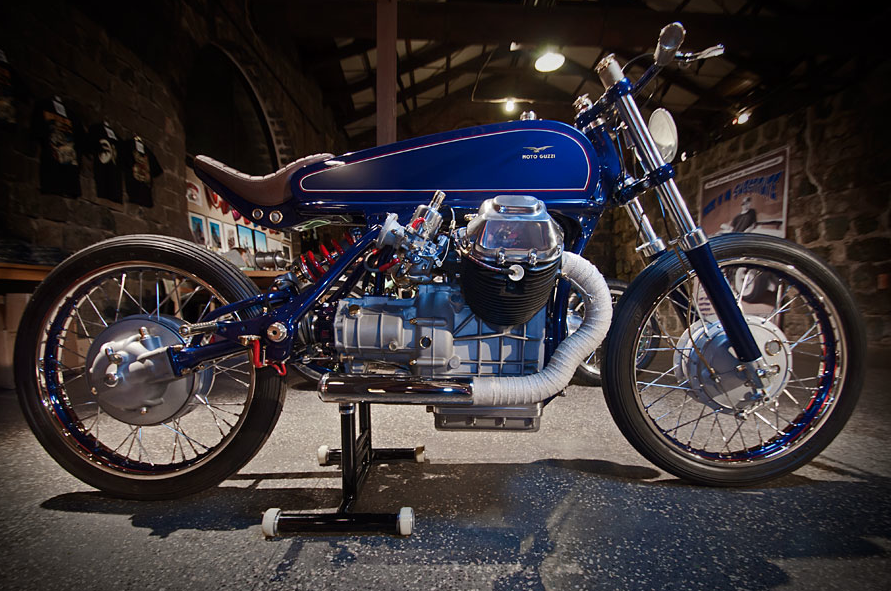
Very unique Moto Guzzi

Beautiful Excelsior Henderson

Monday, January 6, 2014

Rusty Knuckles 2014 Album Releases

Rusty Knuckles Music 2014 lineup
If you are going to kick the door in, be prepared with backup. Folks, we have that in absolute spades with the amount of talent and dedicated rabble rousers within the ranks dropping new albums this year. Not only are there new projects being finished up by Rory Kelly, Flat Tires, Hellbound Glory, Husky Burnette, Jay Berndt and the Green Lady Killers, but have a read below on the killer bands that are putting out albums with us.

Its a damn honor to work with such a hard working and talented group of misfits.

Rusty Knuckles Music 2014 Releases
(not in any particular order for release date)

• Crank County Daredevils / Buzzoven - Split 7" Record
• Husky Burnette - Acoustic EP
• Flat Tires - new full length being recorded with Joe Queer
• Rory Kelly - new full length
• Hellbound Glory - new EP 
• Jay Berndt & The Orpans - new full length featuring horn section from E-Street Band
• The Green Lady Killers - new full length
• Peewee Moore - new full length
• Buzzoven - catalog re-releases
• Bloodwitch - new full length
• The Go Devils - new full length
• Dripping Slits - Catalog Re-Release, new full length
• K. Lloyd - Buzzoven frontman's new solo full length featuring Jimmy Bower of Down and Brian Patton of Eyehategod and Soilent Green

 - - - - - - - - - - - - - - - - - - - - - - - - - - - - - - - - - - - - - - - - - - -

Buzzoven
The fire and the fury that is Buzzoven has found a new home at Rusty Knuckles Music
Buzzov*en was a sludge metal band from North Carolina, formed in 1989 by the remaining members of Sewer Puppet by guitarist/vocalist Kirk Fisher (often credited on releases as "Reverend Dirtkicker"). The band was known for being one of the founders of the sludge genre (after Eyehategod), and also for their out-of-control and violent live shows. The band in its early days toured heavily around the United States and built up a cult following leading up to the release of their first full-length, To a Frown, in 1993, which caught the attention of Roadrunner Records, who released the band's second album Sore in 1994. The band was dropped by Roadrunner, and from then on have gone through several periods of being split-up and reformed, with the only constant member having been Kirk Fisher. Dave Collins who now heads sludge legends Weedeater and Ramsey has gone on to join fellow sludgers Sourvein.


Bloodwitch
Bloodwitch is set to release the album "Tell Your God To Ready For Blood"

BLOODWITCH, the Boston/Providence-based band featuring current members of SEEMLESS and former members of KILGORE. According to the band's official bio, "BLOODWITCH was formed in 2007 by SEEMLESS guitarists Pete Cortese and Jeff Fultz. Pete had begun writing songs for their anticipated third album and found that many of the tunes just didn't fit right for SEEMLESS. What had emerged was a combination of influences from the golden age of British heavy metal, the early style of Bay Area thrash metal, the boogie of AC/DC and ZZ TOP, with the dual guitar harmonies of THIN LIZZY. With the quality of songwriting, Cortese was able to enlist ex-KILGORE vocalist Jay Berndt and ex-KILGORE drummer Bill Southerland into the fold. Rounding out the five-piece is producer and keyboard player for Worcester metal band FROZEN, Pete Rutcho on bass guitar."

BLOODWITCH music focuses on Berndt's lyrical interpretation of a war-hungry society and the band's modern delivery of classic metal. Stay tuned for the new album entitled
"Tell Your God To Ready for Blood".


The Go Devils
The Go Devils will be releasing a stellar album in mid 2014 with Rusty Knuckles Music
The Go Devils create a unique and original infusion of roots, rockabilly, punk, country, swing, and psychobilly." Heartfelt and profound lyrics and top notch song writing are showcased along side music that is melodic and driving, high energy and catchy as hell." Running strong for 4 years and blazing a trail throughout the southeast, This power trio are fast becoming a force to be reckoned with in the developing underground roots music scene, and offer a spectacle of a live show that you would be sorry you missed. Coming to a town near you... If not, ask and ye shall receive!


Peewee Moore
Country music troubadour Peewee Moore joins Rusty Knuckles for 2014
Since July 2007 Peewee Moore has honed a rigid reputation, and following playing over 200 shows a year in more than 100 U.S. Cities carrying the torch of 100% Independent Austin Texas Outlaw Country!

Peewee Moore is a self proclaimed Honkytonk / Outlaw Country Singer / Songwriter in the same vein as Waylon Jennings, Johnny Cash, Johnny Paycheck, and Hank Williams. He has been barnstorming around the country with his trio dubbed "Peewee Moore & The Awful Dreadful Snakes" doing an endless string of one night stands from Austin TX to you name it. If you havent caught a show it's your own fault!

Born and raised in the foothills of the Appalachian rainforest just across the TN border in Fort Oglethorpe, GA, Peewee spent most of his time haunting the streets of Chattanooga TN playing many of his first shows in, and around the "Choo Choo" city. Peewee spent the consecutive years making a name for himself as an accomplished picker, and songwriter throughout the Southeast.

With the gift of raw talent, and showmanship Peewee has been fortunate enough to be able to share the stage with several of his hero's, as well as some of outlaw country, Americana, and rockabilly's most well known, and recieved acts such as Billy Joe Shaver, David Allen Coe, Dwight Yoakam, Steve Earle, Charlie Daniels, Junior Brown, Dale Watson, Wayne Hancock, Cowboy Jack Clement, Shooter Jennings, James McMurtry, Chris Knight, Dicky Betts, Pat Green, Cory Morrow, Todd Snyder, Wanda Jackson, Southern Culture On The Skids, Scott H. Biram, Bobby Bare Jr, and countless others.


Dripping Slits
Illinois's bastard sons, the Dripping Slits will bring their dirty rock n' roll to Rusty Knuckles Music in 2014
Formed somewhere between yesterday's hangover and today's buzz, Dripping Slits is a raucous blend of rock 'n' roll method and madness hailing from Middle-of-Nowhere, Illinois that is sure to arouse your senses with an overdose of venomous guitar riffs, thundering percussion, and plenty of gutteral groove and grit.

Friday, January 3, 2014

Hell Bent For Leather, Or A Great Custom Item Made In USA

When I ship out guitar straps they are bound up with hemp rope and a final logo tag is added

All of the leather work now being produced started in the most simple manner, I wanted a better tool bag for my motorcycle. That is not too much to ask for. Now granted there are some fantastic leather craftsmen far and wide that are superb at their job. There in was my problem. These guys command quite a bit of money as they are true craftsmen and were definitely out of my budget.

Being the student of life that I am, answers were needed for my burning questions and I decided to go the oracle. Yep, forget the Sirens that might have lived on the top of a mountain in Delphi who spoke in riddles, youtube is the modern day oracle for how to videos. Eureka, now I had a plan to hatch in order to create a leather tool bag that fit within my miniscule budget.

After weeks of pouring over leather crafter's mini documentaries and showing how to manipulate tanned hides, I figured I could plop down a few bucks and create a tool bag that would be perfect for my bike. I go into everything with that kind of attitude, as I am of the mindset that I learn more along the journey and enjoy stumbling along the path.

This started a new problem that I had not foreseen, being the ever so practical individual that I am. I really got into the leather work. So much so that I started thinking on tricking out the tool bag, thinking on new versions, belt loops, guitar straps, etc etc. Then a few customers started to trickle in after seeing my original bag. 

My first tool bag truly was nothing special and I still ride with it today. What I came to realize though is that folks really want a good story. They dig knowing who made a product and that the person will stand behind their work. As I would show them my tool bag and we would talk on the types of bags for different bikes and costs, I could envision them seeking out a solid item they could get behind and for a reasonable price.

Two years later I am still quite amazed at where the projects within the hobby of leather work have taken me and the amount of folks asking for custom items. With shipments going out weekly around the world, I can honestly say thank you to everyone that has purchased a tool bag, belt loop, guitar strap or all the other random items I have made from scratch. It's a great honor to be a manufacturer and a craftsman and to be able to stand behind the work 100%. Much of the sales come through our Etsy Store and now we are getting emails or calls directly for quite a few projects. 

Have a look at some of the latest work to get shipped out. One of the big things I will be adding this year is a free digital download card with all orders. The more music I can pass along to show that Rusty Knuckles is truly a multitude of individuals coming together, the better I will feel about all that we as a group strive to create. A high tide will float all boats and that is our core philosophy.

Brand new style of black leather 2.5" inch wide guitar strap with silver grommets

Detail hammer marks on the hand stamped copper rivets for a bag on a 1937 Knucklehead

Yep, a vintage look can easily be achieved on nickel plated brass

Detail on a custom tanned tool bag buckles and hand sewn sides

Eyelets up close and personal on a guitar strap

Logo struck into the leather guitar strap with one strike from my 3 lb hammer

Distressed brown leather guitar strap

Up close and personal with an 8 oz shoulder leather for a Guitar Strap and heavy buckle

The more I got into leatherwork the more I read about having good edges. Then I started to realize that good edge work can really make or break a piece.

Wednesday, January 1, 2014

Bring Aunthenticity To The Table For Long Haul

Is Jay Z a Hip Hop mogul or just another suit and tie guy?
At the end of the day, all we have left is our legacy and most of all, the anecdotes from our personal adventure through this thing called life. A great song can be a masters class lecture in the form of story telling and one that permeates all cultures, time and character. Within those bridges and choruses individuals come alive and decades are lived in a matter of minutes.

The big problem many seem to encounter once certain music gets too popular is that the lead characters might lose their footing by slipping off the foundation for which the music was built. If there is no ground structure to hold up the roof, everything will collapse. This conundrum has been seen before and often comes within political campaigns, celebrity worship and fast rising careers within the music industry. 

The easiest way to avoid these pitfalls is simple and could be as centering as the philosophical prose of Thoreau. Be authentic by sticking to your beliefs for the long haul. Sounds easy and it should be. Just be honest with your music and most of all, honest with yourself.

Below is a reposted article from the Business Insider about how the business moves of Jay Z might be landing him loads of cash, but also crumbling the foundation for which his career was built.

Read more on the Business Insider

"In July, the rapper and business mogul Jay Z partnered with Samsung to release a new album, "Magna Carta Holy Grail," by giving away 1 million copies to the first Samsung mobile users to download a free app.

The deal netted Jay a cool $5 million in sales and a platinum album the moment it was released, and it burnished his image as an innovative businessman. But it's not clear that the $20 million partnership — or other recent Jaz Z ventures — have actually helped Jay Z's image.

According to research from celebrity branding expert Jeetendr Sehdev, Jay Z's partnership with Samsung was the second least popular celebrity marketing deal of 2013 among consumers aged 13-31 (Justin Bieber's partnership with OPI was the most hated). 

In fact, the 1,000 millennials surveyed said the rapper himself was among the people least influential to their purchase decisions among the 80 celebrities Sehdev asked about, a group that included a range of personalities spanning from Tom Brady to Hillary Clinton.

Sehdev said that while Jay Z remains popular with Americans of all ages, his brand is missing one crucial piece needed to persuade them to spend hard-earned money on the products he touts: authenticity.

As a group, millennials consumers place a high premium on buying products from brands they see as being honest and having social goals that go beyond those published in their quarterly earnings reports. And despite Jay Z's promise to "Never Change," these consumers say they don't know what he stands for anymore.

The survey found that Jay Z scored 70% lower in the categories of trustworthiness and honesty than did celebrities like Morgan Freeman and Jennifer Lawrence, an issue Sehdev chalks up to Jay's intense focus on making money seemingly however he can.

For instance, Sehdev said consumers praise Jay Z's intelligence, but question his integrity as an artist, noting that he has collaborated with a variety of musicians from Justin Timberlake to Kanye West, and dabbled in various genres like hip-hop, pop, and R&B.

Perhaps more damaging to Jay Z's ability to persuade consumers through branded partnerships are his constant references to other products in his music. Sehdev said that on "Magna Carta Holy Grail" alone, Jay Z referenced eight different luxury brands more than 20 times.

Despite the album's strong sales, critics condemned it for being an uncreative endeavor motivated by commerce rather than artistic expression.

"Millennials question the exact nature of Jay Z’s role in the artistic process," Sehdev said. "Does he really write his own songs? Is he choosing the artists to collaborate with, or is he just the face of a money-making empire?"

Further, Jay Z's recent business decisions outside music are seen as lacking cohesion with the person he claims to be.

After purchasing a stake in the NBA's New Jersey Nets and serving as the public face of a contentious campaign to move the team to his home borough of Brooklyn, Jay sold his interests in the team less than a year after. 

The sale allowed him to pursue a new venture as a sports agent, while his beloved Brooklyn has yet to receive the affordable housing the Nets promised when they purchased public land to build their new stadium.

"Millennials questions his approach to loyalty, whether it be to a business deal or his fans," Sehdev said. "His motivations to just make money can be viewed by this audience as self-centered, even if they may be business savvy."

Sehdev praised Jay Z's participation in a revealing Vanity Fair cover story last month as a positive step toward regaining the trust of millennial consumers by shedding light on his social views and the family life he shares with his wife, Beyoncé, and their baby daughter Blue Ivy.

To continue this progress, Sehdev said Jay will have to continue to feed the public's thirst for knowledge about his relationship with his superstar wife and be mindful of only taking on partnerships that mesh with the Jay Z brand.

"We rarely see this true side of him," Sehdev said. "I believe Jay Z is going to need more exposure of his true self, meaningful partnerships, and true philanthropic efforts to get back into the good books of Millennials."

Can't Live Without My Radio, I Need A New Boom Box

do-the-right-thing-radio-raheem-puerto-rican-music-duel
Radio Raheem and his Promax J-1 Super Jumbo boombox as seen in a still from Spike Lee’s 1989 film, “Do The Right Thing.”
Nostalgic bliss shows up in many forms and certain items will always be a litmus test within pop culture. If someone were to pull out a killer boombox there will always be a distinct vibe to immediately pop up. I know that my eyes will light up at the sight as I will instantly think of my childhood in the early 80's and recall seeing Beat Street in the theater and thinking how fast can I find a piece of linoleum to break dance on.

Later on, well as in a roughly maybe three years later that same boombox would switch to albums by the Circle Jerks and old Metallica and would be blasting while we skated our local slick curb. 

Do yourself a favor, find a boombox and go make a skate session happen somewhere. If you are more on the hip hop side of things, find a killer wall to paint and blast some early 80's hip hop such as LL Cool J or Grand Master Flash and let the good times roll. 

Huge shout out to my older brother for getting our first boom box, thanks for the memories Toby!


Find more great articles like this on Collectors Weekly

"Boomboxes are, by definition, excessive. With their deafening bass thud and dazzling chrome dials, these electric beasts are heavy enough to tone your biceps. Also known as “ghetto blasters” or “jamboxes,” they rose to fame in the 1980s along with hip-hop, flourishing as a tool for sharing and mixing the latest beats. Yet despite their widespread popularity, the innovators who conceived of these devices are still largely unknown, consigned to anonymity by the corporations that manufactured their creations.

Miles Lightwood hopes to change that. He’s the founder of Boomboxラジカセ Creators, an online archive and forthcoming documentary film devoted to identifying the individuals behind the most successful boomboxes of all time. So far, Lightwood has only located a handful original designers and engineers, a few of whom are already deceased, but he hopes that with the help of the Internet’s global community, more will be found before they pass away.

Compared to today’s sleek micro-gadgets, boomboxes are like electronic dinosaurs, dated as much by their ludicrous size as their outmoded technology. Beginning in the late 1970s, companies recognized that buyers wanted their radios louder and more dynamic, so they made sure each model could project a solid mix of treble, midrange, and bass, while offering options for recording and editing, too. This was what made the analog boxes so big, requiring huge speakers, cassette decks, a radio receiver, and up to 10 D-sized batteries, all wrapped in heavy-duty casing.
“A boombox is a campfire, drawing in those nearby to enjoy a warm analog musical experience.”
The oversized radio-and-cassette-player combos quickly became a sign of status among urban youth, who knew their models by name: The JVC RC-550; the Panasonic RX-7200; the Sharp VZ-2000. Eventually they included features like detachable speakers and keyboard synthesizers, allowing for even greater mixing capability. These monster boxes grew so large and expensive that one model, the Conion C-100F, actually included a motion detector that sounded an alarm if the box was moved.

Today, boombox connoisseurs typically swap information and compare their finds on forums like Boomboxery and Stereo2go, waxing nostalgic for the era of street parties and tape sampling that couldn’t have existed without these master blasters. With his 2010 book, “The Boombox Project,” boombox collector and photographer Lyle Owerko lamented the shift from this culture of public music-sharing to one that exists in private. “The world of sharing music in parks and on city streets now resides in cyberspace as we share in anonymity online. The boombox that marked this change from public music ‘broadcasting’ to private consumption was the JVC PC-100, a mini unit with a detachable headset. Now you could share your music in the public sphere, or keep it private by ejecting the cassette deck and plugging headphones into it.”

Lightwood is hopeful that shedding light on the origins of classic boomboxes might renew interest in the technology that facilitated this communal audio culture. We spoke to Lightwood about the world of vintage boomboxes, and why their creators are often shrouded in mystery.
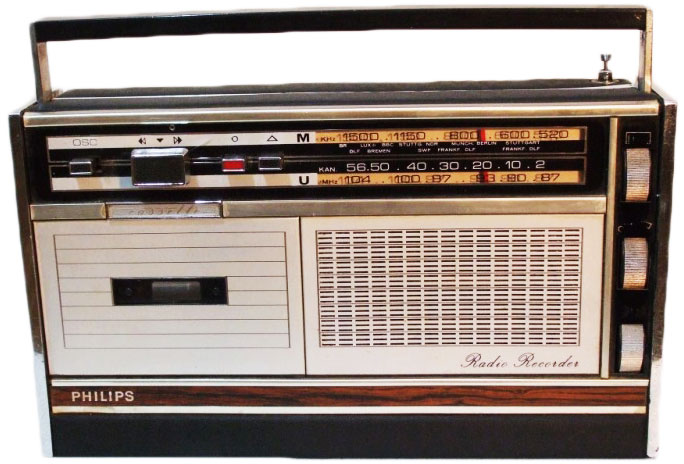
The Philips "Radio Recorder" from 1969 is thought of as the world's first boombox.
The Philips “Radio Recorder” from 1969 is thought of as the world’s first boombox.

Collectors Weekly: Where did the boombox originate?

Miles Lightwood: The boombox by its typical definition—a handled, portable, radio cassette deck with one or more speakers—was actually invented in the Netherlands by Philips in 1969. The one considered the first boombox was made so that you could record from the radio onto the cassette without having any external cables for a microphone. All of a sudden, you’ve got a very easy music-sharing culture, and the Japanese companies basically took that idea and ran with it.

In my mind, the first device that’s like the urban boombox of popular culture is the JVC RC-550, which was a monster box. It’s got a 10-inch woofer, it looks mean, and it’s got lights and the whole package. That was made in ’75.

Collectors Weekly: How did your boombox obsession begin?

Lightwood: When I was younger, I had a couple of boomboxes, and they both got stolen out of my apartment. I was living in a bad part of downtown Los Angeles. One day, I came home, and someone had taken every electronic device I had.

When I was skateboarding in empty pools back in the ’80s, just having a box gave you status. Regardless of whether it was the biggest or flashiest one, it was cool to be the one with the music. Some of those huge Japanese boxes cost around a thousand bucks. There was no Walkman; there was no iPod. Back then, the only way you could share music was with a boombox.
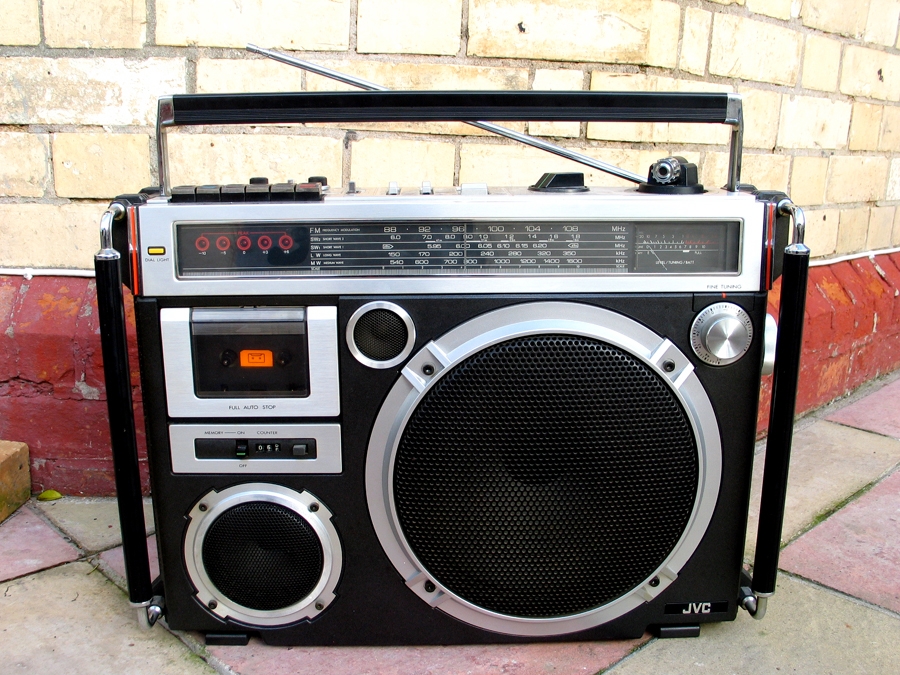
Lightwood considers the JVC RC-550, also known as "El Diablo," as the first radio to resemble a true boombox.
Lightwood considers the JVC RC-550, also known as “El Diablo,” as the first radio to resemble a true boombox. Via radiohier.com.
Then about two and a half years ago, the radio in my car went out, and when I looked into getting it replaced, I realized it was going to cost me about the same as a boombox. So I decided I was just going to get a boombox and keep it in the car. I got what’s called an “AKA,” or a re-badged and re-styled version of an earlier box, and it’s actually still in my car. I listen to it all the time. But like any other type of collecting, one is never enough.

I’ve been collecting boomboxes for a few years now, and earlier this year, I began wondering who created these magnificent machines. We know the musicians, artists, and celebrities that appreciate boomboxes, but more than 30 years later we still don’t know who created these boomboxes: Who is the Jonathan Ive of Sharp? Who are the Charles and Ray Eames of Conion? Who is the Dieter Rams of Magnavox?
“A bigger, louder, flashier box got you more attention on the street—boosting your reputation.”
While functionally developed in the Netherlands, the most iconic boomboxes were created in Japan during the 1970s and ’80s. This was a time when Japanese design and manufacturing was evolving from a copying culture to an innovating culture, and the boombox is a great example of this. I want to find the inventors of these important “grail” boxes and tell the stories of how they designed the machines we love, before it’s too late. Aside from satisfying my own curiosity, boombox creators need to be recognized and celebrated for the contributions they have made, not only to the fields of design and engineering, but also to music-sharing and popular culture worldwide.

I really hope to make this a collaborative, crowd-sourced project, and our website will be the central point for that, possibly enlisting some design schools in Asia to help track down these people. It’s going to be a bit of a challenge, because even once we’ve identified certain people, they’re generally older, so they don’t really have any presence on the Internet.
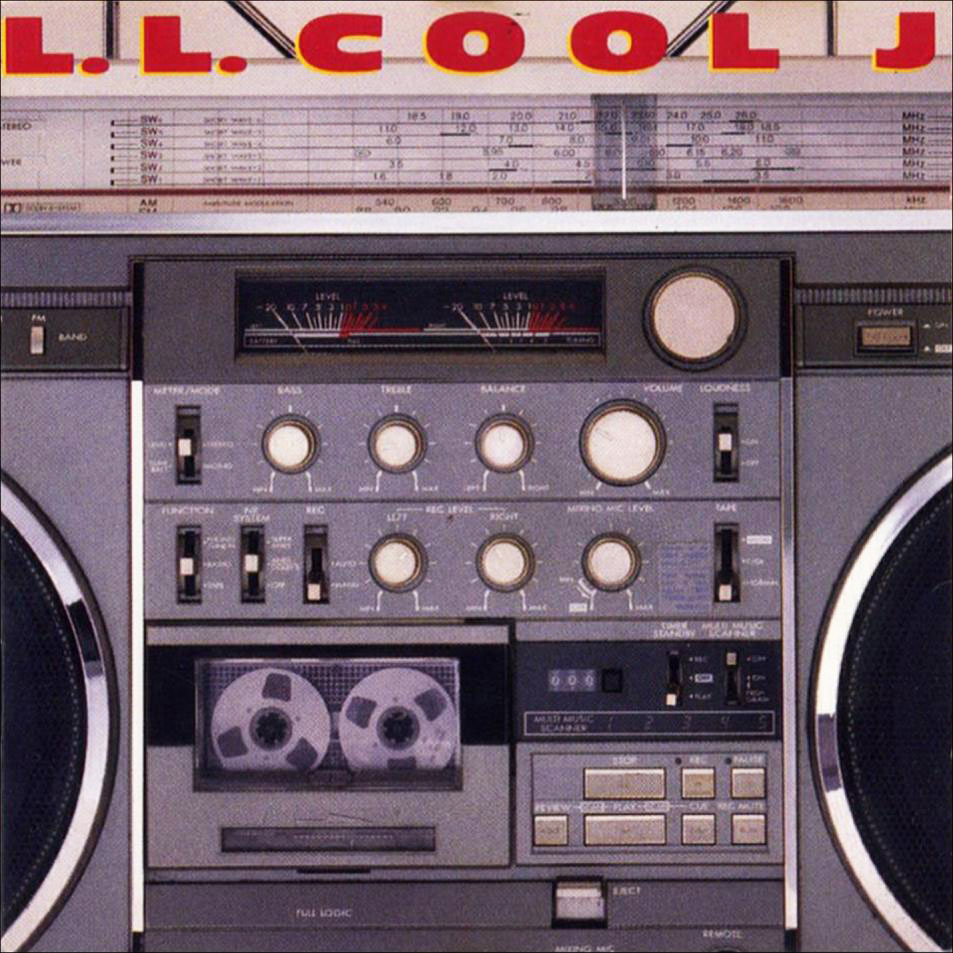
The cover of LL Cool J's 1985 album "Radio" featured a JVC RC-M90.
The cover of LL Cool J’s 1985 album “Radio” featured a JVC RC-M90.
Collectors Weekly: What makes a boombox a grail?
Lightwood: That’s shorthand for “holy grail,” meaning the most collectible or the most recognizable, the ones that have all the features that you associate with a boombox. They’re big; they’re loud; they’ve got all the bells and whistles.

There are certain agreed-upon grails within the community, and then everyone has their own personal grail. Take for example, the JVC RC-M90, which is on the cover of LL Cool J’s first album “Radio.” It has an amazing sound but it’s also got an amazing look, and it’s one of the most sought-after boomboxes. If you can get one, it’s going to cost you at least $800 and a fierce bidding war on eBay or another auction website. I’ve got one of those, but personally, I focus on the Japanese boxes, which are fairly rare. I recently found one of those boomboxes that was stolen from me on eBay, not the exact same one, obviously, but a replacement in really good condition.

I know some collectors who have found grails like a Conion C-100F, another legendary box, on Craigslist. They went over to check it out, and they met this little old lady whose husband passed away, so she was downsizing. The couple originally bought this Conion so they could have some portable music at their cha-cha dance class or something. The box is like a time capsule: It never was a street warrior, never got beat up. I don’t have that type of story yet, but one day I will.
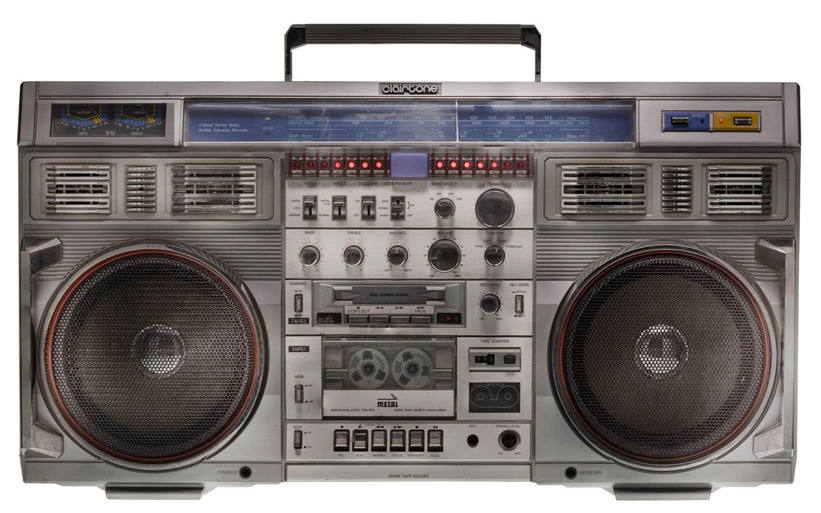
A Conion C-100F, which included an ear-splitting motion detecting alarm (visible in the upper right corner) from the collection of Lyle Owerko. Photo courtesy Lyle Owerko.
A Conion C-100F, which included an ear-splitting motion detecting alarm (visible in the upper-right corner), from the collection of Lyle Owerko. Photo courtesy Lyle Owerko.

Collectors Weekly: Why were they so big?
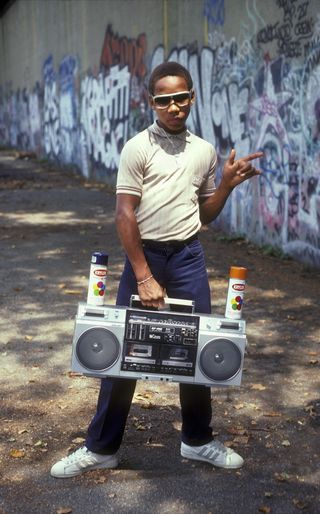
A young B-boy struts his stuff in New York, circa 1980. Photo by Martha Cooper.
Lightwood: The classic grail boomboxes of the ’70s and ’80s were designed to provide a home stereo experience on the go. That meant several large speakers (typically 2 to 3 speakers ranging from 2″ to 10″ in diameter), one or more cassette decks (side-by-side or stacked), a multi-band radio receiver (typically 2 to 5 bands, but some had more), the power supply to blast it in the street (8-10 batteries), and the transformer that allowed you to plug-in at home. In the analog era, to get the loudest sound out of big speakers required a large amplifier and other crossover electronics that occupied quite a bit of physical space within a box.

Transporting all these components safely and with style required a sturdy enclosure that satisfied both aesthetic, sonic, and functional requirements; consequently, these boomboxes were large and heavy. Practical issues aside, a bigger, louder, flashier box got you more attention on the street—boosting your reputation—and manufacturers could charge more; so win-win. Bigger is better.

Collectors Weekly: What have we lost with the switch to MP3 players?

Lightwood: Sonic warmth and physical community. When shared in a public space, a boombox is a campfire, drawing in those nearby to enjoy a warm analog musical experience and connecting them in a spontaneous community. Anytime I share music from a boombox in public, I meet new people, learn new stories, and everyone has a great time. Listening to an MP3 player in public just isn’t the same.
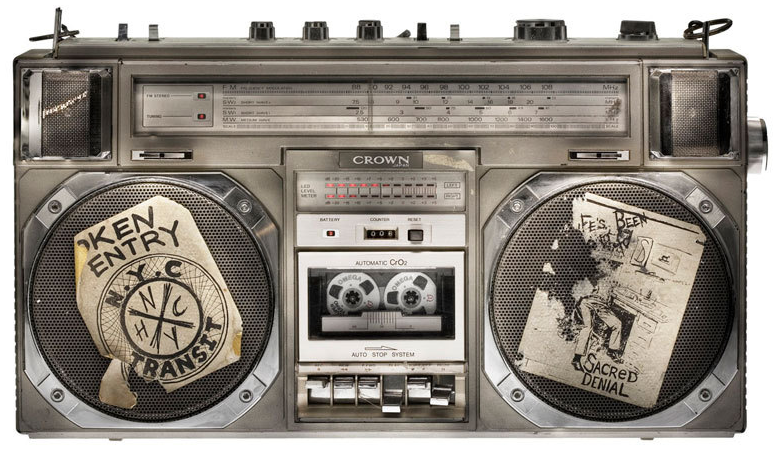
Often boomboxes were customized with emblems of a favorite band or musical style, like this punked-up Crown CSC-950. Photo courtesy Lyle Owerko.

Collectors Weekly: Why is it so hard to locate the original inventors of these devices?

Lightwood: A designer, engineer, or marketer working in a consumer electronics manufacturing company in the ’70s and ’80s was just a cog in the corporate wheel. Then as now, very few people were individually acknowledged for their contributions to a given product. Without assistance from a manufacturer, the only way to identify a creator is via a thorough examination of publicly available documents, and even then, not all these people can be identified.

For several months at the start of the project, I reached out to the original manufacturers to help identify the creators of their boomboxes, but with no success. I continued researching, and once I realized how to search the public patent databases, many creators were revealed. I’ve identified 17 creators thus far, and I’m discovering more each month. Now identified, the real work begins: locating these people around the world and telling their stories before it’s too late, as many of them are elderly.
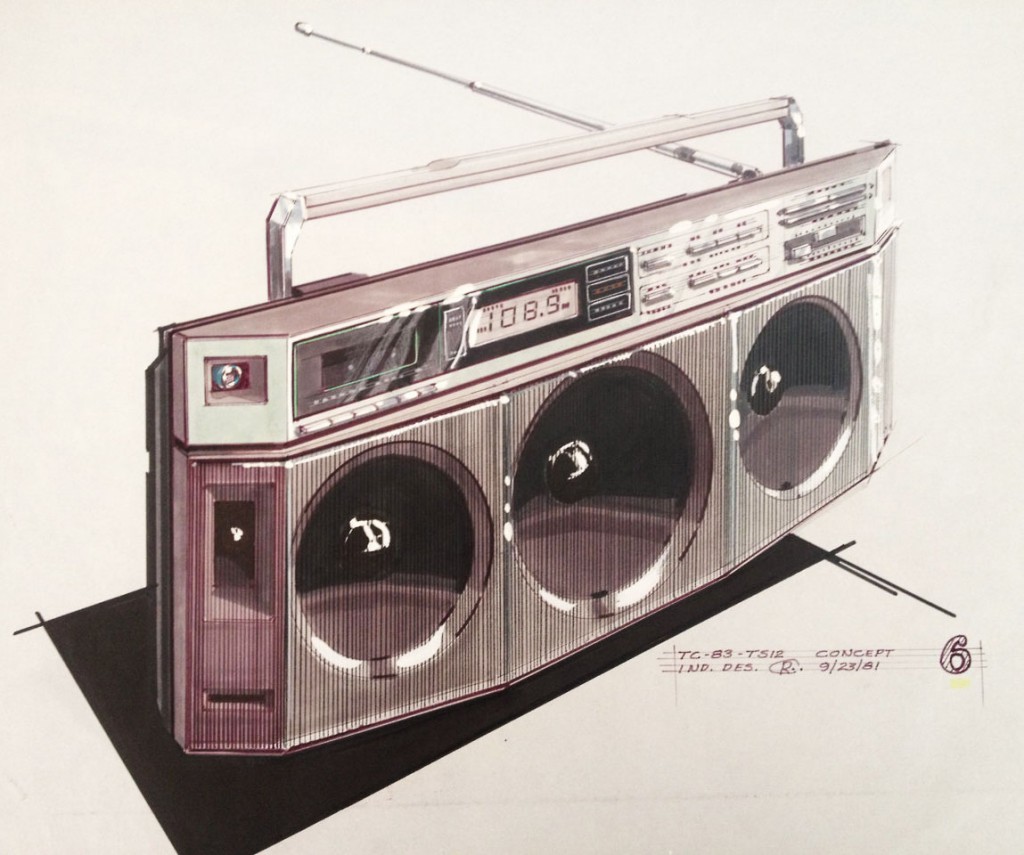
Lightwood purchased this 1981 conceptual drawing by Richard Culbertson from an estate liquidation on Etsy.
Lightwood purchased several conceptual drawings from 1981 by Richard Culbertson through an estate liquidation on Etsy.
So, the first breakthrough was realizing that people’s names are in the patent databases if you know how to look for them. The second was actually getting 50-some odd drawings from the estate of an actual boombox creator. There’s a guy who has a Mid-Century Modern furniture store on Etsy, but he also has drawings and paintings and whatnot. And he came across these Richard Culbertson drawings from an estate liquidator. When I found them, I was like “Holy moly!” They’re all meticulously hand-drawn, just gorgeous.

Collectors Weekly: Are most of the companies who made these boomboxes still operating?

Lightwood: Yes, most of them are still operating. JVC, Panasonic, General Electronic, Pioneer, Sanyo, Hitachi, Toshiba, they’re all around. There’s a few oddball ones that aren’t, like Skitronic, which made the Discolite that has the light-up speakers and was featured in music videos by Madonna, Lady Gaga, and a bunch of others. That company is out of business, and those are grails as well. The sound quality isn’t that great on those, but they’re popular for their looks and their “wow” factor.


Collectors Weekly: How do you find replacement parts for vintage boomboxes?

Lightwood: Replacement parts don’t really exist, but there are a few options, like asking other collectors for used parts, seeking out and buying a parts box, or utilizing new technologies to make your own. I’m involved in the 3-D printing community, and when I was trying to repair my most recent purchase, a Lasonic TRC-931, I needed new knobs. So I started printing up knobs. But I’ve realized that the resolution of most 3-D printers means that you don’t get an exact reproduction part. You get a functional part, but it doesn’t look quite right. There are plenty of internal parts that can fail, gears and whatnot, and those you can easily print because there’s no real cosmetic requirement—it’s all functional.

Collectors Weekly: What’s been your favorite discovery related to boomboxes?

Lightwood: There are so many. Acquiring original drawings from the estate of a boombox creator, or meeting a creator who worked for one of the longest-standing boombox manufacturers.
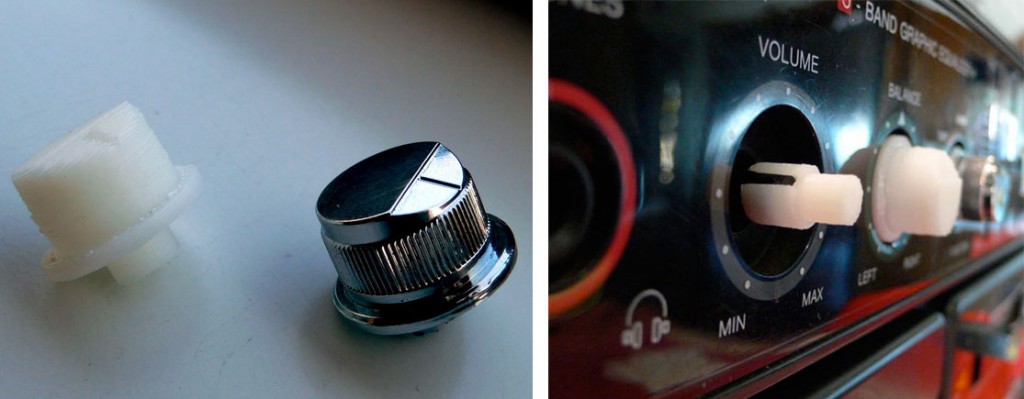
Lightwood has used his 3-D printer to create replacements for knobs and other internal parts.


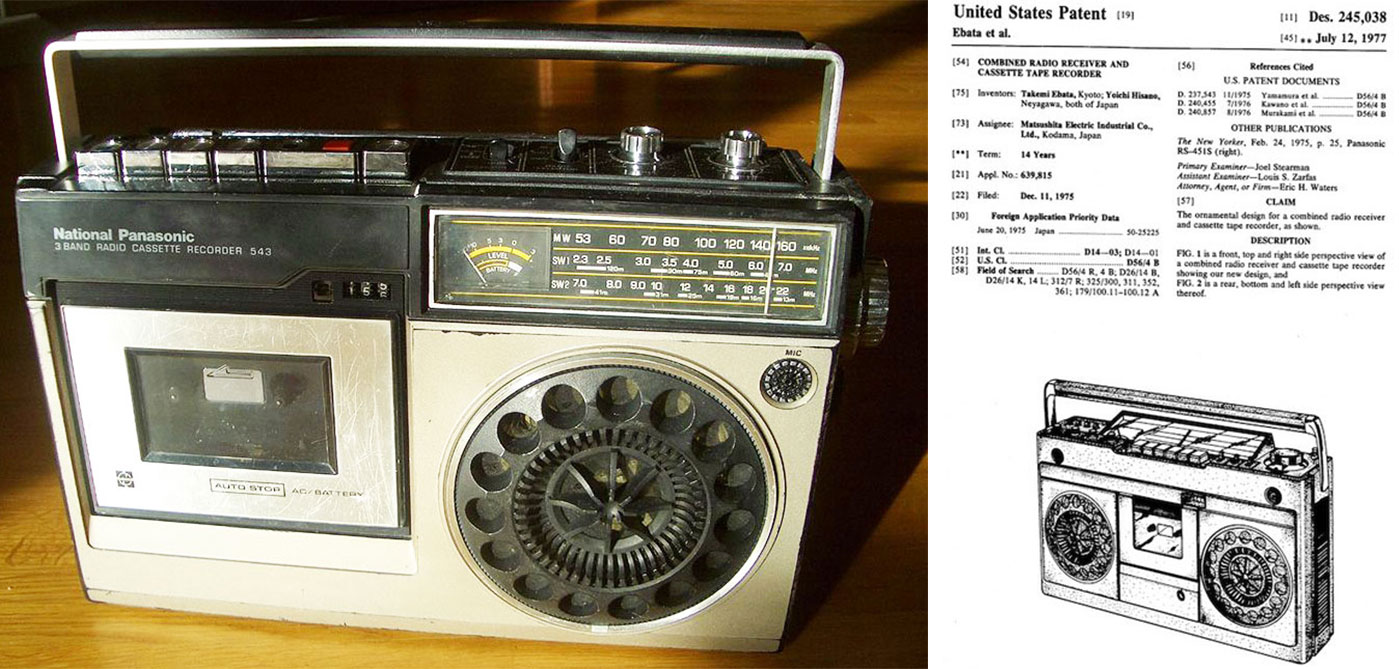
Matsushita was this Japanese company that owned a bunch of different brands, like Technics, JVC, Quasar, Panasonic, and Sanyo. Over a 16-year period, Matsushita sold 4.2 million of one model boombox, the National Panasonic RQ-543. That’s a little over 700 boomboxes a day for 16 years. And that blew my mind; I had no idea they were made in such numbers.

Collectors Weekly: Why was that model so popular?

Lightwood: I don’t really know. Through my research, I realized that several of these Japanese manufacturers have museums devoted to the company founders and their popular products, which include all types of electronics and home appliances. Some guy went to the Matsushita museum and filmed a walkthrough that I found on YouTube, just panning over all the different products in there. And I thought, “Wow, there’s a boombox over there!” It was a gold boombox developed for the Middle Eastern market.
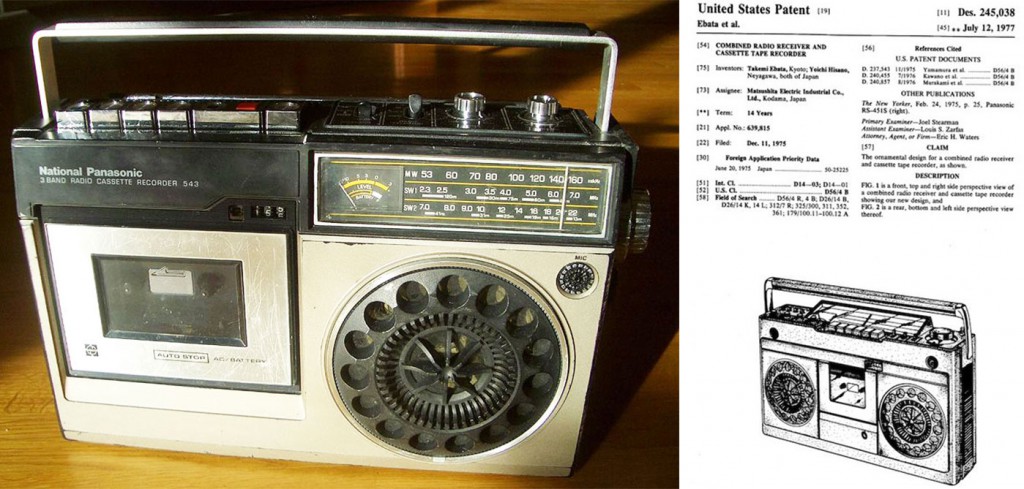
The National Panasonic RQ-543 made by Matsushita sold over 4.2 million models, primarily in the Middle East. Photo via shizaudio.ru.

If I spoke Japanese, I could write to the museum and get a little more background on it. I contacted one individual in the boombox collecting community who lives in the Middle East, in the U.A.E., and asked him if he’s ever seen this gold box. I don’t know if they were all gold, or if this is a commemorative one for the 4.2 million they sold.

This member in the U.A.E. said that most of those boomboxes aren’t even in the country anymore, because the people that would’ve bought them were mostly foreign laborers that were brought in to build or maintain the country’s infrastructure. Once their time was up, they would leave and take their equipment with them, so the boomboxes would end up wherever the laborers came from.

Collectors Weekly: Do you have a favorite boombox?

Lightwood: In no particular order: Victor RC-550, Tisonic PR-7000, Victor RC-M90, Amsen FK-887, Sanyo MR-X920, Sharp GF-999, Lasonic TRC-931, Victor RC-M70. I have them all, and that’s like a parent choosing a favorite child. Each has its own look and sonic personality.

The JVC PC-100 included a detachable cassette player, which began the shift to private audio devices like Walkmans.